
932272


3. Ancient Greece
- Asclepions
- Asclepios was the Greek god of
medicine.
- If people were ill, this is
where they'd go, it was a
temple for Asclepios.
- They'd have to bring an offering-
could be jewels, food or anything
in between.
- They'd have to bring an offering-
could be jewels, food or anything
in between.
- During the day they'd get relaxed,
washed and fed by priests.
- They'd then sleep in the abaton, with the expectation
that they'd be healed by Asclepios, his healing snake
and two daughters.
- The snake would lick the
affected area and they'd be cured.
- However it's more likely that they were given
natural sedatives while the priest did some
actual healing.
- The snake would lick the
affected area and they'd be cured.
- They'd then sleep in the abaton, with the expectation
that they'd be healed by Asclepios, his healing snake
and two daughters.
- Asclepios was the Greek god of
medicine.
- Key Individuals
- Hippocrates
- Believed very strongly in
Clinical Observation.
- Believed in common sense causes
and treatments of disease.
- Diagnosis, Prognosis, Observation, Treatment.
- Believed in common sense causes
and treatments of disease.
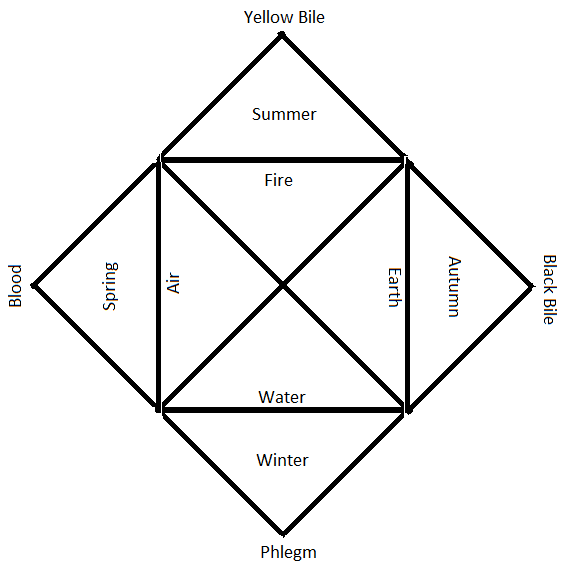
- Imbalance of these four
bodily fluids was what he
though caused disease.
- Therefore, treatments were based on this.
- Blood-letting
- Purgatives
- Laxatives
- Blood-letting
- Therefore, treatments were based on this.
- A lot of work attributed to him is
probably the work of his followers.
- Hippocratic Corpus
- Oath
- Oath
- Believed very strongly in
Clinical Observation.
- Aristotle
- Developed the idea of "The Four Basic
Qualities": Hot, Cold, Wet and Dry".
- This then led on to the theories of the Four
Elements, the Four Temperaments and, most
relevantly, the Four Humours.
- This then led on to the theories of the Four
Elements, the Four Temperaments and, most
relevantly, the Four Humours.
- Developed the idea of "The Four Basic
Qualities": Hot, Cold, Wet and Dry".
- Hippocrates
- Dissection allowed in Alexandria.
- For a while, even live dissection
happened on criminals.
- Herophilus was an anatomist who worked on
blood vessels. He identified the difference
between arteries, veins and nerves.
- For a while, even live dissection
happened on criminals.
- Lack of anaesthetics and antibiotics, along with
poor hygiene hindered surgical progress.
- Most people just died.
- They did setting of fractures and relocating bones.
- Most people just died.
- Had a good lifestyle, including a
good diet, exercise and sleep.
- Being healthy was very important, it would
have been embarrassing not to be.
- Regimen
- Regimen
- Being healthy was very important, it would
have been embarrassing not to be.
- Factors
- Good records e.g. Hippocrates' books
- Role of the Individual- Hippocrates,
Aristotle, Herophilus.
- Communication
- Professionalism
- Hippocratic Oath
- Hippocratic Oath
- Good records e.g. Hippocrates' books
Media attachments
Want to create your own Mind Maps for free with GoConqr? Learn more.