
Notes
Differentiation year 1 and 2
Content of the notes (7)
Page 1
GRADIENTS OF A CURVE
What is a gradient?
A gradient is the measure of how steep a line is (Can be positive if increase or negative if decreasing), it does this by measuring how much you increase in Y by every 1 x you go along.
For example: A line with the equation y=3x+2, the gradient would be 3
A line with the equation y=(1/4)x+59, has a gradient of (1/4)
m is the notation used to represent the gradient
Why would we want to work out the gradient of a curve?
We would want to know the gradient of a curve to know how steep it is at certain points on a graph
*A curve does not have a constant gradient, so we can only find gradients of points on a curve by finding the tangents, but that if the graph doesn't have bounds there would be endless number of tangents to draw and you wouldn't have time in an exam to do them all*
So instead you would find the gradient function of the graph
How would we work out the gradient of a curve?
You would work it out by finding the gradient function/the derivative of the curve
Page 2
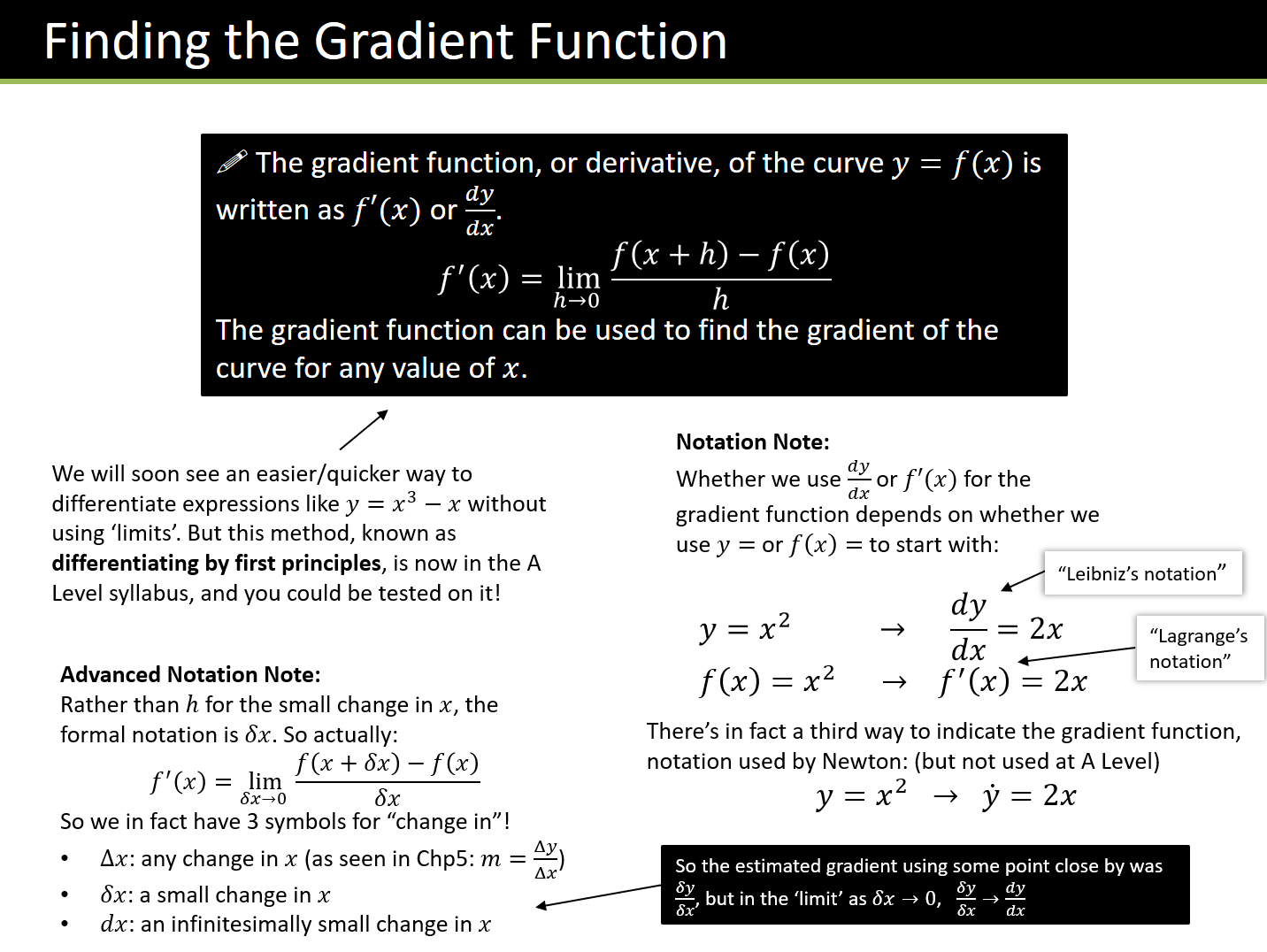
dy/dx and First principles.
What is dy/dx used for?
It is used for working out the steepness of a given point on a curve

Page 3
Differentiation Formulas (Trig and logs)//Basic diffrentiation knowledge
d/dx[sin(x)] = cos(x)
d/dx[cos(x)] = -sin(x)
d/dx[sin(kx)] = kcos(kx)
d/dx[cos(kx)] = -ksin(kx)
d/dx[e^x] = (e^x)
d/dx[ln(x)] = 1/x
d/dx[ln(kx)] = 1/x
d/dx[ln(k+x)] = 1/k+x
d/dx[a^x] = A^xLn(a)
d/dx[a^(kx)] = A^xkLn(a)
d/dx[e^kx] = (ke^kx)
BASIC KNOWLEDGE
dy/dx= 1/(dy/dx)
The normal of a point on the curve is the negative reciprocal of the tangent. E.g (The tangent is 5x therefore the normal of this tangent would be (-1/5x)
Page 4
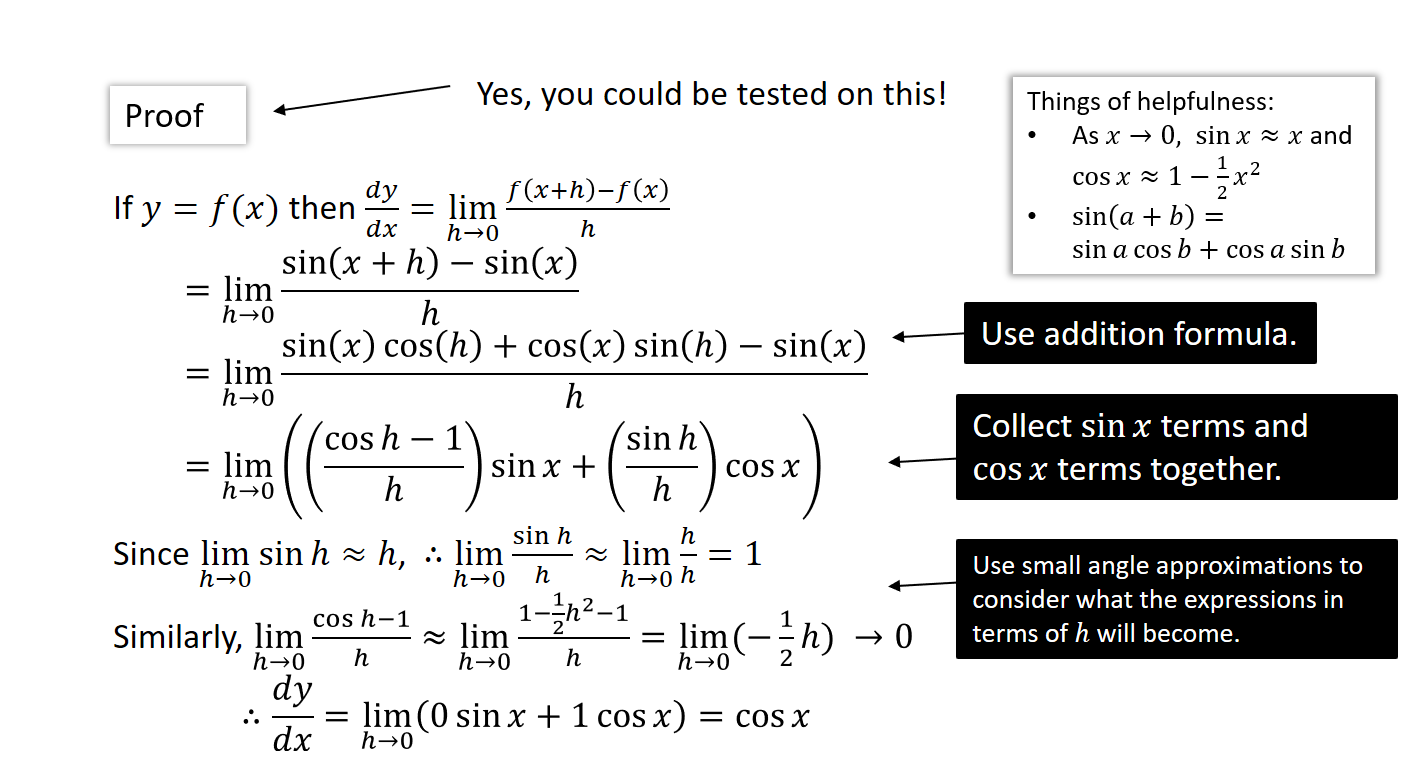
Sin(x) proof by first principle
Proof that d/dx[sin(x)] = cos(x) by first principle.
Video explaining it
First principles
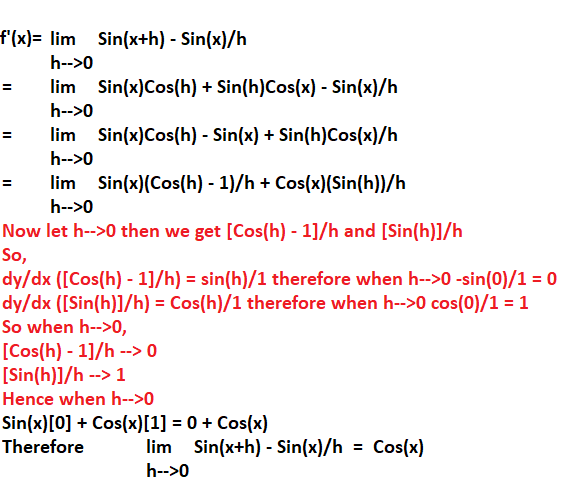
In case of sinh/h, after differentiating numerator and denominator we get cosh/1 which is equal to cos(h). Since h->0, cos(0) = 1, therefor lim(sin(h)/h) as h->0 is equal to 1.
In case of (cos(h)-1)/h, by L’Hopitals rule we get -sin(h)/1 = -sin(h).
As h->0, -sin(h) = -sin(0) = 0
Therefore, lim((cos(h)-1)/h) as h->0 is equal to 0.
Page 5
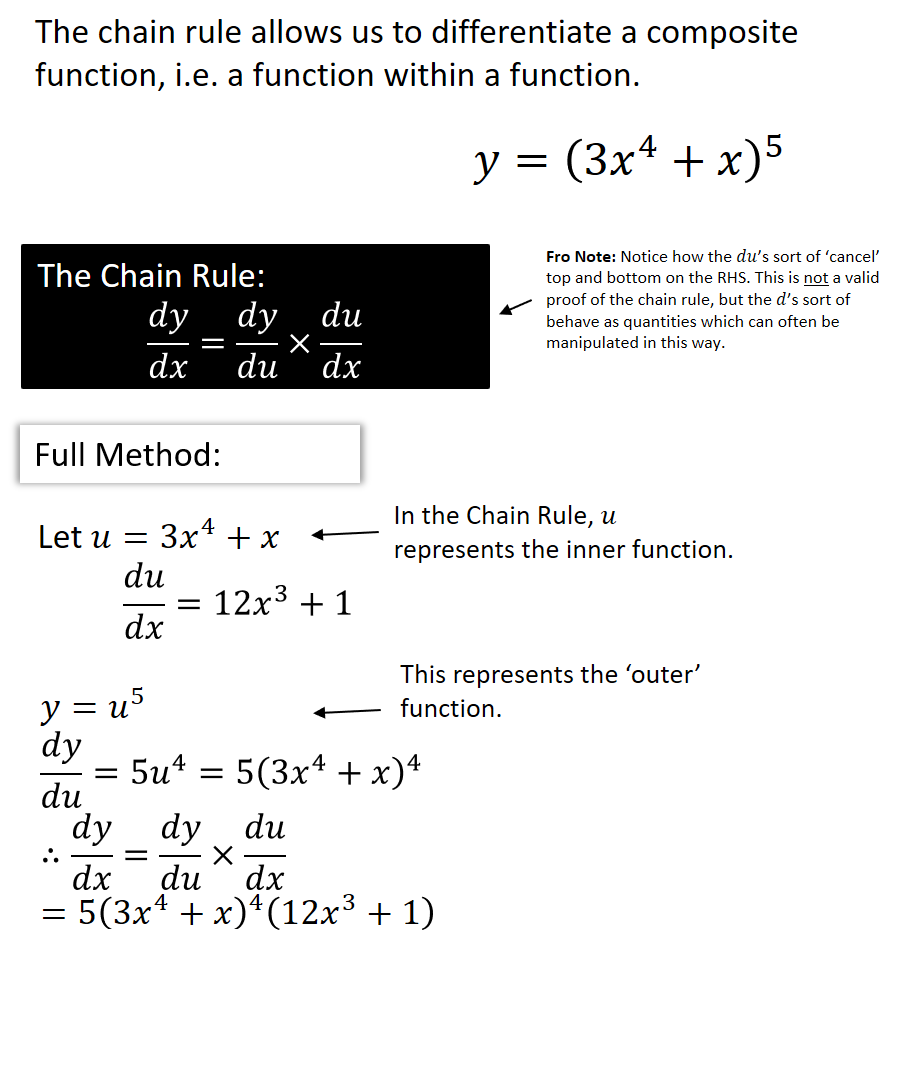
Chain Rule
Page 6
Implicit Differentiation
What is implicit differentiation, and what is its purpose?
Implicit differentiation is the act of differentiation without rearranging into the format y=f(x) or x=f(y). It is useful for cases were it not easy to rearrange into this form.
E.G x²+2xy = 3 or cos(x+y) are examples of implicit equations
What are we actually doing when we differentiate the format y=f(x) or x=f(y)?
We are actually differentiating both sides, this is because:
d/dx(y) = dy/dx or d/dy(x) = dx/dy
y = x² or x = y²
(d/dx) y = x² (d/dx) [We differentiate with respect to x/y both sides] (d/dy) x = y² (d/dy)
dy/dx = 2x or dx/dy=2x
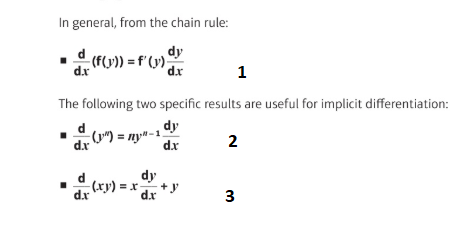
1/2. Because we don't know what y is we cannot differentiate it with respect to x, so instead we find the first derivative of with respect to y and multiply it by dy/dx.
For example when differentiating with respect to x; d/dx (y) = (1)dy/dx or d/dx (y²) = (2y)dy/dx
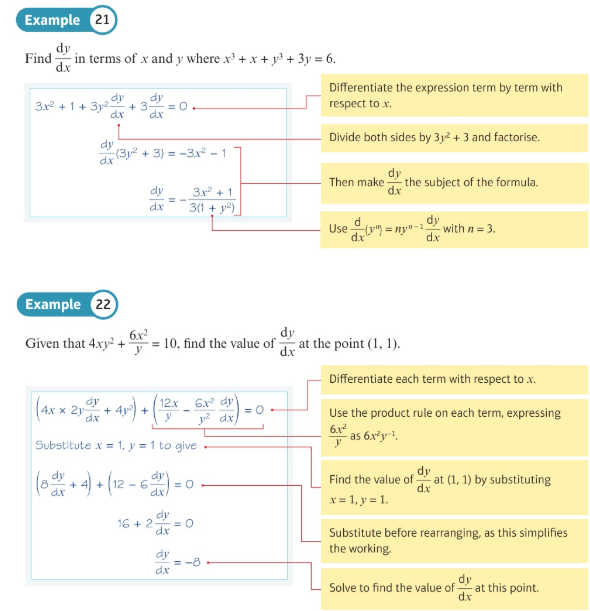
3. E.G from example 22:
d/dx(4xy²) = (4x)(y²) = 4x(d/dx of y²) + y²(d/dx of 4x) = 4x(2y[dy/dx]) + y²(4) = 4x(2y[dy/dx])+ 4y²
https://www.pearsonactivelearn.com/ebook.asp?id=NjgwMDI1fGJvb2t8MjYzfDA=
PAGE 255/256 for practice
Page 7
Product Rule
Information
- Description
- A level Maths (Pure Year 1) Note on Differentiation year 1 and 2, created by BUKDABOSS . on 12/12/2018.
- Created by
- BUKDABOSS . · Dec 2018
- Updated
- Feb 7, 2019
- Views
- 7
- Rating