
Notes
IBA312 Week 1 Notes
Content of the notes (3)
Page 1
Week 1
What is strategy?
Strategy is the overarching plan that a business will follow.
It also indicates what it will not do
It is important to first identify the factors of a case and identify the factors connected to success or failure
Shows how it differs from competitors - competitive advantage is not permanent
Length of competitive advantage is determined by speed to acquire skills required to keep the advantage
Managing risk:
Above-average returns occur when risks are managed effectively - if not then average returns at best
Managing risks effectively reduces uncertainty about investments
Investments can be measured by monthly returns or overall profitability, measured in terms of the amount and speed of growth
Strategic Management Process
Required for above-average returns
1. Analyse external environment and internal organisation to find
Resources
Capabilities
Core Competences (including strat inputs)
2. Use info from internal and external analysis - develop vision, mission and formulate 1 or more strats
3. Implement strategies towards strat competitiveness and above-average returns
4. Use dynamic strategies to ensure actions take place in context of strategy formulation and implementation efforts result in positive outcomes as market changes as does competitive structures
Competitive Landscape
Fundamental nature changing - scare and volitile
Boundaries are blurred
Economies of scale, huge advertising budgets no longer as effective
Traditional managerial mind-set unlikely to be strat competitiveness
New mind-set needed:
Flexibility
Speed
Innocation
Integration
Challenges envolve from changing conditions
Effective strat management reduces the likelihood of failure for firms as they encounter the conditions of today’s competitive landscape
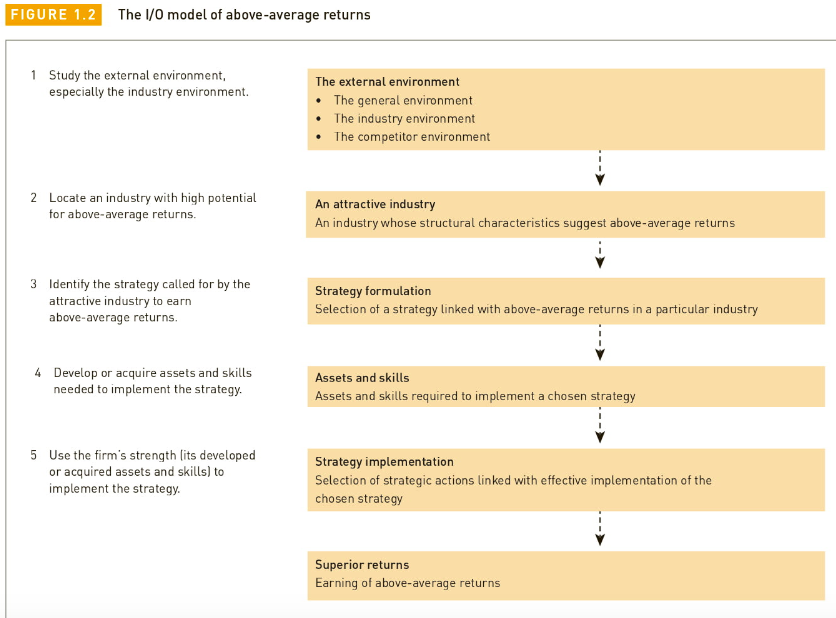
Industrial Organisation (I/O model)
External environment is primary determinant
Identifying then competing successfully in attractive industry/segment of industry
Challenges firms to find the most attractive industry in which to compete
Firms are assumed to have similar valuable resources, their performance generally can be increased only when they operate in the industry with the highest profit potential
Learn how to use their resources to implement the strategy required by the industry’s structural characteristics
First, the external environment is assumed to impose pressures and constraints that determine the strategies that would result in above-average returns
Second, most firms competing within an industry or within a segment of that industry are assumed to control similar strategically relevant resources and to pursue similar strategies in light of those resources
Third, resources used to implement strategies are assumed to be highly mobile across firms, so any resource differences that might develop between firms will be short-lived
Fourth, organisational decision makers are assumed to be rational and committed to acting in the firm’s best interests, as shown by their profit-maximising behaviours
Five Factor Model
Analytical tool used to help firms find the industry that is the most attractive for them.
Encompasses several variables and tries to capture the complexity of competition.
Suggests that an industry’s profitability (i.e., its rate of return on invested capital relative to its cost of capital) is a function of interactions among five forces:
Suppliers
Buyers
Competitive rivalry among firms currently in the industry
Product substitutes
Potential entrants to the industry
Typically, the model suggests that firms can earn above-average returns by producing either standardised goods or services at costs below those of competitors (a cost leadership strategy) or by producing differentiated goods or services for which customers are willing to pay a price premium (a differentiation strategy)
Suggests that above-average returns are earned when firms are able to effectively study the external environment as the foundation for identifying an attractive industry and implementing the appropriate strategy
External environment and a firm’s resources, capabilities, core competencies and competitive advantages influence the company’s ability to achieve strategic competitiveness and earn above-average returns
Assumes that a firm’s strategy is a set of commitments and actions flowing from the characteristics of the industry in which the firm has decided to compete
See image below:
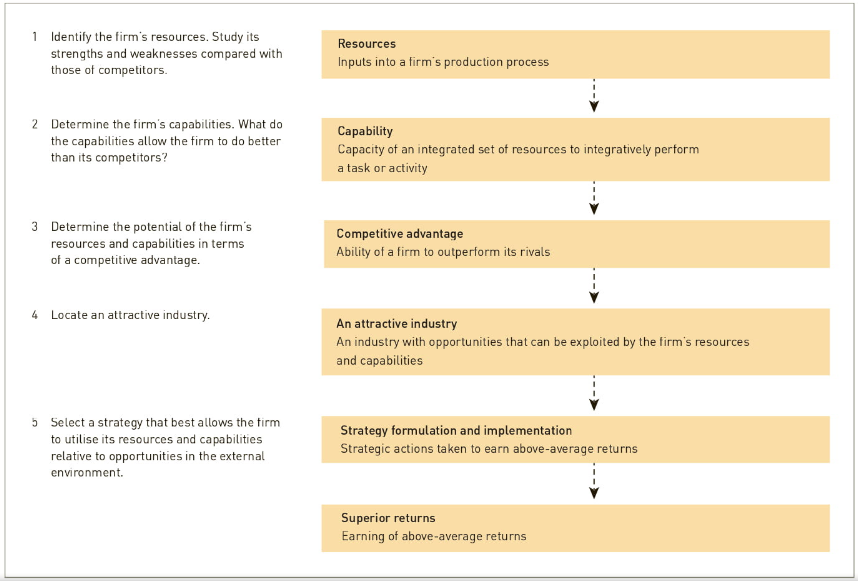
Resource based model
Internal organisation primary determinant
Firm's unique resources and capabilites - crit link to strat competitiveness
The uniqueness of its resources and capabilities is the basis of a firm’s strategy and its ability to earn above-average returns
Individual resources alone may not yield a competitive advantage
Resources have a greater likelihood of being a source of competitive advantage when they are formed into a capability
Differences in firms’ performances across time are due primarily to their unique resources and capabilities rather than the industry’s structural characteristics
Assumes that firms acquire different resources and develop unique capabilities based on how they combine and use the resources; that resources and certainly capabilities are not highly mobile across firms; and that the differences in resources and capabilities are the basis of competitive advantage
Capabilities become stronger and more difficult for competitors to understand and imitate.
As a source of competitive advantage, a capability ‘should be neither so simple that it is highly imitable, nor so complex that it defies internal steering and control’.
Suggests that the strategy the firm chooses should allow it to use its competitive advantages in an attractive industry (the I/O model is used to identify an attractive industry).
Not all of a firm’s resources and capabilities have the potential to be the foundation for a competitive advantage
Potential is realised when resources and capabilities are valuable, rare, costly to imitate and non-substitutable
Valuable when they allow a firm to take advantage of opportunities or neutralise threats in its external environment
Costly to imitate when other firms either cannot obtain them or are at a cost disadvantage in obtaining them compared with the firm that already possesses them
Non-substitutable when they have no structural equivalents but most can be imitated or substituted over time - meaning resources are hard to be the main sources of competitive advantage
Individual resources are often integrated to produce integrated configurations in order to build capabilities with these four attributes and when they do they become corecompetencies
Resources and capabilities are valuable
Rare
Costly to imitate
Non-substitutable
Both the industry environment and a firm’s internal assets affect that firm’s performance over time
To form a vision and mission, and subsequently to select one or more strategies and determine how to implement them, firms use both the I/O and the resource-based models.88
Models complement each other in that one (I/O) focuses outside the firm while the other (resource-based) focuses inside the firm
Hypercompetitism condition
Assumption of market stability changed to inherent instability and change
Results from dynamics of strat manoeuvering in global and innovative combatants
Rapidly escalating competition from
Price-quality position
Competition for new know-how
First-mover advantage
Competition to protect or invade established product/geographic markets
Aggressively challenge competitors in the hopes of improving the competitive position and position
Factors that create a hypercompetitive environment:
Emergence of global economy
Emergence of rapid technological change
Global Ecomony
Relatively unfettered by artificial constraints, such as:
Tariffs
The global economy significantly expands and complicates a firm’s competitive environment
Statisitics reveal similar to hyper-competitiveness
Globalisation
Product of a large number of firms competing against one another in an increasing number of global economies
Financial capital may come from one national market to buy raw materials in another, then manufacturing equipment bought from a third national market to produce goods to be sold in a fourth
Increases range of opportunities for companies competing in competitive landscape
Advantages:
Must make culturally sensitive decisions
Anticipate ever-increasing complexity in their operations as goods, services, people and so forth move freely across geographic borders and throughout different economic markets
Led to overall higher standards in quality, cost, productivity, product introduction time and operational efficiency
Employees can move freely and are a competitive advantage, managers must learnt to operate in a 'multi-polar' world
Only companies capable of meeting, if not exceeding, global standards typically have the capability to earn above-average returns.
Disadvantages/risks:
‘Liability of foreignness’ from operating outside of domestic country
Time required to learn in new markets - performance can suffer until knowledge is learned and established in the new market/location
Chance of over-diversifying beyond management ability with extended operations leading to negative overall effects
Not the only strategic competitiveness - critical to remain committed to and strategically competitive in both domestic and international markets by:
Staying attuned to tech opportunities and potential competitive disruptions created by innovation
Needs to respond to local need
Technology
Diffusion
Increased over past 15 to 20 years
The shorter product life cycles resulting from these rapid diffusions of new technologies place a competitive premium on being able to quickly introduce new, innovative goods and services into the marketplace
The shorter product life cycles resulting from these rapid diffusions of new technologies place a competitive premium on being able to quickly introduce new, innovative goods and services into the marketplace
Global economy is driven around constant innovation
12 to 18 months for competitor information collection - has reduced competitive benefits of patents
Disruptive Technologies
Can create what is essentially a new industry or can harm industry incumbents.
Incumbents are able to adapt based on their superior resources, experience and ability to gain access to the new technology through multiple sources (e.g., alliances, acquisitions and ongoing internal research)
ie. Apple created ipod which changed the landscape
Information age
Important changes is that the ability to effectively and efficiently access and use information has become an important source of competitive advantage in virtually all industries
Information technology advances have given small firms more flexibility in competing with large firms, if that technology can be efficiently used
Change and diffusion will continue to increase based upon the declining cost of IT and increased accessibility to technology and global links
Internet links to hyper competitiveness
Levels of strategy:
Corporate strategy
The portfolio mix of businesses held by a multi-business organisation/corporation
For example, Rio Tinto’s corporate strategy is to be a worldwide leader in finding, mining, and processing mineral resources, delivering high shareholders returns while operating in an ethically and socially responsible manner, and being committed to long term sustainability.
Rio Tinto’s Corporate Strategy deals with:
What portfolio of resources business Rio Tinto wants to be in
How this particular portfolio creates more value for Rio Tinto than an alternative portfolio
Where synergies are created between the business in the portfolio
How much investment should be given to each business
What performance returns Rio Tinto should expect from the portfolio overall
Business strategy
Positioning in an industry relative to competitors to create sustainable competitive advantage
For example, Rio Tinto’s Iron Ore division business strategy deals with:
How much Rio Tinto Iron Ore can grow
Which customers it should sell to and where it should sell
How Rio Tinto Iron Ore should compete in the iron ore industry
What sustainable competitive advantage it should seek to compete on
What position it should aim to hold in the industry
Functional strategy
How functions of the business contribute towards achieving the business strategy
Rio Tinto’s Iron Ore functional strategy would need to consider:
Where Rio Tinto Iron Ore should produce its products
What exploration systems would be most effective for exploring iron ore on a global basis
What marketing systems would be most appropriate for marketing iron ore on a global basis
How Rio Tinto Iron Ore accounting systems should work to fit in with Rio Tinto’s corporate accounting needs
Who defines strategy?
Why do we need strategy?
When do we use strategy?
Where do we apply strategy?
How do we design and implement strategy?
Vision
A vision statement articulates the ideal description of an organisation and gives shape to its intended future
An effective vision stretches and challenges people as well
Vision statements reflect a firm’s values and aspirations and are intended to capture the heart and mind of each employee and, hopefully, many of its other stakeholders
Endures while mission may change based on environmental factors
CEO is mainly responsible for this
Mission
More concrete than vision
Should establish a firm’s individuality and should be inspiring and relevant to all stakeholder
The vision and mission provide the foundation that the firm needs to choose and implement one or more strategies
The probability of forming an effective mission increases when employees have a strong sense of the ethical standards that guide their behaviours as they work to help the firm reach its vision.95
Thus, business ethics are a vital part of the firm’s discussions to decide what it wants to become (its vision) as well as who it intends to serve and how it desires to serve those individuals and groups (its mission)
The main reason is that the mission deals more directly with product markets and customers, and middle- and first-level managers and other employees have more direct contact with customers and the markets in which they are served
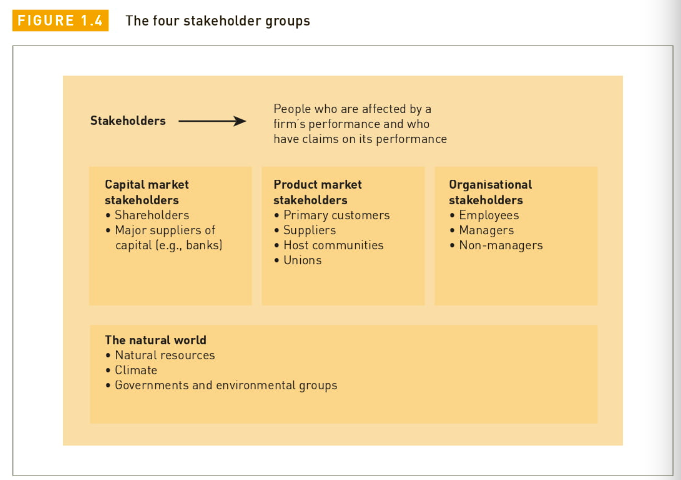
Stakeholders
Claims on a firm’s performance are enforced through the stakeholders’ ability to withhold participation essential to the organisation’s survival, competitiveness and profitability
Stakeholders continue to support an organisation when its performance meets or exceeds their expectations, firms that effectively manage stakeholder relationships outperform those that do not, can be managed to be a source of competitive advantage
Have dependency relationships with their stakeholders, they are not equally dependent on all stakeholders at all times - not every stakeholder has the same level of influence
The more critical and valued a stakeholder’s participation, the greater a firm’s dependency on it.
Greater dependence, in turn, gives the stakeholder more potential influence over a firm’s commitments, decisions and actions
Managers must find ways to either accommodate or insulate the organisation from the demands of stakeholders controlling critical resources
Classifications:
Capital market stakeholders (shareholders and the major suppliers of a firm’s capital)
Expect a firm to preserve and enhance the wealth they have entrusted to it. The returns they expect are commensurate with the degree of risk accepted with those investments
Dissatisfied lenders - stricter covenants on subsequent borrowing of capital
Dissatisfied shareholders - reflect concern through selling stock
Institutional investors (e.g., pension funds and mutual funds) - willing to sell their stock if the returns are not what they desire, or take actions to improve the firm’s performance such as pressuring top managers to improve the governance oversight by the board of directors.
Some institutions owning major shares of a firm’s stock may have conflicting views of the actions needed, which can be challenging for managers.
some may want an increase in returns in the short term while the others desire a focus on building long-term competitiveness
Managers may have to balance their desires with other shareholders or prioritise the importance of the institutional owners with different goals.
Shareholders who hold a large share of stock are influential, especially in the determination of the firm’s capital structure (i.e., the amount of equity versus the amount of debt used).
Refer that the firm minimise its use of debt because of the risk of debt, its cost and the possibility that debt holders have first call on the firm’s assets in case of default over the shareholders
When a firm is aware of potential or actual dissatisfaction among capital market stakeholders, it may respond to their concerns.
The firm’s response to stakeholders who are dissatisfied is affected by the nature of its dependency relationship with them (which, as noted earlier, is also influenced by a society’s values)
The greater and more significant the dependency relationship is, the more likely a direct and significant response by the firm
The product market stakeholders (the firm’s primary customers, suppliers, host communities and unions representing the workforce)
Some might think that product market stakeholders (customers, suppliers, host communities and unions) share few common interests - all can benefit as firms engage in competitive battles
Customers, as stakeholders, demand reliable products at the lowest possible prices
Suppliers seek loyal customers who are willing to pay the highest sustainable prices for the goods and services they receive
Although all product market stakeholders are important, without customers the other product market stakeholders are of little value.
The firm must try to learn about and understand current and potential customers
Host communities want companies willing to be long-term employers and providers of tax revenue without placing excessive demands on public support services.
Union officials are interested in secure jobs, under highly desirable working conditions, for the employees they represent - product market stakeholders are generally satisfied when a firm’s profit margin reflects at least a balance between the returns to capital market stakeholders (i.e., the returns lenders and shareholders will accept and still retain their interests in the firm) and the returns in which they share
The organisational stakeholders (all of a firm’s employees, including both non-managerial and managerial personnel)
Employees – the firm’s organisational stakeholders – expect the firm to provide a dynamic, stimulating and rewarding work environment
Usually satisfied working for a company that is growing and actively developing our skills, especially those skills required to be effective team members and to meet or exceed global work standards
Learn how to use new knowledge productively are critical to organisational success. In a collective sense, the education and skills of a firm’s workforce are competitive weapons affecting strategy implementation and firm performance
Strategic leaders are ultimately responsible for serving the needs of organisational stakeholders on a day-to-day basis - successful, strategic leaders must effectively use the firm’s human capital
The importance of human capital to their success is possibly why outside directors are more likely than inside strategic leaders to propose lay-offs, with insiders more likely to use preventative cost-cutting measures and seek to protect incumbent employees
A highly important means of building employee skills for the global competitive landscape is through international assignments. The process of managing expatriate employees and helping them build knowledge can have significant effects over time on the firm’s ability to compete in global markets
The natural environment (as represented by activist groups)
Increasingly important as a stakeholder because of the vital issue of the depletion of nature because of human actions
he presence of well-organised, well-funded environmental groups representing the interests of nature means that organisations must be very careful about their impact on the environment if they do not want legal challenges and brand damage to occur
Evident in resource extraction industries ie. coal and iron ore must respect nature
The most obvious stakeholders are shareholders - these stakeholders’ rights are grounded in laws governing private property and private enterprise
Another type of shareholder - the firm’s customers – prefer that investors receive a minimum return on their investments
Customers could have their interests maximised when the quality and reliability of a firm’s products are improved, but without high prices
High returns to customers, therefore, might come at the expense of lower returns for capital market stakeholders.
Stakeholder management:
1. A firm must thoroughly identify and understand all important stakeholders.
2. It must prioritise them in case it cannot satisfy all of them.
Power is the most critical criterion in prioritising stakeholders.
Other criteria might include the urgency of satisfying each particular stakeholder group and the degree of importance of each to the firm.
When the firm earns above-average returns - the challenge of effectively managing stakeholder relationships is lessened substantially.
With the capability and flexibility provided by above-average returns, a firm can more easily satisfy multiple stakeholders simultaneously.
When the firm earns only average returns, it is unable to maximise the interests of all stakeholders
The objective then becomes one of at least minimally satisfying each stakeholder
Trade-off decisions
Are made in light of how important the support of each stakeholder group is to the firm. For example, environmental groups may be very important to firms in the energy industry but less important to professional service firms.
A firm earning below-average returns does not have the capacity to minimally satisfy all stakeholders
Societal values also influence the general weightings allocated among the four stakeholder groups
Although all the groups are served by firms in the major industrialised nations, the priorities in their service vary because of cultural differences.
Strategic Leaders
Help the firm achieve its vision and fulfil its mission
Decisive, committed to nurturing those around them and committed to helping the firm create value for all stakeholder groups
Employees who perceive that their CEO is a visionary leader also believe that the CEO leads the firm to operate in ways that are consistent with the values of all stakeholder groups, rather than emphasising only the maximising of profits for shareholders
Visionary leadership helps to obtain extra effort by employees, thereby achieving enhanced firm performance
These findings are consistent with the argument that: ‘To regain society’s trust ... business leaders must embrace a way of looking at their role that goes beyond their responsibility to the shareholder to include a civic and personal commitment to their duty as institutional custodians’.
Identifying strategic leaders - CEOs and other top-level managers.
In the final analysis, CEOs are responsible for making certain their firm effectively uses the strategic management process
Pressure on CEOs to manage strategically is stronger than ever
Many other people help choose a firm’s strategy and then determine the actions for successfully implementing is that the realities of 21st-century competition (e.g., the global economy, globalisation, rapid technological change, and the increasing importance of knowledge and people as sources of competitive advantage) are creating a need for those ‘closest to the action’ to be making decisions and determining the actions to be taken
In fact, the most effective CEOs and top-level managers understand how to delegate strategic responsibilities to people throughout the firm who influence the use of organisational resources
Delegation also helps to avoid too much managerial hubris at the top and the problems this causes, especially in situations allowing significant managerial discretion
A willingness to be brutally honest, a penchant for wanting the firm and its people to accomplish more, and tenacity are prerequisites for an individual’s success as a strategic leader
Strong strategic orientation while simultaneously embracing change in the dynamic competitive landscape we have discussed
To deal with this change effectively, strategic leaders must be innovative thinkers and promote innovation in their organisation.
Promoting innovation is facilitated by a diverse top management team representing different types of expertise and leveraging relationships with external parties
Best leverage partnerships with external parties and organisations when their organisations are ‘ambidextrous’; that is, the organisations simultaneously promote exploratory learning of new and unique forms of knowledge and exploitative learning that adds incremental knowledge to existing knowledge bases, allowing them to better understand and use their existing products
Need to have a global mind-set, or what some refer to as an ambicultural approach to management
Regardless of their location in the organisation, often work long hours and their work is filled with ambiguous decision situations- opportunities afforded by this work are appealing and offer exciting chances to dream and to act
Organisational Culture
Strategic leaders’ decisions and actions shape a firm’s culture
Refers to the complex set of ideologies, symbols and core values that are shared throughout the firm and that influence how the firm conducts business.
Social energy that drives – or fails to drive – the organisation
Some organisational cultures are a source of disadvantage
It is important for strategic leaders to understand, however, that whether the firm’s culture is functional or dysfunctional, their effectiveness is influenced by that culture
The relationship between organisational culture and strategic leaders’ work is reciprocal in that the culture shapes the outcomes of their leadership while their leadership helps shape an ever-evolving organisational culture
Strategic Management Process
Steps:
Analyse their external environment (Chapter 2) and internal organisation (Chapter 3).
Identify marketplace opportunities and threats in the external environment (Chapter 2), and to decide how to use the resources, capabilities, core competencies and competitive advantages in the firm’s internal organisation to pursue opportunities and overcome threats (Chapter 3).
SWOT analyses (strengths, weaknesses, opportunities and threats).
The firm forms its strategy taking into account the firm’s vision and mission.
The firm’s strategic inputs (see Figure 1.1) provide the foundation for choosing one or more strategies and deciding how to implement them. As suggested in Figure 1.1 by the horizontal arrow linking the two types of strategic actions, formulation and implementation must be simultaneously integrated to successfully use the strategic management process.
Integration happens as decision makers think about implementation issues when choosing strategies and as they think about possible changes to the firm’s strategies while implementing a currently chosen strategy
Three levels of strategies:
We examine business-level strategies (Chapter 4).
A business-level strategy describes the actions a firm takes to exploit its competitive advantage over rivals. A company competing in a single product market (e.g., a locally owned grocery store operating in only one location) has but one business-level strategy, while a diversified firm competing in multiple product markets (e.g., GE) forms a business-level strategy for each of its businesses.
In Chapter 5, we describe the actions and reactions that occur among firms in marketplace competition. Competitors typically respond to and try to anticipate each other’s actions. The dynamics of competition affect the strategies firms choose, as well as how they try to implement the chosen strategies.
Corporate-level strategy (Chapter 6)
For diversified firms - is concerned with determining the businesses in which the company intends to compete as well as how to manage its different businesses. Other topics vital to strategy formulation, particularly in the diversified company, include acquiring other businesses and, as appropriate, restructuring the firm’s portfolio of businesses (Chapter 7) and selecting an international strategy (Chapter 8).
With cooperative strategies (Chapter 9), firms form a partnership to share their resources and capabilities in order to develop a competitive advantage. Cooperative strategies are becoming increasingly important as firms seek ways to compete in the global economy’s array of different markets.
Functional strategy
To examine actions taken to implement strategies, we consider several topics in Part 3 of the book. First, we examine the different mechanisms used to govern firms (Chapter 10).
With demands for improved corporate governance being voiced by many stakeholders in the current business environment, organisations are challenged to learn how to simultaneously satisfy their stakeholders’ different interests.
Finally, the organisational structure and actions needed to control a firm’s operations (Chapter 11), the patterns of strategic leadership appropriate for today’s firms and competitive environments (Chapter 12), and strategic entrepreneurship (Chapter 13) as a path to continuous innovation are addressed.
Page 2
Week 1 Review
1. In your own words, explain the following terms:
Strategic competitiveness
When a strategy is successfully formed and implemented to create a competitive advantage
Strategy
The plan of an organisation to follow the plan guided by its stakeholders based on the mission and vision
Competitive advantage
An advantage over the other companies that are vying for the same advantage
Above-average returns
An increase in returns than would normally be seen on that level of investment
Strategic management process
The process of implementing strategy into firms to give a competitve advantage and receive above average returns
2. What are vision and mission? What is their value for the strategic management process?
Vision is the overarching plan for an organisation and what it wants to achieve. Stakeholders often have an important role in deciding what this will be. It is more stable than the mission
Mission is the specifics of how to implement the vision and which business it is competing in, which is often mainly implemented by the CEO, however there is also an expectation that others closer to the front line are also involved.
3. What are the elements of the strategic management process? How are they interrelated?
Analyse internal and external factors via SWOT
Decide business level strategy
Examine actions needed for implementation
Page 3
Week 2
The General/Macro Environment
Learn about external environment by acquiring information about
Competitors
Customers
Other stakeholders to build their own base of knowledge and capabilities.
Use this information then firms take action such as building new capabilities and core competencies, to buffering themselves against any negative environmental effects and to pursue opportunities as the basis for better serving their shareholder’s need.
The general environment is composed of dimensions in the broader society that influence an industry and the firms within it.
Grouped into 7 dimensions OR ‘environmental segments’ Each segment composed of elements
Demographic
• Population size• Age structure• Geographic distribution• Ethnic mix• Income distribution
Economic
• Inflation rates• Interest rates• Trade deficits or surpluses• Budget deficits or surpluses• Personal savings rate• Business savings rates• Gross domestic product
Political/legal
• Antitrust laws• Taxation laws• Deregulation philosophies• Labour training laws• Educational philosophies and policies
Sociocultural
• Women in the workforce• Workforce diversity• Attitudes about the quality of work life• Shifts in work and career preferences• Shifts in preferences regarding product and service characteristics
Technological
• Product innovations• Applications of knowledge• Focus of private and government-supported R&D expenditures• New communication technologies
Global
• Important political events• Critical global markets• Newly industrialised countries• Different cultural and institutional attributes
Physical
• Energy consumption• Practices used to develop energy sources• Renewable energy efforts• Minimising a firm’s environmental footprint• Availability of water as a resource• Producing environmentally friendly products• Reacting to natural or man-made disasters
Industry environment
5 factors
The threat of new entrants
The power of suppliers
The power of buyers
The threat of product substitutes
The intensity of rivalry among competitors
Interaction of these determine an industry’s profit potential; in turn, the industry’s profit potential influences the choices each firm makes about its strategic actions.
Challenge: locate a position within an industry where it can favourably influence the five factors or where it can successfully defend against their influence.
The greater a firm’s capacity to favourably influence its industry environment, the greater the likelihood that the firm will earn above-average returns.
Competitiveness:
Analysis of the general environment is focused on environmental trends
An analysis of the industry environment is focused on the factors and conditions influencing an industry’s profitability potential; and an analysis of competitors is focused on predicting competitors’ actions, responses and intentions.
In combination, the results of these three analyses influence the firm’s vision, mission and strategic actions.
Performance improves when the firm integrates the insights provided by analyses of the general environment, the industry environment and the competitor environment
External analysis
Scanning
Reveals ambiguous, incomplete or unconnected data and information
Challenging but critically important for firms, especially those competing in highly volatile environments
Must be aligned with the organisational context
Technology used ie:
news event detection uses information-based systems to categorise text and reduce the trade-off between an important missed event and false alarm rates
Monitoring
Analysts observe environmental changes to see if an important trend is emerging monitoring, analysts observe environmental changes to see if an important trend is emerging monitoring from among those spotted through scanning.
Successful - ability to detect meaning in environmental events and trends
ie. Tesco - Turkish, Sri Lankan, Latin, Filipino, African and South African cuisine to its food offerings. One analyst noted: ‘Britain has become one of the most ethnically diverse nations on Earth, and there is a very strong, growing demand by those who have settled here to buy food from their homelands’.
Effective monitoring
Firm to identify stakeholders and understand reputation as the foundation for serving their needs
Scanning and monitoring:
Particularly important when a firm competes in an industry with high technological uncertainty
Can provide the firm with information, serve as a means of importing knowledge about how to successfully commercialise new technologies the firm has developed
are concerned with events and trends in the general environment at a point in time
Forecasting
Analysts develop feasible projections of what might forecasting, analysts develop feasible projections of what might forecasting happen, and how quickly, as a result of the changes and trends detected through scanning and monitoring.
Ie. analysts might forecast the time that will be required for a new technology to reach the marketplace, the length of time before different corporate training procedures are required to deal with anticipated changes in the composition of the workforce
Forecasting demand for new technological products is difficult because technology trends are continually driving shorter product life cycles
Each new device generation costs more
During an economic downturn, forecasting becomes more difficult and more important.
Ie. P&G, Unilever and Colgate-Palmolive, which primarily sell branded products, have been pushed by retailers to lower their prices, while at the same time these retailers (including Coles and Woolworths) are selling lower-priced, private-label goods
Product companies are forecasting the effects of the two trends noted as they seek to project demand. Fortunately, these consumer product companies are seeing demand increase for branded products as the economy improves
Assessing
The objective of assessing is to determine the timing and significance of the effects of environmental assessing is to determine the timing and significance of the effects of environmental assessing changes and trends that have been identified.30 Through scanning, monitoring and forecasting, analysts are able to understand the general environment. Going a step further, the intent of the assessment is to specify the implications of that understanding. Without assessment, the firm is left with data that may be interesting but of unknown competitive relevance. Even if the formal assessment is inadequate, the appropriate interpretation of that information is important. How accurate senior executives are concerning their competitive environments may be less important for strategy and corresponding organisational changes than correctly interpreting environmental trends. Thus, although gathering and organising information is important, it is paramount to appropriately interpret that intelligence to determine if an identified trend in the external environment is an opportunity or a threat
Information
- Description
- 3rd year IBA312 Management Strategy and Decision Making (Week 1) Note on IBA312 Week 1 Notes, created by Juliette Cross on 31/05/2020.
- Created by
- Juliette Cross
- Views
- 3
- Rating