
Notes
Innate immunity
Content of the notes (1)
Page 1
The innate immunity is active from birth and provides a quick non specific response to VIRAL INFECTIONS
The Complement System
It consists of ~20 proteins that work together to destroy invader and signal to other immune player for help. It is fast and multi-functional as all components are preformed and circulates as zymogens, it destroys invaders, enhances eating and signals to other cells. It is controlled by self proteins. It is initiated by 3 different steps:
1. Classical: requires an antibody
2. Alternative: antibody independent. The components are made in the liver then released into the blood.
C3 is the most abundant and splits into two fragments C3a and C3b. C3b is very reactive and binds non specifically amino/OH groups which many bacteria have on their surface, this happens very quickly to ensure C3b is stabilised and not neutralised.
C3b then binds Factor B which is cleaved by Factor D to Bb this forms C3bBb. The reaction speeds up in a positive feedback loop so lots of C3b is formed and covers the whole bacterium.
C3bBb can also cleave C5 to make C5a and C5b. C5b combines with C6, C7, C8 and C9 forming the membrane attack complex (MAC) that destoys pathogens.
C3 is formed spontaneously but MAC doesn't form in all our cells because we need alot of proteins to control the complement system:
DELAY ACCELERATING FACTOR: accelerates the breakdown of C3bBb to stop the positive feedback loop
FACTOR 1: cleaves C3b, the reaction is increased by a protein on human cell surfaces
CD59 (protectin): a cell surface protein that prevents MAC formation in all cells
3. Mannose binding lectin (MBL) is made in the liver and found in moderate concentrations in blood and tissue, its production is increased when there is an infection. It binds mannose so yeast, viruses, parasites and bacteria that are non-self. It doesn't bind self cells as mannose isn't found on them.
The alternative pathway is the first to act and then the MBL pathway.
Complement also:
Opsonisation (decoration): C3b can be clipped to form iC3b (inactive-can't make MAC) but remains attached to the phagocyte in order to signal to phagocytes which have iC3b receptors. This helps the phagocytes get hold of bacteria with a polysaccaride coat.
Chemoattractant (call for help): C3a diffuses to tell and activate phagocytes where the protein is (C5a does the same). C3a and C5a are ANAPHYLATOXINS which signify the presense of a non-self cell and produce a concentration gradient for phagocytes to follow.
The Professional Phagocytes
Macrophages have 3 stages of alertness:
Monocytes are resting in tissue they collect rubbish and slowly proliferate. Low levels of MHC class II so they can't talk to T cells.
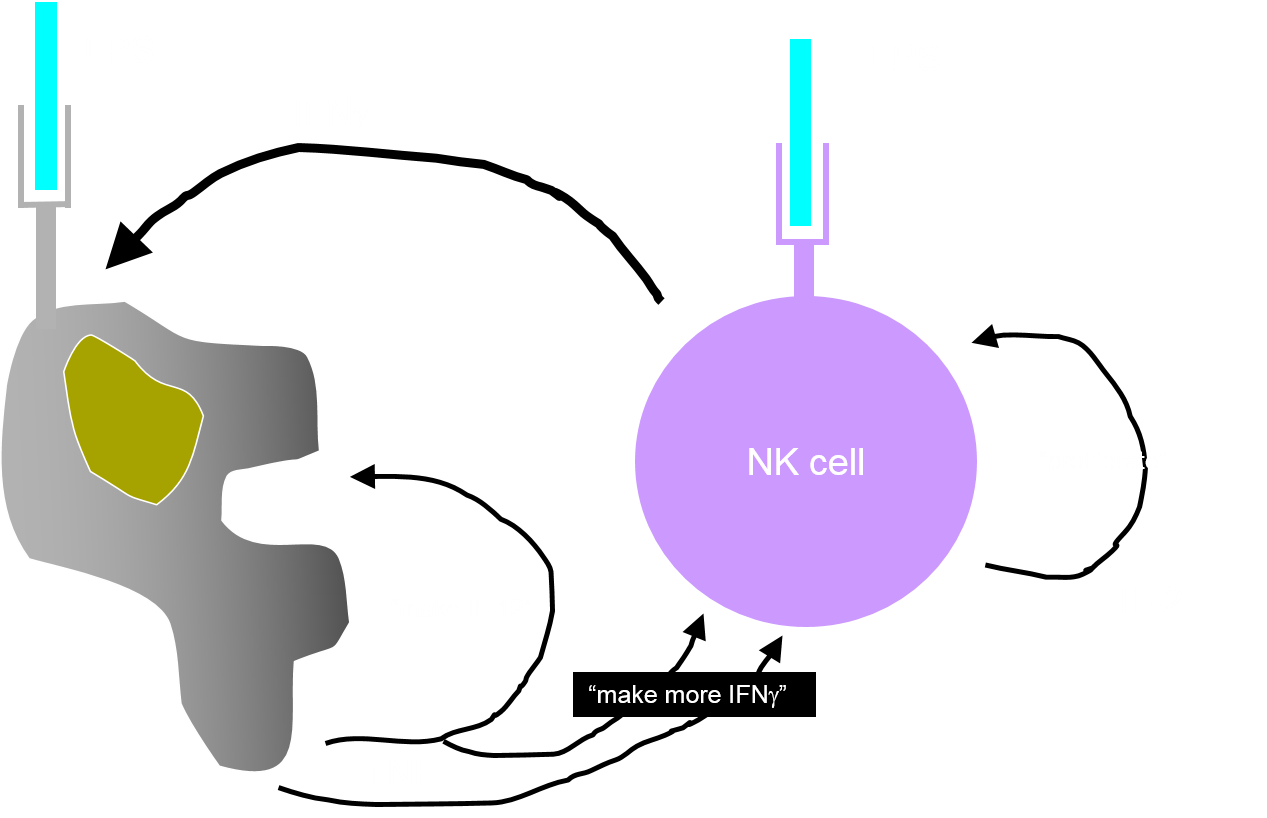
Activated/primed macrophages have upregulate MHC class II and can present antigen to T cells. Helper T cells and NK cells produce cytokines (IFNy) to help prime macrophages.
Hyperactivated macrophages have direct contact with invader. LPS or mannose binding to macrophage stops proliferating and concentrates on killing. The cytokine TNF is produced which helps to kill infected cells and activate the immune system.
Neutrophils are the most important cell in the innate immunity and make up 70% of white blood cells. They only live for ~5 days and die via apoptosis. They become active as soon as they leave the blood where their purpose is to eat and kill, they DO NOT PRESENT ANTIGENS. There are very few deficiency diseases as we can't live without them.
How do neutrophils know where to go?
For a neutrophil to leave the blood SLIG on the neutrophil and ICAM muct bind together. When an infection occurs:
Macrophages produce IL-1 and TNF cytokines as warning signals for endothelial cells to recieve
The endothelial cells then express selectin (SEL) which is the ligand to SLIG and signals for neutrophiles to slow down and they start rolling along the blood vessel and sniff for C5a and LPS which indicate inflammation.
When signs of inflammation are found the neutrophil displays integrin (INT), which is stored inside the cell, on its surface.
INT binds ICAM very strongly and stops the neutophil so it can leave the blood vessel via diapedesis to go and kill things.
They follow a trail of chemoattractants (C5a, LPS and F-met peptides). F-met peptides are almost unique to bacteria and macrophages "burp" them after eating. Cytokines on route further activate them.
The 3 interactions (SLIG-selectin, ICAM-integrin and C5a-CR) act as a safety mechanism. 70% of cells in the circulation are neutrophils but very few are found in healthy tissue as thy are 'on call' in the blood where as macrophages are in the tissues acting as look outs and call the neutrophils to where they are needed.
Natural killer (NK) cells
These are the lymphocytes of the innate immunity which kill tumor cells, virus infected cells, bacteria, fungi and parasites by forcing them to commit apoptosis by injecting granzyme into them. Interaction between NK Fas ligand with Fas on infected cells is used as the signal for cell to die. This method means that any virus inside the cell doesn't get out.
NK cells obey 'kill' signal (NK proteins and surface molecules reveled on infection) and 'no kill' signals (MHC I expressed by all nucleated cells).
Killer T cells check MHC class I to ensure peptides are self, some viruses switch off MHC I expression and no expression of MHC I is a kill signal.
They are like T helper cells and T killer cells as they destroy infected cells and produce cytokines.
They are like macrophages as they contain granules, have several states of readiness and their warning signals include LPS
Bacterial Infections releases LPS which binds receptors on NK cells that then produce IFNy. IFNy primes macrophages to be activated. LPS binds receptors on macrophages causing them to become hyperactivated and make TNF. TNF binds macrophage TNFR so it makes IL-12 causing more IFNy production from NK cells hperactivating more macrophages.
Information
- Description
- University introductory immunology Note on Innate immunity, created by Beckie Thorne on 19/04/2015.
- Created by
- Beckie Thorne
- Views
- 9
- Rating