
Notes
Functional Programming
Content of the notes (3)
Page 1
For each of the three Vs: give a system used to work with it.
Volume:
Distributed Systems
Graph Schemas
Velocity:
Functional Programming
Variety:
Machine learning
Fact-based Models
Explain what a higher-order function is:
A higher-order function is one that either takes a function in as an argument or returns a function
Write the set comprehension for a set that contains all whole numbers from 0 to 50:
{z | z E N and z < 51}
A function, mod7(x) finds the remainder of dividing x by 7. For example, mod7(12) is 5, as 12 divided by 7 is 1 remainder 5. Write down the domain and co-domain of this function.
Lists:
Map, Fold, & Filter perform operations on lists.
Lists are dynamically re-sizable data structures (differs from arrays). This means that values can be added and removed
Map:
A function that takes two arguments: A function and a list of values. To the head of the list of values it applies the function.
2. Fold:
A function that takes three arguments: 1. A function that combines two values into one. 2. A root (beginning) value. 3. A list of values. Fold uses the function to combine the root value and the head of the list, then folds the combined value with the tail of the list. Input: List, Output: One number.
Page 2
towers is defined as
towers = ["Blackpool", "Paris", "New Brighton", "Toronto"]
What are the head and tail of this list?
Head = "Blackpool"
Tail = ["Paris, "New Brighton", "Toronto"]
Call Number Argument Value Reutrned
1 | ^
2 | |
3 | |
4 - - - - - - - - - -
Call Number Argument Value Returned
1 | [4,2,5,3] | 0
2 | [2,5,3] | 0
3 | [5,3] | 0
4 | [3] | 0
5 | [] | 0
Page 3
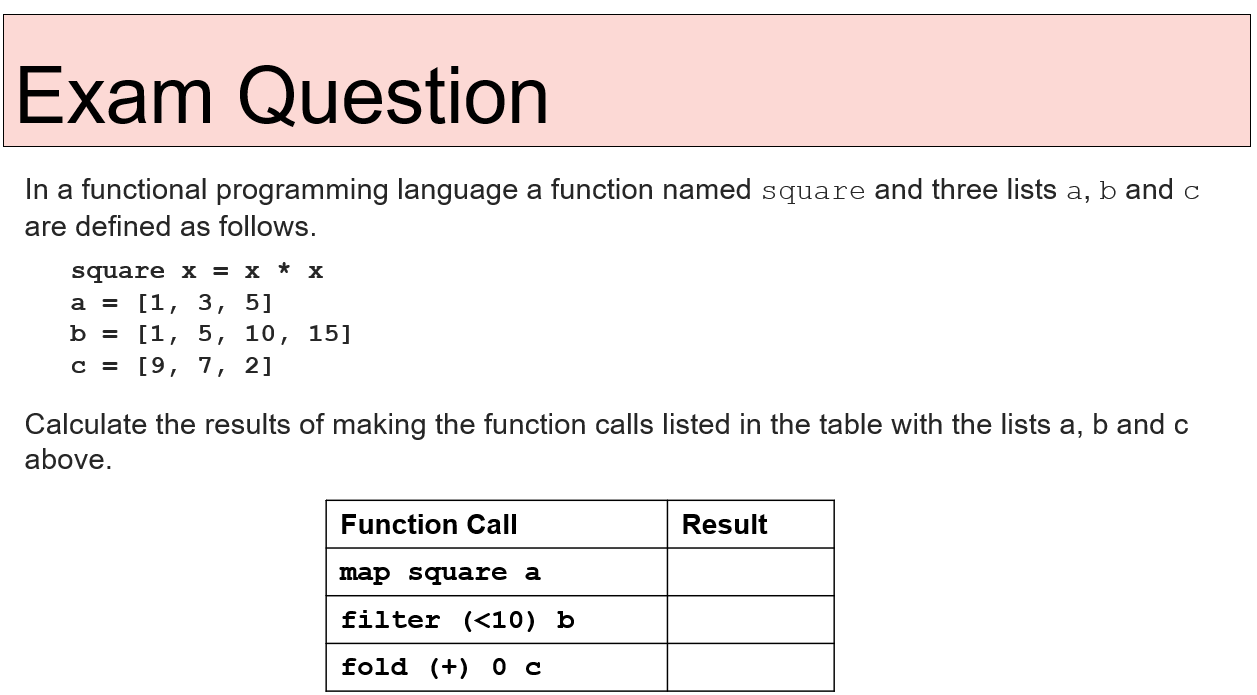
map square a = [1, 9, 25]
filter (<10) b = [10, 15]
fold (+) 0 c = 18
Information
- Description
- A level IT (4.12) Note on Functional Programming, created by Ethan Fidzinski on 11/06/2026.
- Created by
- Ethan Fidzinski
- Views
- 0
- Rating