
Notes
Groups of the periodic table- Halogens
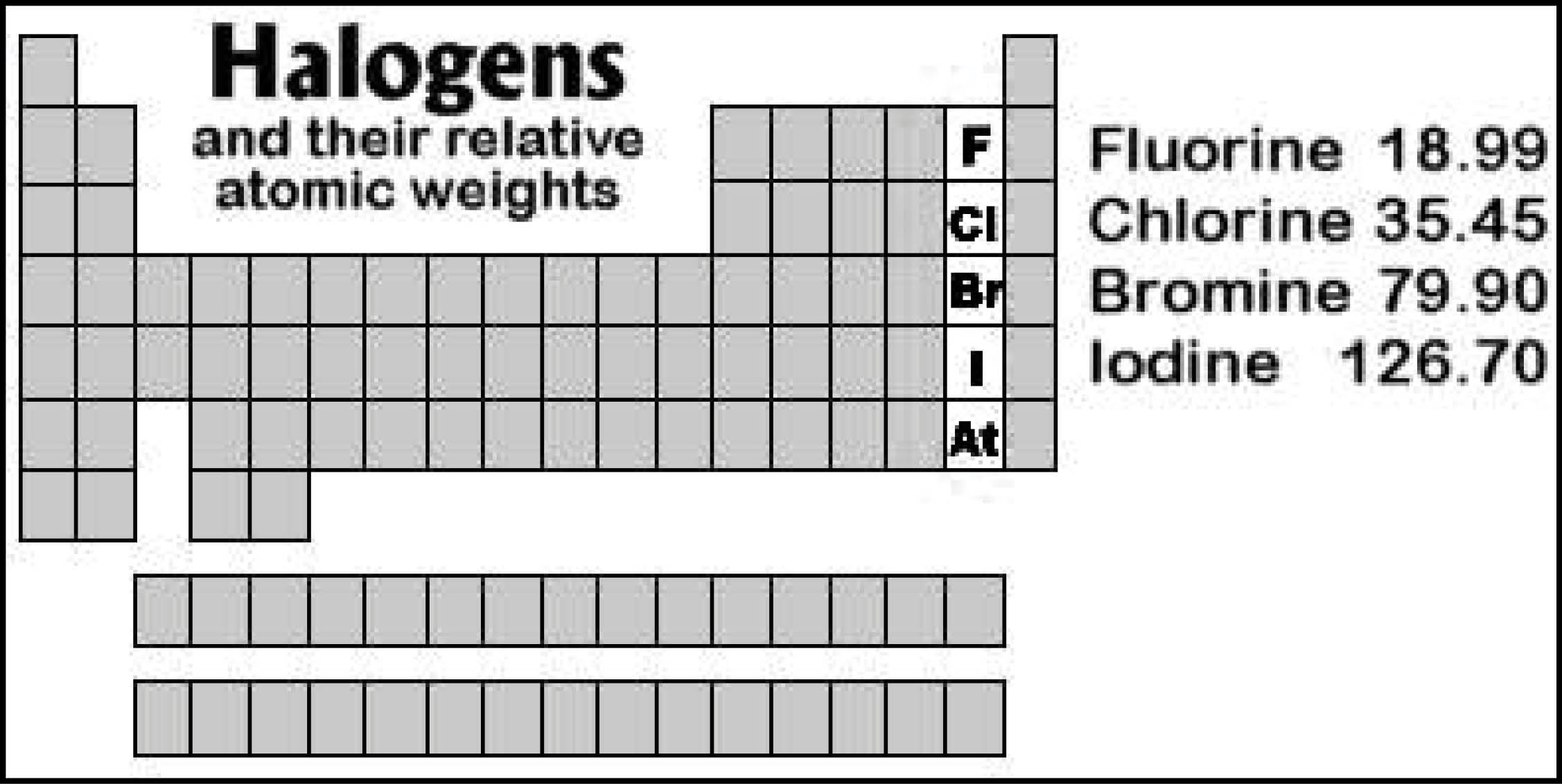
Content of the notes (1)
Page 1
The halogens or halogen elements are a group in the periodic table consisting of five chemically related elements, fluorine (F), chlorine (Cl), bromine (Br), iodine (I), and astatine (At). In the modern IUPAC nomenclature, this group is known as group 17.
The group of halogens is the only periodic table group that contains elements in all three familiar states of matter(solid, liquid and gas) at standard temperature and pressure. All of the halogens form acids when bonded to hydrogen. Most halogens are typically produced from minerals or salts. The middle halogens, that is, chlorine, bromine and iodine, are often used as disinfectants. The halogens are also all toxic.
Halogens are highly reactive, and as such can be harmful or lethal to biological organisms in sufficient quantities. This high reactivity is due to the high electronegativity of the atoms due to their high effective nuclear charge. They can gain an electron by reacting with atoms of other elements. Fluorine is one of the most reactive elements in existence, attacking otherwise-inert materials such as glass, and forming compounds with the heavier noble gases. It is a corrosive and highly toxic gas
New Page
Information
- Description
- An explanation of the halogens as a homologous group in terms of the periodic table
- Created by
- mia.rigby
- Views
- 402
- Tags
- History
-
- Created by eoin.examtime · Jan 22, 2014
- Copied by mia.rigby · Jan 22, 2014
- Rating