
Notes
6.1: Energy
Content of the notes (8)
Page 1
6.1: Energy
Energy: Energy is the capacity to do work.
2. Energy is the limit of an object to perform work
S.I Unit:Joule (J)
Work means when a body moves to achieve a purpose
In order to work energy is either transferred or converted.
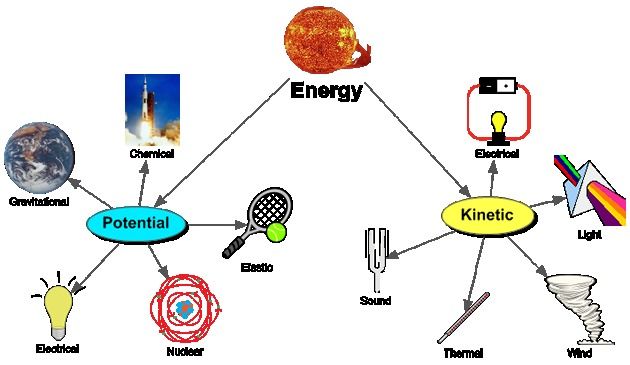
Different Forms of Energy:
Kinetic
Can be used to do work .
Potential:
Chemical
Gravitational Potential
Elastic.
Page 2
There are 2 types of energy
Kinetic energy: Due to motion
Potential Energy: Energy due to position
Energy is a scalar quantity
Energy/Work=F*d
Energy remains conserved it is not wasted.
Chemical potential energy: Energy stored in an object due to the arrangement of it's electron.
Batteries
Food
Fossil fuel
Gravitational potential energy:
Energy stored in it's body due to it's height from the ground.
Elastic potential energy:
Energy in an object due to it's elastic deformation
For e.g: a rubberband
Page 3
Other forms of energy:
1. Electrical energy
Energy of an electric charge due to it's motion or position.
2.Light energy
light is an electro -magnetic wave that is visible to the naked eye. Made up of electric and magnetic fields oscillating at a frequency.
3. Thermal energy:
heat energy
4. Nuclear energy:
Page 4
PRINCIPLE OF CONSERVATION OF ENERGY:
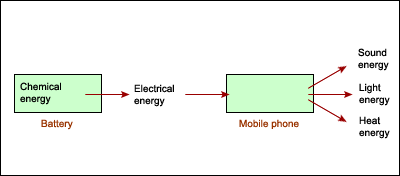
The principle of conservation of energy states that energy cannot be created or destroyed but can be conserved and transferred.
The diagram below show the energy transfer of a Mobile phone.
Page 5
Efficiency:
Total energy output=Total energy input
Efficiency= Output x 100
Input
Summary of all the work:
Energy is the capacity to do work
Cannot be created or destroyed
Efficiency= Output x 100
Input
Page 6
6.2: WORK
Work done only is when an object happens to move under the influence of a force applied.
W=Fxd
S.I.Unit=Joule(J)
WORK DONE=ENERGY TRANSFERRED
WORK AND IT'S RELATION WITH KINETIC ENERGY:
kinetic energy= 1 x Mv•2
2
Potential energy= Pe=mg
Total energy= gravitational energy+kinetic energy
=mgh+1/2mv2
Page 7
Power:
Rate of work done.
Power = work done
Time taken
Problem time:
A bulb rated 60 W coverts 20% energy to supply light energy
Calculate the quantity of light energy emmited in 3 minutes.
P= work done/time taken
40=w/180
7200(j)
20 x7200
100
=14400KJ
Page 8
By the Principle of Conservation of Energy,
total
energy of ==
gravitational
potential
energy at
point Q
+
kinetic
energy at
point Q
+
dissipated
energy
system
Information
- Description
- GCE O-Level Physics (CHAP 6: Energy,Work and Power) Note on 6.1: Energy, created by Fatima Zehra on 09/08/2016.
- Created by
- Fatima Zehra
- Views
- 11
- Tags
- Rating