
Flashcards
Paediatrics: Neonatology (Developmental Dysplasia of the Hip and Talipes)

Cards in this deck (12)
- 1What is developmental dysplasia of the hip (DDH)?Disorder of hip joint development resulting in hip instability/subluxation/dislocation leading to acetabular dysplasia.
OHOP - 2Incidence: 2:1000 (but up to 20:1000 newborn hips are unstable; 90% spontaneously stabilize by 9/52). What are the risk factors?* FHx (1:5)
* Female > male (5:1)
* L > R (1.5:1)
* Racial predilection
* Breech presentation
OHOP - 3DS progression = Capsular laxity + shallow acetabulum → instability/subluxation/dislocation → muscle contracture → progressive acetabular dysplasia with a fibrofatty substance filling the acetabulum; femoral head becomes hypoplastic. What is the typical Hx?* Usually uneventful pregnancy
* Parents may notice delayed walking
* P'less limp
* Prone to falls
* DDH may be incidental finding
OHOP - 4All newborn infants are screened for DDH before discharge. Describe how you would perform Ortolani's & Barlow's test.* Is hip dislocated? If so, is it reducible? Ortolani’s test (O for out). Gently elevate (anteriorly) & abduct the dislocated hip to reduce it (clunk of reduction).
* If not dislocated, can I dislocate it (ie dislocatable)? Barlow’s test. Gently adduct & depress (posteriorly) femur, vulnerable hip dislocates.
These 2 provocation manoeuvres become unreliable after age 6–8/52.
OHOP - 5Ix of DDH pre & post 6/12.* <6/12 - hip US (before ossification, operator-dependent)
* >6/12 - AP pelvis radiograph. A shallow acetabulum with ^acetabular index & hypoplastic femoral head in superolateral position is demonstrated
OHOP - 6Rx of DDH.* <6/12:
> Pavlik harness (maintain hip in flexed position with some hip abduction)
* Age 6–18/12:
> Manipulation & closed reduction (+/− adductor tenotomy) + hip spica plaster cast
> Open reduction + hip spica plaster cast
* 18–24/12:
> Trial of closed reduction
> Open reduction +/− pelvic osteotomy + hip spica plaster cast
* 2–6yrs:
> Open reduction +/− femoral shortening +/− pelvic osteotomy + hip spica plaster cast
OHOP - 7What is postional talipes & how is it corrected?* Caused by intrauterine compression - is common
* Foot is of normal size
* Deformity is mild
* Can be corrected to neutral position with passive manipulation
* If positional deformity is marked parents can be shown passive exercises by physiotherapist
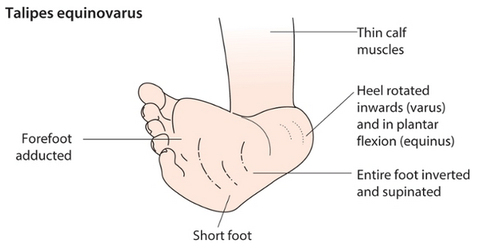
ITOP p453. - 8What is talipes equinovarus?* Entire foot is inverted & supinated, forefoot adducted & heel is rotated inwards & in plantar flexion
* Affected foot is shorter
* Calf muscles thinner than normal
* Position of foot is fixed, cannot be corrected completely & often bilateral
* Birth prevalence is 1:1000 live births, affects predominantly males (2:1), can be familial & usually idiopathic
See pics on following cards.
OHOP - 9—
- 10Rx of talipes equinovarus.Rx is started promptly with plaster casting & bracing, may be required for many months. Usually successful unless condition is very severe, when corrective SX is required.
ITOP p453. - 11What is talipes calcaneovalgus?Foot is dorsiflexed & everted. Usually results from intrauterine moulding & self-corrects. Passive foot exercises are sometimes advised.
ITOP p453. - 12—Poo I'm soo bored.

Information
- Description
- SGUL LOB's for Paediatrics: Neonatology (Developmental Dysplasia of the Hip and Talipes).
- Created by
- Andrew Street · Jan 2017
- Updated
- Jan 30, 2017
- Views
- 86
- Rating