
Notas
Research Methods- A Level final revision
Conteúdo das notas (1)
Página 1
Content analysis- observational technique that indirectly observes behaviour via analysis of communication e.g. the media. Coding is used to systematically categorise data.
+ Circumnavigates ethical issues of experiments as it already exists
- Analysis outside of the context produces inaccurate conclusions
Reliability- consistency across time and researchers
Inter-rater reliability- same test, same participants, same time, multiple observers watching separately
Test-retest- same test, same participants, different time, results are correlated
Questionnaires- needs good test-retest reliability and not ambiguous questions
Observations- observers trained in behavioural categories which must have no overlap
Interviews- same interviewer and structured
Experiments- standardisation
Validity- accuracy
External validity- if the findings can be generalised beyond the study
Internal validity- if you measure what you intended to measure
Ecological validity- generalisation to other settings
Temporal validity- are findings true over time?
Face validity- do you appear to be measuring what you claim to be measuring?
Concurrent validity- do the results from one test match those from another established test?
Eyeballing- assesses face validity
Ask participants to do established test and correlate the results with new test. If coefficient is +0.8, the new test is valid.
Experiments- use of control group, standardisation, single/double bind method
Questionnaires- incorporate a lie scale
Observations- covert observations prevent researcher intervention. Have unambiguous coding categories
Levels of data
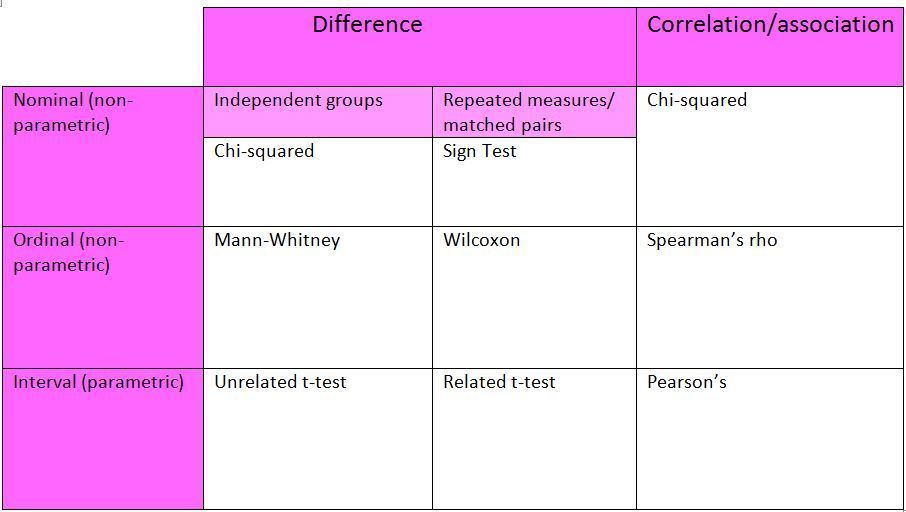
Nominal- data in categories, mode is suitable measure of central tendency
Ordinal- data in an order e.g. rating scales, median is suitable measure of central tendency, range is suitable measure of dispersion
Interval- data based on numerical scores- mean is suitable measure of central tendency, standard deviation is suitable measure of dispersion
Parametric- most powerful, must have drawn from a population of normal distribution for the variable being measured. There should be homogeneity in variance (SD of one is not more than twice of the other)
Non-parametric- doesn't require normal distribution, doesn't require homogeneity of variance
Type 1 error- false positive, rejecting the null hypothesis, occurs with too high level of significance e.g. 10%
Type 2 error- false negative, accepting the null hypothesis, occurs with too low level of significance e.g. 1%
Sections of a scientific report
Abstract- 150-200 words, aims and hypotheses, methods and procedures, and results and conclusions- a summary
Introduction- literature review, including details of theories, concepts and studies. It should follow a logical progression, with the aim and hypotheses at the end
Method- detailed enough for replication, design, sample (size, target population, sampling method), apparatus/materials, procedure (brief/debrief, standardised instructions), and ethics
Results- summary of key findings, descriptive statistics, inferential statistics, and the final outcome (which hypothesis?)
Discussion- findings are described in verbal form, and are discussed in relation to the literature in the introduction. Includes limitations and how to tackle them in the future, and implications.
References- surname, date published, book title, city, publisher
Features of a science
Objectivity- free from bias
Empirical evidence- evidence should be obtained via direct sensory experience e.g. experiments
Replicability- research should be standardised so findings can be tested. It is useful for validity, reliability, generalisability, and theory construction
Theory construction and hypothesis testing- observation of a behaviour leads to the development of a hypothesis. A study is designed to gather evidence, and if the hypothesis is supported then the theory is strengthened, but if not the theory is revised. New hypotheses from old theories is called deduction.
Paradigm- a set of agreed methods and assumptions. Psychology had a paradigm shift- new evidence leads to paradigms being replaced.
Falsifiability- it should be possible to test a theory and prove it false.
Informações
- Descrição
- Final brief notes on AQA A Level Research Methods (only second year, not AS Level).
- Criado por
- Grace Fawcitt
- Visualizações
- 92
- Tags
- Avaliação