
Quiz
Cyanthostomes and Small Strongyles
Este quiz tem tipos de pergunta que abrem no player de sempre.
Perguntas do quiz (16)
1Small strongyles are the most common and important helminth parasite of horses.
- AVerdadeiro
- BFalso
2How many species of small strongyles are there?
- A>40
- B30-40
- C10-20
- D20-30
3Following a direct lifecycle, how long does it take for the egg to form infective L3 on pasture and what 2 conditions must be at optimum for this to occur?
- A7 days - moisture and temperature
- B10 days - nutrients and temperature
- C5 days - moisture and temperature
- D3 days - nutrients and temperature
4What is unique to the infective L3 larvae that assists in its survival in the environment?
- ACuticle from L2 - protected and retains viability but cannot feed
- BNutrient storage - ability to feed, remains active and survive until ingested
- CCuticle from L2 - protected, retains viability, can still feed
- DCilli - motility
5Label the lifecycle
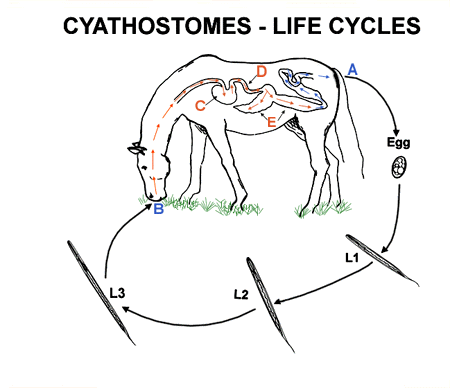
- AIngest sheathed L3
- BIngest L4
- CL3 passes through stomach
- DL4 passes through stomach
- ELarvae exsheath in SI
- FLarvae ensheath in LI
- GPenetrate crypts in cecum and colon
- HPenetrate crypts in small intestine
- IEggs passed in feces
- JL4 passed in feces
6Larval stages cause the most significant damage.
- AVerdadeiro
- BFalso
7What is the prepatent period?
- A6-14 weeks
- B6-8 weeks
- C12-14 weeks
- D4-6 weeks
8Larvae can undergo arrested development and remain encysted in the gut wall for up the 2.5 years.
- AVerdadeiro
- BFalso
9What is the best diagnostic test for strongyles if a horse is showing clinical signs?
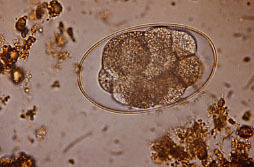
- AFecal egg count
- BELISA
- CDirect fecal smear
- DBaermanns test
10What type of treatment program is being used for effective strongyle control?
- ATargeted treatment
- BScheduled whole herd treatment
11What are the 3 'essentials' of a worm control program?
- AChoice of drug
- BTiming of treatment
- CMonitoring control with fecal egg counts
- DQuantity of drug
- EHousing of horses
12The Egg Reappearance Time is the time period from [blank_start]treatment[blank_end] to when the horse [blank_start]begins shedding Strongyle-type eggs[blank_end] again.
Pyrantel & benzimidazoles - [blank_start]6 weeks[blank_end]
Ivermectin - [blank_start]8 weeks[blank_end]
Moxidectin - [blank_start]10 -12 weeks[blank_end]- Atreatment
- Bfecal egg count
- Cbegins shedding Strongyle-type eggs
- Dtreated for Strongyles
- E6 weeks
- F8 weeks
- G8 weeks
- H10-12 weeks
- I10 -12 weeks
- J6 weeks
13Which anthelmintics have efficacy against arrested Cyathostome larvae?
- AMoxidectin
- BFenbendazole
- CIvermectin
- DPyrantel
14Treatments should be based on [blank_start]fecal egg counts[blank_end].
All horses should be treated every [blank_start]6 months[blank_end] to eliminate [blank_start]large strongyles[blank_end].
[blank_start]High[blank_end] egg shedders (>200-300 epg) should be treated [blank_start]more frequently[blank_end] during times of [blank_start]peak transmission[blank_end]. Do not treat when transmission is [blank_start]low[blank_end].
Maintain a parasite [blank_start]refugia[blank_end] on pasture.- Afecal egg counts
- Bdisease presence and clinical signs
- C6 months
- D12 months
- Elarge strongyles
- Fsmall strongyles
- GHigh
- HLow
- Imore frequently
- Jless frequently
- Kpeak transmission
- Llow feed/poor pasture
- Mlow
- Nhigh
- Orefugia
- Pfree
15Other factors that can be used in conjunction with target treatments include;
- APasture sanitation
- BPasture rotation
- CPasture spelling/alternative grazing
- DIsolate horses
- EIncrease pasture size
16Cyathosomes in horses have developed a resistance to which anthelmintic drug?
- ABenzimidazoles
- BIvermectin
- CMoxidectin
- DPyrantel
Informações
- Descrição
- Equine Nematodes - Small Strongyles
- Autor
- Caitlin Wringe
- Idioma
- English
- Visualizações
- 1
- Etiquetas
- Avaliação
- Ainda sem avaliações Avalie este quiz