
Flashcards
Advanced Propulsion
Flashcards do conjunto (54)
- 1Why is it doubtful whether current bipropellant S.I's can be improved by more than 10%?Because T is given by the ratio (spec energy/spec heat) - too low and we have a monopropellant situation, low SI. Too high and we exceed safe temperatures for combustion nozzle (material properties).
- This requires cooling by going to non stoichiometric combustion or coolant injection - 2What are other factor limits the SI?Molecular weight, m, it is limited by the propellant combination.
Upper limit to SI is proportional to (T/m)^1/2 which is not amenable to great improvement in conventional chemical systems. - 3Why does LH2/LF2 offer little advantage in SI over LH2/LO2?Difficult to store and unpleasant combustion products.
- 4There are two chemical systems which offer a gain in SI, what are they?- Atomic Hydrogen 2H-->H2 (difficult to store)
- Recombination of hydrogen H+ and e- --> H (If this is possible there are better things to do with the ions - in an electric ION engine) - 5What is variable cycle air-breathing?Supplements SI by using atmosphere for reaction mass and/or propellant
- 6Pros and cons of air breathing ?Pros:
Improved SI - free reaction mass
Cons:
Not usable in space or any other non reactive atmosphere
-Difficult thermodynamics - 7What is Exhaust jet power equal to?W=1/2*mdot*Ve^2
(Energy over time)
So mdot=2W/Ve^2
mdot=dm/dt - 8What is the equation for energy input?E=W*t
E=(1/2*dm/dt*Ve^2)*t
E=1/2*Mp*Ve^2
E=1/2*P*Ve
Where P is impulse (momentum*time)
t is burn time
Mp is propellant mass
Ve is exhaust velocity - 9What does Energy/impulse equal?E/P=1/2*Ve^2
- 10What does Exhaust thrust equal?T=dmt/dt*Ve
T=Mp*Ve/t
T=2W/Ve
T=(2W*dm/dt)^0.5 - 11What does power/thurst equal?W/T=Ve/2
Same as Energy/Impulse and both proportional to Ve - 12What do these proportionality's show us?That increasing SI greatly improves motor performance by reducing Mp for a given impulse, but it requires proportionately great energy input from the power system.
- 13Power system mass equals?Mw=k*E
- 14Propellant mass?Mp=P/Ve
- 15Total mass is equal too?Mtot=Mw+Ms+Mp
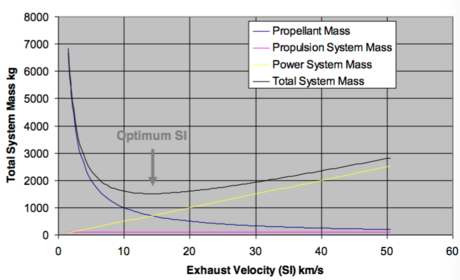
Where Ms is propulsion system mass - 16On an Exhaust Velocity SI km/s vs Total System Mass kg, where is the Optimum SI
- 17For a chemical rocket k~1 so how does this affect the graph?
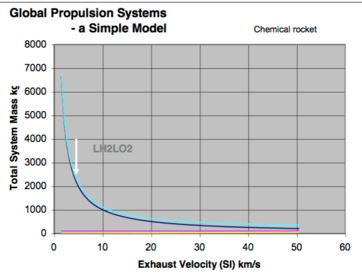
- 18What too ways can electric propulsion work?Electrical heating of a fluid
Electromagnetic acceleration of a charged particle, magnetic or conducting material and require an electrical power source. - 19What types of electrothermal propulsion systems are there?Resist jet and arc jet
- 20How do electrothermal motors work?Chemical energy is replaced by electrical energy and converted to heat, by Ohmic heating or an electric arc.
Laws of thermodynamics developed for chemical rockets apply. - 21How does a resistojet work?Ohmic heating of a working fluid by heaters incorporated in ducting.
Sometimes used to augment heat of dissociation of monopropellants, possible synergy with disposal of fluid waste. - 22What are the pros of resistojets?Improves performance of low SI (monopropellant) systems when excess electrical power is available
- 23What do they look like (diagram)?
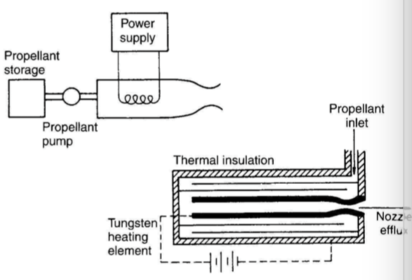
- 24How does an arcjet work?Ohmic heating of a working fluid through an electric arc (T~1000K), usually struck between axial electrode and nozzle throat
- 25What is the main problem with an arc jet?Due to the high temperature it leads to the migration of material causing an eventual short circuit and shut down.
- 26What does an arc jet look like (diagram)?
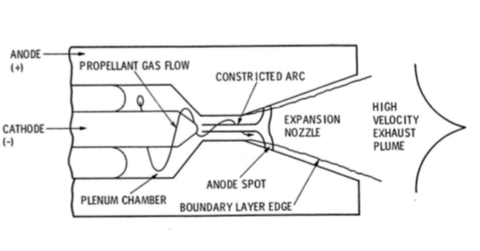
- 27What electrodynamic systems are there?Railgun and ion engine
- 28How do electromagnetic systems work?Uses electromagnetism to directly accelerate mass.
Unless heat conversion taking place laws of thermodynamics don't apply.
Use laws of electromagnetism to calculate mass acceleration.
Masses must be magnetic, charged or conducting in order to respond to electric and magnetic field. - 29How does a railgun work?Linear electric motor on airless body (e.g. moon) accelerating spacecraft.
Very attractive for lunar or asteroidal surface material exploitation. - 30Pros and cons?Highly energy efficient and can attain km/s
Tends to be larger in size than most systems. - 31What does a railgun look like (diagram)?
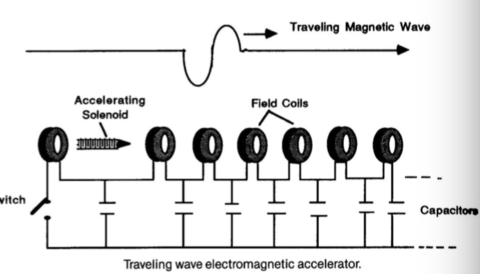
- 32How does an ion engine work?Uses direct electromagnetic acceleration of charged particles to produce thrust
- 33Pros and cons of an ion engine?Pros: Works for very long periods of time
Cons: Produces very little thrust mN... - 34What does the diagram for an ion engine look like?
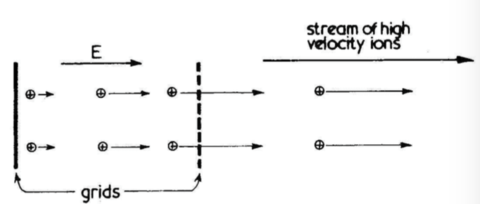
- 35What are the two types for ion engines (in terms of ions)?Conductive metals
Inert gases - 36What are the types of conductive metals used and why?Cs - Caesium
Hg - Mercury
Due to low ionisation potential (energy required to remove an electron) - 37What are there issues?Conductive metals so severe toxicity and contamination problems
- 38What types of inert gases are used?He, A, Xe. More benign chemically
Remember ions are not inert
These are harder to ionise. - 39What are the two main problems with Ion engines in general?Low thrust available
Necessity to maintain charge neutrality by the ejection of electrons. - 40What is most desirable for an ion engine?Produce ions with great efficiency in ion source and to maximise motor life and efficiency
- 41How can motor life and efficiency be increased?By preventing the erosion and poisoning of electrodes.
- 42How can the speed of an ion be calculated?
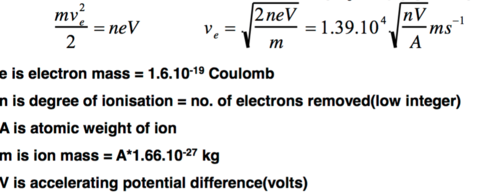
- 43What does GOCE stand for?Gravity field and steady state Ocean Circulation Explorer
- 44Why does the GOCE orbit closer to earth (think of its function)?The gravitational variations are stronger closer to earth.
- 45What do the two winglets on the GOCE provide?Aerodynamic stability
- 46What satellite perturbations can influence the measuring of gravity?Disturbances from moving parts
- 47What is gradiometry?The measurement of gravitational differences between an ensemble of test masses inside the satellite
- 48How does a Hall effect plasma thruster work?Uses electrons orbiting in radial magnetic field to generate Lorentz force on Xenon ions to propel them backwards.
- 49Pros and cons of hall effect plasma thruster?higher mass flow than ion engine
Lower Isp - 50What does a Hall plasma thruster look like (diagram)?
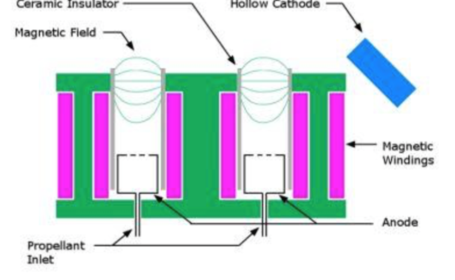
- 51How do solar sails and electric propulsion share the same mission characteristics?They provide low thrust over a long period of time to attain the desired mission impulse
- 52What problem does the long period of time they are used over create?It invalidates the assumption that impulses are over a negligibly short duration so trajectory becomes difficult
- 53Why is this assumption important?It allows us to use Keplers laws or the Vis-Visa equation. Trajectories are no longer conic sections (hyperbola, ellipse, circle...).
- 54How are the trajectories for low thrust systems calculated?Using direct numerical solutions, not usually difficult but the computation and optimisation takes careful examination.
Informações
- Descrição
- Degree Aerospace Engineering FlashCards sobre Advanced Propulsion, criado por Luke Hansford em 19-12-2015.
- Criado por
- Luke Hansford
- Visualizações
- 230
- Avaliação