
Flashcards
cwsillichompnotes
Flashcards do conjunto (30)
- 1Competent writers almost always use commas for one of two purposesCommas used to set off: to set off some element of the sentence from what precedes, what follows, or both
Commas used to separate: to separate two elements as they might be separated by a pause or rising inflection of the voice if one were speaking.
The few uses that fall into neither of these categories are the arbitrary use of commas on certain specific occasions and the insertion of a comma when its presence is necessary for the sake of clarity. - 2Commas Used to Set Off An appositive or a term of direct address is set off by commas (what's the exception?)The original factory, an old stone structure, is still standing.
Note: No comma is used when a noun and its appositive are so closely related as to join in expressing a single idea. For example:
The invasion was led by my brother John. - 3Commas Used to Set Off An adverbial clause preceding its principal clause, or an adverbial phrase at the beginning of a clause, is usually set off by a comma (what's the exception?)On all floors except the second and the fourth, the fire hazards have been removed.
Note: If an adverbial clause or phrase is extremely short, and if omission of the comma could not cause confusion, the comma may be omitted. For example:
When he arrived he was immediately seated.
During July the plant will be closed. - 4Commas Used to Set Off Independent elements, participial phrases, gerund phrases, and other such constructions at the beginning of a sentence are set off by commasNo, the shipment has not yet arrived.
Worried by the complaints, we began an investigation. - 5Commas Used to Set Off A conjunctive adverb (however, moreover, therefore, etc.) is usually set off by commas when it comes within the clause to which it applies. When it comes at the beginning of a clause, it may or may notbe followed by a comma but will always be preceded by a period or semicolon:
His objection, therefore, was ignored.
I had heard the rumor before; consequently, I did not believe it. - 6Commas Used to Set Off Any mildly parenthetical element is enclosed in commas if it seems desirable to set it apart from the rest of the sentence. A writer is called upon to usehis own judgment in applying this rule, for too many commas will make a sentence jerky and hard to read:
The frame, he insisted, was too tight.
The central section, for example, was undamaged. - 7Commas Used to Set Off A term such as "namely" or "that is," used to introduce an example or a list, is usually set apart from that example or list by a comma. (The mark that precedes such an expression depends onthe sentence structure.)
The crops--that is, wheat, peas, and alfalfa--are in good condition.
Three species of tree were observed, namely, pine, fir, and cedar. - 8Commas Used to Set Off Nonrestrictive clauses are set off by commas. Restrictive clauses,however, are not set off:
The south side, which had been exposed to the sun, was badly faded.
He moved to Arizona, where the climate was not so moist.
Note: In these examples, the clauses introduced respectively by “which” and “where” merely add some additional facts. If they were omitted, the meaning of the remainder of the sentence would be unchanged. Hence they are nonrestrictive. However, some clauses introduced by “where” or “who” are restrictive. Each is used to limit--to restrict--the meaning of the main statement, which would be radically changed if the clause in question were omitted.
The roads went to pieces where the permafrost had been disturbed.
All motorists who drive recklessly should be fined heavily. - 9Commas Used to Set Off A word or phrase placed in an abnormal position in a sentence should be set off by a comma or commas:To a trained accountant, the problem would look easy.
- 10Commas Used to Set Off A direct quotation is set off by a comma or commas (What is the exception?)"The tires are threadbare," he asserted, "and will blow out at any moment."
Exceptions: A quotation that blends into the regular structure of the sentence is not set off by commas. A title in quotation marks is not set off by commas unless some other rule makes commas necessary:
The poet's prophecy about "airy navies grappling in the central blue" has become an unpleasant reality.
The rhythm of "The Raven" is very striking. - 11Commas Used to SeparatePA notes apply - study the rules thoroughly.
Note: When both clauses are extremely short and simple, the comma may be omitted (The coordinating conjunctions are "and," "but," "for," "or," and "nor." ("Yet" and "so" may also be treated as coordinating conjunctions when this rule is applied - same as PA.):
It was damaged but it still is usable.
Two or more adjectives preceding a noun are ordinarily separated by commas. (The comma before the last adjective is omitted, however, if that adjective is so closely associated with the noun that the two merge into a single thought unit.) Also, a comma is used between adverbs that modify the same object.
He has a modest, unassuming manner.
The watchman was a feeble old man.
Slowly, relentlessly, the stream wore away the rocks. - 12Commas Used ArbitrarilyA comma is used between the last and the first name of a person when the last name appears first, and also after the first name unless the sentence structure calls for some other mark:
Please insert the name Fitzgerald, Duane, in the proper place in the alphabetical list.
A comma is sometimes used to indicate the omission of one or more words:
July will be devoted to writing; August, to revision.
A comma may be used whenever it is necessary to force a pause for the sake of clarity.
Inside, the building was in better condition. - 13An appositive isa noun or noun phrase that renames another noun right beside it. The appositive can be a short or long combination of words.
e.g. The insect, a cockroach, is crawling across the kitchen table. - 14An adverb clause isa group of words that function as an adverb. The clause can modify verbs, adverbs and adjectives by telling when, where, why, how, how much and under what condition.
- 15Adverbial clauses begin witha subordinating conjunction (such as after, whether, if, because and although) and they contain a subject and a predicate.
- 16Examples of adverb clausesWhether you like it or not, you have to go to bed now. (Whether you like it or not)
She likes the red car more than her husband does. (more than her husband does) - 17In English grammar, a participial phrase isa word group consisting of a present participle (also known as an -ing form) or past participle (also known as an -en form), plus any modifiers, objects, and complements. A participial phrase commonly functions as an adjective.
- 18Examples of participial phrasesPresent participial phrase: A referee, always working before unfriendly crowds, has orders to exude poise under the most trying circumstances.
Past participial phrase: Driven by a steam engine, the first dishwasher was invented by an Indiana housewife in 1889. - 19A gerund phrasewill begin with a gerund, an ing word, and will include other modifiers and/or objects. Gerund phrases always function as nouns, so they will be subjects, subject complements, or objects in the sentence.
Eating ice cream on a windy day can be a messy experience if you have long, untamed hair. - 20Don't mistake a gerund phrase for a present participle (participial) phrase.Bernard hates buttering toast with a fork.
Buttering toast with a fork = gerund phrase, the direct object of the verb hates.
Buttering toast with a fork, Bernard vowed that he would finally wash the week's worth of dirty dishes piled in the sink.
Buttering toast with a fork = present participle phrase describing Bernard.
My dog's most annoying habit is hogging the middle of the bed.
Hogging the middle of the bed = gerund phrase, the subject complement of the linking verb is.
Last night I had to sleep on the couch because I found my dog Floyd hogging the middle of the bed.
Hogging the middle of the bed = present participle phrase describing Floyd. - 21What is a conjunctive adverb?When the job of an adverb is to connect ideas, we call it a conjunctive adverb.
List: accordingly, also, besides, consequently, conversely, finally, furthermore, hence, however,
indeed, instead, likewise, meanwhile, moreover, nevertheless, next, nonetheless, otherwise, similarly, still, subsequently, then, therefore, AND
thus.
A conjunctive adverb can join two main clauses. In this situation, the conjunctive adverb behaves like a coordinating conjunction, connecting two complete ideas. Notice, however, that you need a semicolon, not a comma, to connect the two clauses.
MAIN CLAUSE+;+Conjunctive adverb+,+MAIN CLAUSE.
e.g. The cat ate a bowlful of tuna; then, to the squirrels' delight, the fat feline fell asleep in the rocking chair. - 22A conjunctive adverb will alsointroduce, interrupt, or conclude a single main clause. In this situation, you will often need commas to separate the conjunctive adverb from the rest of the sentence.
At 10 a.m., Paul was supposed to be taking his biology midterm. Instead, he was flirting with the pretty waitress at the coffee house.
Maria declined Jeff's third invitation to go out. This young man is determined, nevertheless, to take her to dinner one night soon.
After mowing the yard in the hot sun, Pedro was too hungry to shower. He did wash his dusty hands, however.
If the break is weak, do not use comma(s).
Anna called to say her car would not start. Rafael will therefore have to walk to school.
Weak interruption = no commas.
The long noodles splashed tomato sauce all over the front of Brenda's shirt. Ordering fettuccine was a mistake indeed.
Weak interruption = no comma. - 23What is an independent clause?A main clause—sometimes called an independent clause—must contain a subject and a verb as well as express a complete thought. Look at the examples below:
Diane kicked the soda machine.
Diane = the subject; kicked = the verb.
A giant spider has made its home behind the shampoo bottle in Neil's bathroom.
Spider = the subject; has made = the verb.
Sima and Michele are skipping their chemistry class to sit by the lake and watch the sun sparkle on the water.
Sima, Michele = the subjects; are skipping = the verb. - 24You must have at least one of these in every sentence.You must have at least one main clause in every sentence. A main clause is the essential component. Without a main clause, a group of words is a fragment, a major error in writing.
A sentence can contain any number of other grammatical units, such as participle phrases, prepositional phrases, subordinate clauses, appositives, etc. It must, however, contain at least one main clause. Take a look at the example below:
While dissecting a cow heart in her anatomy and physiology class, Shenicka realized that a cheeseburger, her favorite lunch, was no longer appetizing.
While dissecting a cow heart = participle phrase.
In her anatomy and physiology class = prepositional phrase.
Shenicka realized = the essential main clause.
That a cheeseburger was no longer appetizing = subordinate clause.
Her favorite lunch = appositive. - 25Do not confuse a main clause with a subordinate clause.When you place a subordinate conjunction in front of a subject and verb, you will no longer have a complete thought. The group of words becomes a subordinate clause, like these examples:
When Diane kicked the soda machine ...
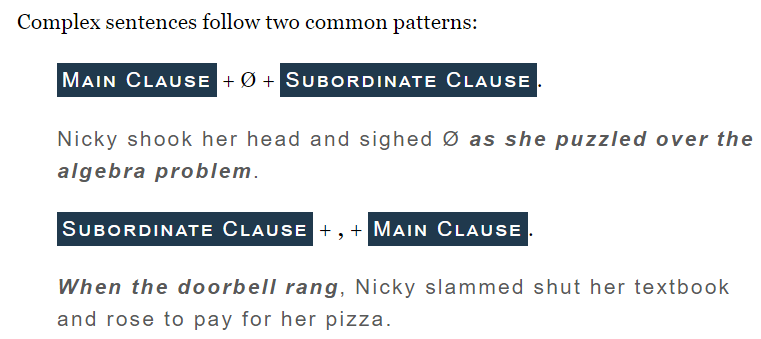
When Diane kicked it, what happened? Did the soda machine cough up her drink? Did the soda machine fall on top of poor Diane, crushing her underneath? Did quarters start shooting out of the coin return slot? Because you no longer have a complete thought, you no longer have a main clause. - 26Punctuate a complex sentence correctly.
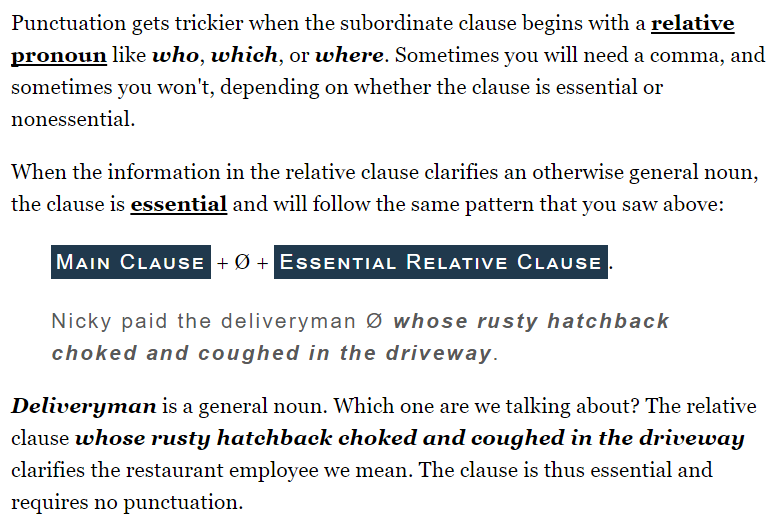
- 27Essential relative clause and punctuation
- 28Punctuation gets trickier when the subordinate clause begins witha relative pronoun like who, which, or where.
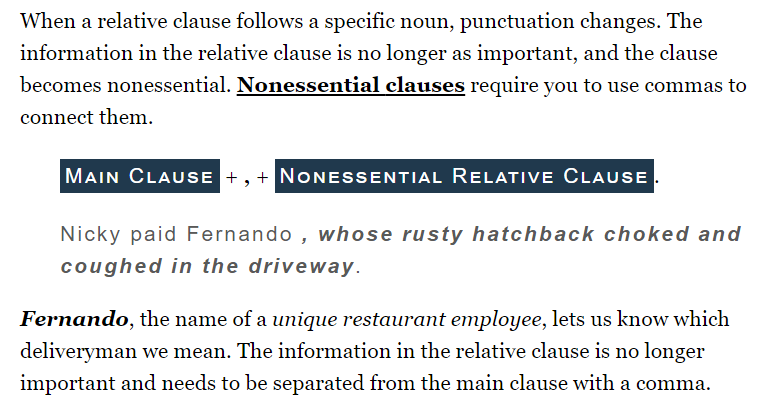
List of relative pronouns: that, which, whichever, who, whoever, whom , whomever and whose. - 29Non-essential clauses and punctuation
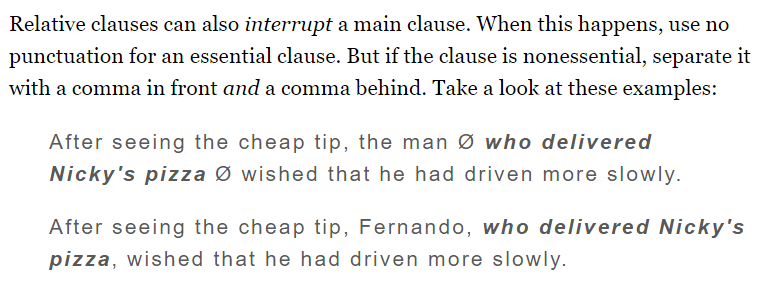
- 30Explain how relative clauses can interrupt a main clause and how this affects punctuation.
Informações
- Descrição
- PA FlashCards sobre cwsillichompnotes, criado por A M em 11-04-2017.
- Criado por
- A M
- Visualizações
- 0
- Avaliação