
Flashcards
International Business Law HSRW SS2018
Flashcards do conjunto (37)
- 1Commercial Law ( Wirtschaftsrecht): OverviewBusiness Law (Wirtschafts-Privatrecht) -> Contracts & Companies
Regulatory Law ( Wirtschafts-Verwaltungsrecht) -> Authorities & Permits
Tax Law - 2Commercial Law EconomyCommercial Law = the law that applies to the economy
Economy = production of goods and services (+ offering them for sale) - 3Business law as a part of commercial law Business Law is part of? Private Law/Civil Law... Example: (Particular) Business law...Business Law is part of Private law /Civil Law
Private Law/ Civil Law deals with legal relationships between private persons (Individuals & Companies) - 4Private Law/Civil Law Example: (Particular) Business law...Examples: Purchase contracts, lease contracts, construction contracts, labour contracts, damage for personal injury or for property injury, law-suits in such areas
Particular business law deals with further matters, e.g. companies, labour law, bankruptcy etc. - 5Regulatory Law as a part of commercial law (1) Regulatory Law:Regulatory law = law by which the goverment regulates / restricts economic activity. It is a part of public law = law which governs relationships between individuals or companies and the goverment
- 6Regulatory Law as a part of commercial law (2) General trade supervision law: Import & ExportGeneral trade supervision law: Health protection, environmental protection, consumer protection
- 7Tax Law as a part of commercial lawTax goverment imposes different types of taxes:
Taxes on profits (e.g. corporate income tax)
Taxes on sales (e.g. VAT) - 8Commercial Law = primarily domestic lawrules of CL are primarily promulgated (verkündet) by the legislator of nation states
International business law is not primarily "international law", but primarily national law = domestic law, which varies from country to country - 9International Law: One main issueThe law of which jurisdiction apply to a specific commercial activity of a company?
Commercial activity is e.g. purchase contract, damage claim against other business - 10Corporations: Introduction (1)- Corporation is a seperate legal person
- Final step of its foundation is registration in a public register, which is a formal process
NO Liability of the shareholders for obligations created by corporation - 11Corporations: Introduction (2)Act vis-a-vis third parties through (managing) directors
- (Managing) directors appointed by shareholders
- (Managing) directors and shareholders not necessarily identical persons - 12Corporations: Formation (1)- Various documents to be signed and to be filed with register, e.g. shareholders (founders) sign articles of association (= agreement between the shareholders
- Founders appoint first (managing) director - 13Corporations: Formation (2)In many jurisdictions: Payment of share capital by founders to bank account of corporation (was opened by director with a commercial bank)
Documents are filed with and reviewed by public register
Registration of corporation in public register - 14Corporations: Origin of its businessCorporation founded from scratch starts with no business ----Shareholders transfer funds and assets to the corporation (= contributions)---Corporation acquires assets through business dealings of its own
(director signs purchase contract for corporation by which corporation buys assets
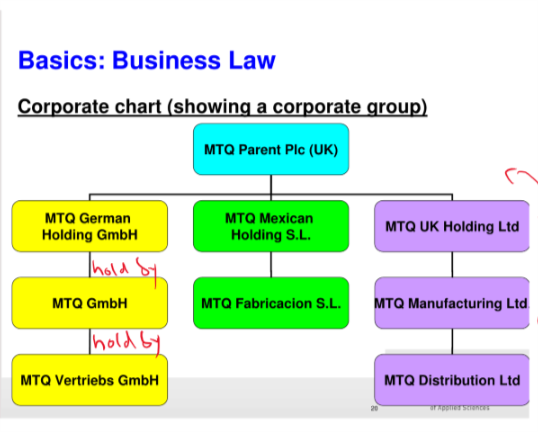
Shareholders may also grant loans to their corporation - 15Corporations: GroupsMajor businesses are organized as corporate groups = a parent company controls 1 or more DIRECT or INDIRECT subsidiaries through direct or indirect majority ownership
Parent is not liable for subsidiaries, may create liability through payment guarantee issued to subsidiarys creditor - 16Corporate chart (describe it)
- 17Freedom of contractPrinciple: Freedom of parties to decide (i) whether or not to conclude a contract and (ii) the contents of the contract
Contract may derogate from flexible statutory law, contract then takes precendence
No derogation from rules of mandatory statutory law
Matters not governed by contract are coverned by statutory law, unless application of statutory law is excluded in the contract - 18Contract negotiations: Main pointsObject of contract ( sold assets/ services: scope, quality)
Price, way of payment, payment guarantees
Liability for breach(= risks and their legal treatment)
Duration of contract for cco´s - 19Contract negotiation: Main pointd (2) What else determines outcome of negotiations?Bargaining power of each party often determines the outcome of negotiations:
Are alternatives available?
Or is one of the parties under economic pressure to enter into the contract? - 20Contract formationParties sign/enter into/conclude a contract when in full agreement on its main contents
Once concluded, contract binding upon a party---However, parties may change(alter,modify) signed contract or undo(annual/reverse) when parties agree such amendment/annulment - 21Contents of a contractUnder contract, claims/obligations of parties arise e.g. sales contract
- seller must transfer possession &ownership in sold object to buyer
- buyer must pay purchase price to seller
- all as agreed in contract/as required under civil law of applicable jurisdication
Next step = performance of contract - 22Cancellation of a contractBasic rule: No unilateral withdrawal from/ rescission of/ cancellation of signed contract
Exceptions: Party may unilateral withdraw IF one party made erroneous assumption e.g. about sales object---was deceived---faces a breach---requirements for such withdrawal satisfy in individual case - 23Termination of a contractcontract for continuing obligations (e.g. lease agreement, mid-term supply agreement) may be terminated by each party with no cause---by giving notice(e.g. 2 weeks or 6 months)
---if required for such a termination are satisfied in individual case
---
--- - 24International law relating to trade and commerce (i)Public International Law
-conventions, treaties and accords among nations and rules of international organisations (govern int. trade)
= Govermental regulation of international business
EU treaties, NAFTA, WTO, OECD, UN agencies---Keywords: customs and tariff laws - 25International law relating to trade and commerce (ii)International Business Law
- Private Law applicable to international business transactions between private businesses (companies or individuals)
-Keyword: International sales contract
- This course focuses on international business law (mostly B2B) - 26International Business Law: 3 main areasInternational trade = International sales
International trademarks, patents
Foreign direct investment - 27International tradeContracts = Business law
CISG
Incoterms
Overseas transportation
International payment
Arbitration - 28Intellectual propertyTrademark and patent registration
License contract - 29Foreign direct investmentInternational M&A transaction (optional)
- 30"International" in IBLInvolving parties in at least 2 different countries= cross border transactions
- transfer of ownership by physical delivery into another state OR
-transfer of ownership to party located in another state without physical delivery e.g. acquisition of(i) real estate (ii) foods already located in buyer´s country (iii) finance products (iv) shares in a company (v) rights - 31Business in IBL Purchase (and delivery) ofGoods and assets
Energy
Construction work for infrastructure project
Financial products or services
Intellectual property rights
Shares/ participation in companies (M&A) - 32Business in IBL: PartiesTypical of international business: b2b contracts, no direct sales to consumers
But b2c or c2c contracts in some areas:
- Luxury items
- Purchases of consumer goods through internet sales platforms
- Tourism - 33Law in IBL: Choice of lawChoice of law: Parties simply agree on the applicable law that applies to the sales contract---Thus the law governing the sales contract in many cases mostly
- the law of a certain jurisdiction, that was agreed by parties in contract
- and not some international law
For issues not adressed in contract - 34Law in IBL: Private international law: GeneralAbsence of a choice of law: Which law governs contract = law of which country
- Every jurisdiction has rules governing this issues = the private international law or conflict of laws
Choice of law clauses are business standard, normal case is: law of chosen jurisdiction applies to contract - 35Law in IBL: Private international law: GermanyEGBGB (Einführungsgesetz zum BGB)
- contract validly concluded? Form. representation--- Ownership in an asset validly transferred to buyer?
Rome | Regulation (EU)
Contract for the sale of goods shall be governed by law of country where seller has his habitual residence - 36Law in IBL: Application of domestic lawBut mandatory regulations of a country of origin and country of destination apply as well (domestic law)
- DL of country of origin,e.g export bans,transport&storageregulations
- DL of country of destination on tariff
, import restiction, transport & storage, marketing & sales(permits etc.) - 37Law in IBL : Application of domestic law (2) Can it be circumvented?Such mandatory regulations of domestic law cannot be circumvented by choice of law, nor is the application of mandatory regulations of DL a matter of private international law, because
-choice of law and private international law only relate to private law governing the rights and dities between parties under sales contract
- whereas mandatory regulations of DL of a country involved deal with public law duties of the parties to the public in general
Informações
- Descrição
- BWL FlashCards sobre International Business Law HSRW SS2018, criado por Julian Schepers em 13-04-2018.
- Criado por
- Julian Schepers · abr 2018
- Atualizado
- 22 abr 2018
- Visualizações
- 59
- Avaliação