
Flashcards
evolution
Flashcards do conjunto (51)
- 1EvolutionThe process by which different kinds of living organism are believed to have developed from earlier forms during the history of the earth.
- 2Biological evolutionis change in the properties of populations of organisms that transcend the lifetime of a single individual
- 3What do we need to know to understand evolution?Evolution is about selection of changes over time
- 4What did we know at the beginning of 1800?World is few thousands years old
All life forms were created just the way they look now
None ever got extinct, they can all be found somewhere - 5What changed? 19th Century IdeaJames Hutton FOUND TIME!
Thomas Malthus FOUND SELECTION
Carolus Linnaeus FOUND LINKS between life forms
CHARLES DARWIN PUT IT ALL TOGETHER! - 6Precursors Linneus and taxonomyCarolus Linnaeus was a sixteenth-century Swedish physician and Botanist.
He founded the science of taxonomy, the branch of biology concerned with naming and classifying living things.
He developed the two part system of binomial nomenclature we use today.
His genera were clustered into increasingly broader categories; families, classes, phyla, and kingdoms…although he did not believe in evolution by descent, this pattern does provide a framework for thinking about evolution from a common ancestor. - 7Precursor Thomas MalthusThomas Malthus, an eighteenth century economist, published “An Essay on the Principle of Population” in 1798.
This document had profound implications
Simply stated: people tend to have more children than can possibly survive, and human populations have historically been kept in check by famine, starvation, and disease. Population grows exponentially, agriculture grows linearly. - 8Precursor James Hutton (1726-97)The English geologist, proposed that it was possible to explain geological land formations by processes that are currently in operation, such as erosion and sedimentation.
Canyons were cut by the erosion of streams, layers of sediment were deposited at the edge of river deltas, these processes occurred slowly over a very long time-this idea was called gradualism. - 9Precursor/opponent Lamarckdeveloped the first comprehensive model of evolution. Lamarck was a French Zoologist, curator of the invertebrate collection at the Paris museum. Lamarck saw many different lines of descent among the fossil invertebrates he encountered: instead of Aristotle’s single scala natura, there were many.
He proposed that organisms increased in complexity through time because of an innate tendency.
Lamarck proposed that interactions of organisms and environment drove the process of evolution.
He followed the widely accepted notion that characteristics acquired during an individual’s lifetime could be passed to one’s offspring. - 10Precursor/opponent LamarckHe proposed that patterns of use and disuse drove the evolution of adaptations. In stretching their necks to reach leaves high in the treetop, giraffes acquired slightly longer necks, and passed these longer necks to their offspring.
Lamarckian evolution can be disproved by experiment, specifically, we now know that acquired characters cannot be passed to offspring, also, evolution carries no innate tendency toward increasing complexity, but Lamarck’s theory was an important prelude to Darwin’s, it opened the door to thinking that organisms can and do change over the course of time. - 11Darwin He knew:World was old (100s of millions of years) (Hutton and lyell)
Different species have similarities suggesting common ancestors (Linneum)
Populations are limited by external factors (food, infection..) (malthus) - 12Darwin He LearntThat fossil armadillos right next to live armadillos, similar but not identical (Argentina)
That the world is dynamic (earthquake – marine fossils lifted thousands of feet above sea.
Galapagos: A great variety is present depending on geographical location and isolation. Mockingbirds looks all a bit different in different island differences can/do accumulate? - 13DarwinIn 1838 Darwin develops the idea of Natural selection, which he does not publish until Wallace letter in 1858
Followed by ‘The origin of species’ - 14The origin of species, 1859All organisms produce more offspring than can possibly survive
All organisms vary for a wide variety of different attributes and features-they also vary in reproductive success: some have more offspring than others.
Some variation is heritable.
Some of this variation must influence reproductive success
Given that the above are true…desirable characteristics will thus be preferentially passed to offspring
This is a logical conclusion of the first four points
Darwin concluded, based upon intuitive grounds, that, over vast spans of time, present day species have descended from a common ancestor. The book contained no mechanism for speciation, however. - 15The origin of species Darwin’s manuscript contained several new ideas, ideas not found in earlier notions of evolution;All species evolved from earlier species.
The mechanism is natural selection; members of a species possessing more desirable traits will have more offspring and survive to reproductive maturity.
Evolution occurs over a very long span of time. - 16Lysenko (1898-1976)did not believe Darwin, Stalin supported him, Russian peasants we forced to plant summer whet seed supply in Siberia in the belief they will adapt to growing in winter!
Over six million people died. - 17Natural SelectionIs one of the basic mechanisms of evolution, along with mutation, migration, and genetic drift.
- 18Natural Selection Darwin's grand idea of evolution by natural selection is relatively simple but often misunderstood. To find out how it works, imagine a population of beetles:There is variation in traits. For example, some beetles are green and some are brown
There is differential reproduction. Since the environment can't support unlimited population growth, not all individuals get to reproduce to their full potential. In this example, green beetles tend to get eaten by birds and survive to reproduce less often than brown beetles do
There is heredity. The surviving brown beetles have brown baby beetles because this trait has a genetic basis.
The more advantageous trait, brown coloration, which allows the beetle to have more offspring, becomes more common in the population. If this process continues, eventually, all individuals in the population will be brown. - 19Fundamental to the process of Evolution by natural selection are:Variation in reproductive success (variable number of offspring)
Variation in the trait
heritability
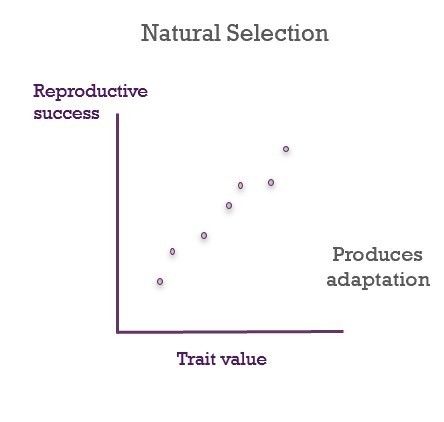
Non-zero correlation between reproductive success and the trait
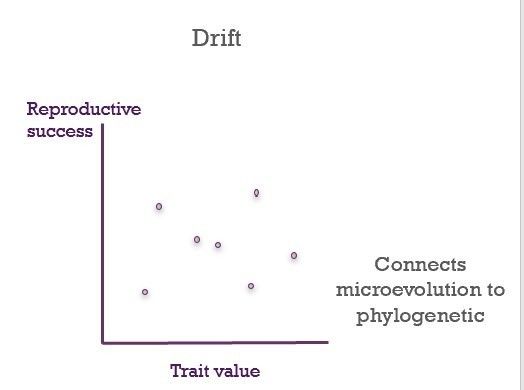
- Zero correlation = neutral evolution = drift (genes-chin) - 20Correlation Natural selection
- 21correlation drift
- 22Evolution of the evolution theoryDarwin didnt know about genes
- 23Consequence of discovery of genes and ChromosomesWe are ALL related.
We come from a common ancestor - 24Microevolution - ProcessTakes place all the time:
Selection plus Drift
Natural selection is driven by variation of reproductive success
The strength of selection on a trait is measured by the correlation of variation in the trait with variation in reproductive success
When there is no correlation, there is no systemic change in the tract, just drift - 25Macroevolution - HistoryCompounded effects of microevolution: Same principle but we look at it in terms of geological time.
Refers to the ONE tree of life, everything has ONE origin - 26Microevolution Evolution can beAdaptive
Neutral
Maladaptive - 27MicroevolutionAdaptive evolution is NOT Survival of the fittest
Design for REPRODUCTIVE SUCCESS, it is all about how many children/grandchildren you have AND whether you have more than somebody else in the population
Selection is RELATIVE (Master and disciples and tiger) - 28Strength of selection and speed of evolution Nothing happens for long period of timesIf population is small, little genetic variation, slow response.
Great variation has to slow down, directional selection becomes stabilizing selection because of links between traits.
The environment does not change
Developmental constraints - 29Strength of selection and speed of evolution Incredibly fastPopulation are large and selection is strong
Antibiotic resistance
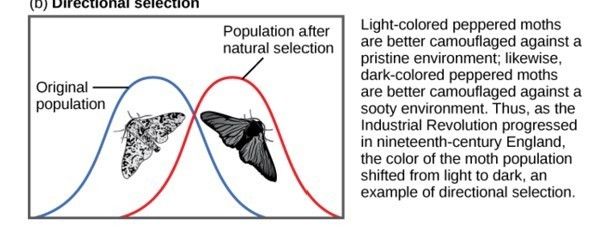
Strong directional rapid selection (rapid-if you don’ finish ab treatment in 1 week one will have evolved resistance) - 30adaptive evolution Types of selectionDirectional,
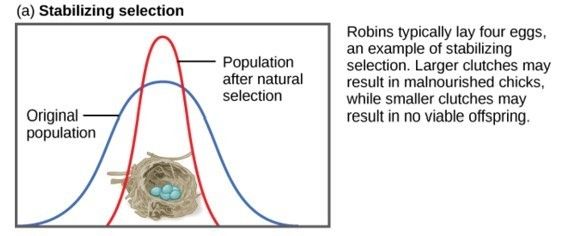
Stabilizing (towards the mean),
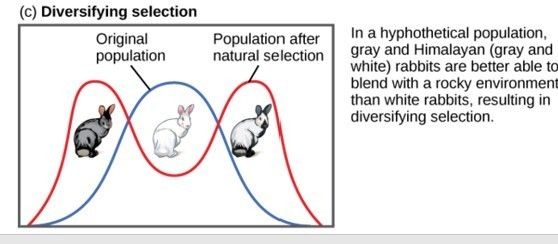
Disruptive (against the mean, for the extremes)
Sexual
Frequency-dependent
Individual, kin, group and species - 31stabilising selection
- 32directional selection
- 33diversifying selection
- 34Natural Vs Sexual selectionPeacock survival versus mating, guided by having to compete for female (if female chooses, small number?)
direct benefit,
sexy-son,
resistant to diseases (he is wearing something expensive to produce) - 35Frequency dependent selectionThis happens whenever the advantage of doing something depends on what else is present and on what other people on the population are doing.
The 50:50 sex ratio
Genetic diversity for immune genes
E.g. Gene conferring resistance for a disease, will spread in human population until it becomes common, than the disease causing agent will start evolving ways to overcome such resistance, once it does ..process starts again. - 36Individual, kin, group and species selectionGroup selection is implausible but not impossible.
Correlation between traits and reproductive success is often much weaker for groups than for individuals.
Variation in reproductive success among individuals is often greater than reproductive success among groups. The potential strength of individual selection is therefore normally much greater than the potential strength of group selection. - 37Individual, kin, group and species selectionThe amount of genetic variation in a trait that can be accounted for by differences among individuals is generally much greater than the amount that can be accounted for by differences among groups. The potential response to individual selection is therefore normally much larger than the potential response to group selection
Generation time between individuals is much shorter than between groups or species (1-10 millions years)
The number of incidence in variation between individuals is much greater than the number of incidence of selection on groups. - 38Some genetic variation does not always produce fitness variationNeutral variation derive from:
1. Synonymous substitutions
2. pseudogenes and other non-transcribed DNA
3. neutral amino acid variation (no changes in geometry or function of a problem)
4. Canalization, the limitation of phenotypic variation by developmental mechanisms (4 limbs, 5 fingers..) – these genes can accumulate variations. - 39Mechanisms of Neutral or Random EvolutionMolecular events:
Mutations (some mutations are not random, mutation rate can be increased, they occur at some sites more easily than in others, transitions are more common than transversion.)
Cellular events:
Mendelian lottery Meiosis is a fair coin.
Population effects
Funder effects – due to the allele frequency present in the funder (rare genetic diseases can be common in small population)
Bottleneck effect – population crashes to a very small size. - 40Maladaptive evolutionIf natural selection is strong in one place and organisms get really well adapted to it, but they move to another place, where they don't do well, this is maladaptation.
- 41Transition from non-life to lifeMultiplies- Self assembly
Possibly in different microenvironments, then come together?
Must contain genetic information
Shows variation in heredity
Metabolism (in terms of thermodynamics)
To make it we need:
-Lipids
-Aminoacids
-Purines/pyrimidines
-Sugars
-Phosphates to link things together - 42Eukaryotic cellBig changes: from circular chromosome attached to a wall to compartmentalised chromosome Needs an organizing centre: actin filaments (homologues with bacterial flagella).
Prokaryotes need to lose cell wall. In order to lose cell wall they need to build something to support their structure. - 43Eukaryotic cell AutogenousEukaryotes arose directly from a single prokaryote ancestor by compartmentalization of functions brought about by infoldings of the prokaryote plasma membrane
This model is usually accepted for the endoplasmic reticulum, golgi, and the nuclear membrane, and of organelles enclosed by a single membrane (such as lysosomes).
According to the autogenous hypothesis, mitochondria and chloroplasts have evolved within the protoeukaryote cell by compartmentalizing plasmids or vesicles of DNA within a pinched off invagination of the cell membrane.
Key contributors have been Klein and Cronquist (1967) and Cavalier-Smith (1975, 1978).
5. Organelles evolved gradually in steps. - 44BiochemistryThe basic similarity of all living things suggests that they evolved from a single common ancestor.
All living things pass on information from generation to generation using the DNA molecule.
All living things also use a molecule called ATP to carry energy around the organism. - 45Gene similarityIf evolution is true then we might also expect that closely related organisms will be more similar to one another than more distantly related organisms
- 46Comparative AnatomySimilar comparisons can be made based on anatomical evidence.
The skeleton of humans and gorillas are very similar suggesting they shared a recent common ancestor, but very different from the more distantly related woodlouse…
#
yet all have a common shared characteristic: bilateral symmetry - 47Vestigial StructuresAs evolution progresses, some structures get side-lined as they are not longer of use. These are known as vestigial structures.
The coccyx is a much reduced version of an ancestral tail, which was formerly adapted to aid balance and climbing.
Another vestigial structure in humans is the appendix. - 48Fossil RecordThe fossil record shows a sequence from simple bacteria to
more complicated organisms through time and provides the most compelling evidence for evolution. - 49Transitional fossilsMany fossils show a clear
transition from one species,
or group, to another.
Archaeopteryx was found
in Germany in 1861. It
share many characteristics
with both dinosaurs and
birds.
It provides good evidence
that birds arose from
dinosaur ancestors - 50GeographyGeographic spread of organisms also tells of their past evolution.
Marsupials occur in two populations today in the Americas and Australia.
This shows the group evolved before the continents drifted apart - 51Antibiotic resistanceWe are all familiar with
the way that certain
bacteria can become
resistant to antibiotics
This is an example of natural selection in
action. The antibiotic acts as an
environmental pressure. It weeds out
those bacteria with low resistance and
only those with high resistance survive
to reproduce.
Informações
- Descrição
- Biology UNI (term 1) FlashCards sobre evolution, criado por megan trent em 10-12-2019.
- Criado por
- megan trent
- Visualizações
- 0
- Avaliação