
Flashcards
WCC VCE PE Acute responses to exercise
Flashcards do conjunto (57)
- 1Acute responsesOccur for the duration of the activity and recovery and are dependent on the duration, intensity and type of activity being undertaken
- 2Cardiac OutputQ=SVxHR.
The total volume of blood pumped from the heart (LV) per minute (L/min)
@rest 5.2 @max 28.5 - 3Cardiac Output ResponseIncreases rapidly for the first 2-3 mins and then gradually depending on the intensity
- 4Cardiac Output Why it changesSo that more blood can be ejected out of the heart per minute and therefore more oxygen can be delivered to the working muscles,
- 5Diastolic blood pressurethe relaxation or filling phase of the heart
(Usually 80) - 6Diastolic blood pressure ResponseStays relatively stable during whole body exercise, increases during resistance training
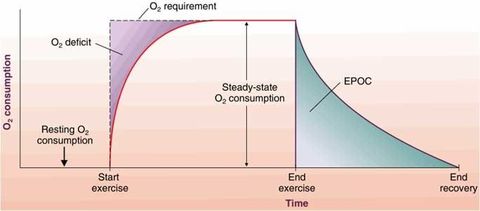
- 7Steady statethe condition of a system or physiological function that remains at a relatively constant (steady) value; after a few minutes of sub-maximal exercise, a person will reach a steady state in which heart rate and oxygen consumption remain constant for a given exercise intensity
- 8Stroke volumethe volume of blood expelled from the left ventricle with each heart beat
@rest 75ml @max 150ml - 9Stroke volume Response@Submax- Increases rapidly and then Steady State
@Max it will reach its maximum capacity and plateau - 10Stroke volume Why it changesSo that more blood can be ejected out of the heart (LV) per beat and therefore more oxygen can be delivered to the muscles
- 11Systolic blood pressurethe contraction or pumping phase of the heart creating higher pressures on artery walls
Usually 120 at rest - 12Systolic blood pressure ResponseIncreases during all exercises
- 13Systolic blood pressure Why it changesBecause more blood is being pumped out per beat/minute and therefore it causes an increase in pressure
- 14Tidal volumethe total volume of air moved in and out of the lungs during inspiration and expiration
- 15Tidal Volume Response@Submax- Increases rapidly and then Steady State @Max it will reach its maximum capacity and plateau
- 16Tidal Volume Why it changesMore air is breathed in resulting in a greater opportunity for O2 to be diffused into the capillaries via the alveoli
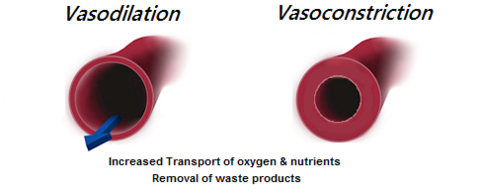
- 17Vasoconstrictionnarrowing (shrinking) of the blood vessels causing a decrease in blood flow
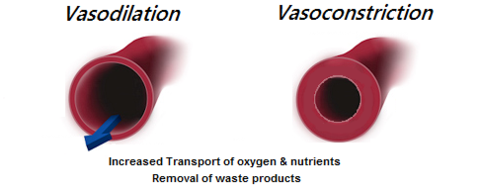
- 18Vasodilationwidening (swelling) of the blood vessels causing an increase in blood flow
- 19VentilationV=TVxRR.
The amount of air breathed in and out per minute. - 20Ventilation ResponseIncreases rapidly for the first 2-3 mins and then gradually depending on the intensity
- 21Ventilation Why it changesTo increase the volume of oxygen in the lungs that can be diffused into the blood and transported to the working muscles
- 22Venous returnThe amount of blood that is returned back to the heart via the veins.
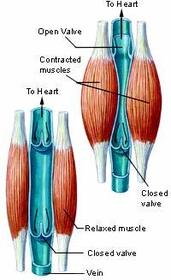
- 23Venous Return ResponseVenous return will increase due to the muscle pump. Increased through active recovery.
- 24Mechanisms of venous return: The muscle pumpMuscular contraction compress veins, pushing the blood through the veins back to the heart. One way valves prevent back flow of blood
- 25Venous return Why it changesVenous return takes place so that there can be an increase in cardiac output. Results in more blood being delivered back to the heart so more oxygenated blood can be pumped back out to the working muscles.
- 262 factors that regulate body temperature1) Sweat produced by sweat glands
2) increased blood flow to the skin - 27Pulmonary DiffusionThe movement of oxygen and carbon dioxide to an area of high concentration to an area of low concentration. Occurs in the alveoli of the lungs and the muscle capillaries
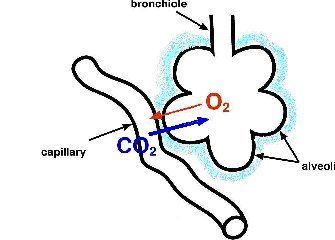
- 28Pulmonary Diffusion ResponseWill increase
- 29Pulmonary Diffusion Why it changesIn order to increase the transfer of oxygen into the blood stream and delivery to the working muscles to rely on the aerobic ES.
- 30Blood VolumeThe amount of volume of blood
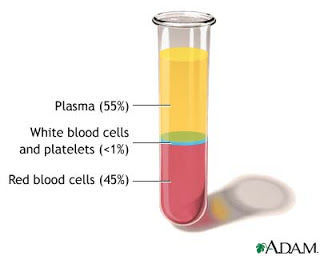
- 31Blood Volume ResponseWill decrease
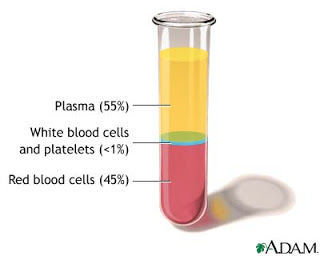
- 32Blood Volume Why it changesCaused by a decrease in plasma volume due to sweating. Depends on the intensity, duration and environmental factors
- 33Redistribution of blood flowThe redirection of blood away from areas where it is not needed (e.g. spleen, kidneys) to areas where it is (e.g. working muscles)
- 34Redistribution of blood flow ResponseTo increase the amount of oxygen being delivered to the organs that need it during exercise (e.g. working muscles)
Increasing blood flow to the skin assists in the regulation of body temperature through heat exchange with environment - 35Redistribution of blood flow Why it changesVasoconstriction occurs in arterioles restricting bloodflow/O2 to the inactive areas (digestive system), and vasodilation occurs in arterioles increasing blood flow / oxygen to the working muscles
- 36Oxygen Consumption (VO2)The volume of oxygen that can be taken up and used by the body
- 37Oxygen Consumption (VO2) ResponseIncreases
- 38Oxygen Consumption (VO2) Why it changesTo increase the amount of oxygen that is delivered and used by the working muscles. Caused by an increase in cardiac output and the amount of oxygen being extracted from the blood into the muscle
- 39a-v O2 DifferenceThe difference in oxygen concentration in the arterioles compared to the venules. Meaning how much O2 diffused into the muscles
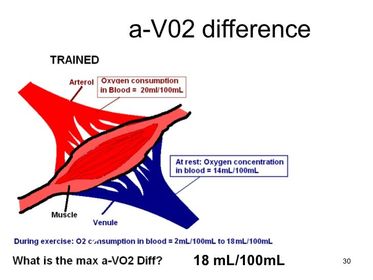
- 40a-v O2 Difference ResponseIncreases from around 25% @rest to close to 75% at maximal intensity
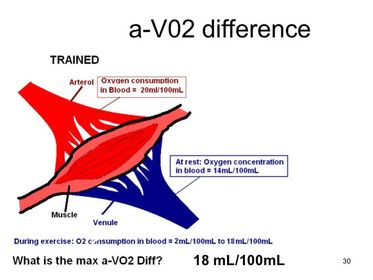
- 41a-v O2 Difference Why it changesIncreased O2 into the muscles results in more energy being produced (resynthesis of ATP) through the Aerobic energy system
- 42Motor UnitA motor neuron and the muscle fibers it stimulated
- 43Motor Unit recruitment ResponseIncreased number recruited / increase frequency of messages
- 44Motor Unit recruitment Why it changesAllows for increased force production, enabling more force to be developed in the activity.
More muscle fibres are recruited – the all-or-nothing principle. If a motor unit receives the impulse, all its fibres will contract - 45Energy SubstratesThe chemicals that are required to resynthesis ATP i.e. PC, glycogen, triglycerides
- 46Energy substrates ResponseDecrease at different rates depending on the duration and intensity of the activity
- 47Energy substrates Why it changesOnce ATP stores are depleted, PC, muscle glycogen and muscle triglycerides are all used to resynthesise ATP and so they get used up. Associated fuel depletion can be a fatiguing factor
- 48Body TemperatureA change in the internal temperature of the body
- 49Body Temperature ResponseIncreases until it is controlled by
• Sweat glands produce sweat
• Redistribution of blood to skin (via vasodilation) - 50Body Temperature Why it changesHeat is a by-product of using the Aerobic energy system. Mechanisms work to prevent an increase in core body temperature.
- 51LactateA by-product of anaerobic glycolysis
- 52Lactate ResponseIncreases at the start of exercise and then remains constant when production =removal. Increases past the lactate inflection point when intensity increases
- 53Lactate Why it changesIncreases due to an increase in intensity and therefore, increased contribution from the anaerobic glycolysis ES. Indicates an increase in H+
- 54Respiratory RateHow many breaths you take per minute
- 55Respiratory Rate ResponseWill increase
@rest 12 @max 30 - 56Heart RateHow many times the heart (Left Ventricle) beats per minute
- 57Heart Rate ResponseWill increase
@rest 70 @max 220-age
Informações
- Descrição
- These flashcards test your knowledge of Acute responses to exercise and include definitions, responses and why each occurs
- Criado por
- Tim Hodge
- Visualizações
- 4.332
- Tags
- Avaliação