
Flashcards
GCSE Psychology Edexcel Unit 1 - Cue Cards (Unfinished)
Flashcards do conjunto (149)
- 1Define PerceptionThe way the brain makes sense of the visual image detected by the eyes
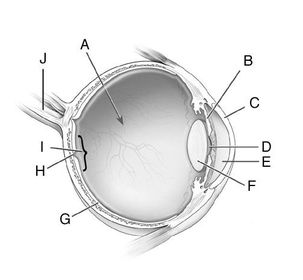
- 2RetinaThe light-sensitive layer at the back of the eye. It is made up of rods and cones.
- 3RodsLight-sensitive cells in the retina that respond even in dim light.
- 4ConesLight-sensitive cells in the retina that can detect colour.
- 5Optic nerveBundle of nerve cells that leads out from the retina at the back of the eye. It carries information from the rods and cones to the brain.
- 6Name the biological process of seeing and the psychological process of seeing.Vision - biological process
Perception - psychological process - 7Name the points of the: - Pupil - Retina - Optic NerveD - Pupil
G - Retina
J - Optic nerve - 8What travels along the optic nerve?Nerve impulses from the rods and cones
- 9BlindspotThe area of the retina where the optic nerve leaves. It has no rods or cones so cannot detect light.
- 10Optic ChiasmaThe cross-shape where some of the information from the left and right eye crosses over to pass into the opposite side of the brain.
- 11Visual CortexThe area at the back of the brain that interprets visual information.
- 12What is the job of the visual cortex?To interpret the information from the rods and cones.
- 13Depth CuesThe visual 'clues' that we use to understand depth or distance.
- 14Monocular depth cuesInformation about distance that comes from one eye, such as superimposition, relative size, texture gradient, linear perspective and height in the plane.
- 15Binocular depth cuesInformation about distance that needs two eyes, such as stereopsis.
- 16Size constancyWe perceive an object as the same size even when its distance from us changes.
- 17For size constancy, state the d-u-bs and ne-d-s- Distant things are scaled up to make them seem bigger than the image on the retina (d-u-b)
- Nearby things are scaled down to make them seem smaller than the image on the retina (ne-d-s) - 18Relative sizeSmaller objects are perceived as further away than larger ones.
- 19Texture gradientAn area with a detailed pattern is perceived to be nearer than one with less detail.
- 20Height in the planeObjects closer to the horizon are perceived to be more distant than ones below or above the horizon.
- 21SuperimpositionA partly hidden object must be further away than the object covering it.
- 22Linear perspectiveParallel lines appear to converge (meet) in the distance.
- 23StereopsisA binocular cue to depth. The greater the difference between the view seen by the left eye and the right eye, the closer the viewer is looking.
- 24Gestalt lawsPerceptual rules that organise stimuli
- 25In the figure-ground relationship, compared to the ground, the figure is...- More complex
-More symmetrical
- Smaller - 26We tend to group things that are similar, such as in:- Size
- Colour
- Shape - 27Figure-groundA small, complex, symmetrical object (the figure) is seen as separate from the background (the ground).
- 28SimilarityFigures sharing size, shape or colour are grouped together with other things that look the same.
- 29ProximityObjects which are close together are perceived to be related.
- 30ContinuityStraight lines, curves and shapes are perceived to carry on being the same.
- 31ClosureLines or shapes are perceived as complete figures even if parts are missing.
- 32What are the three types of illusion?- Fictions
- Ambiguous figures
- Distortions - 33Visual illusionA conflict between reality and what we perceive.
- 34FictionAn illusion caused when a figure is perceived even though it is not present in the stimulus.
- 35Illusory ContourA boundary (edge) that is perceived in a figure but is not present in the stimulus.
- 36Motion after-effectAn illusion caused by paying attention to movement in one direction and then perceiving movement in the opposite direction immediately afterwards.
- 37Colour after-effectAn illusion caused by focusing on a coloured stimulus and perceiving opposite colours immediately afterwards.
- 38Leeper (1935)Showed participants a picture of a young or old face, then the 'Leeper's lady' illusion. The picture they had already seen affected their perception of the illusion. Participants who had seen an old face identified the old woman first. Those who had seen a young face interpreted the young woman first.
- 39Ambiguous figureA stimulus with two possible interpretations, in which it is possible to perceive only one of the alternatives at any time.
- 40Distortion illusionWhere our perception is deceived by some aspect of the stimulus. This can affect the shape or size of an object.
- 41Name four distortion illusions- Ponzo illusion
- Muller-Lyer illusion
-Hering illusion
-Ebbinghaus illusion - 42Name the 5 Gestalt laws- Figure-ground
- Similarity
- Proximity
- Continuity
- Closure - 43Name the 5 monocular depth cues- Relative size
- Texture gradient
- Height in the plane
- Superimposition
- Linear perspective - 44State the name and type of the illusionEbbinghaus illusion
Distortion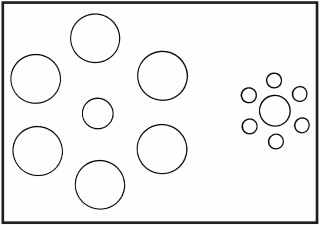
- 45State the name and type of the illusionRubin's vase
Ambiguous figure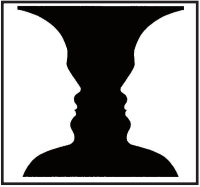
- 46State the name and type of the illusion.Leeper's lady
Ambiguous figure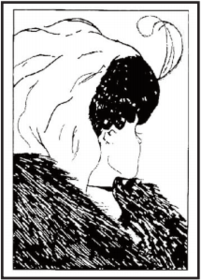
- 47State the name and type of the illusion.The Kanizsa triangle
Fiction illusion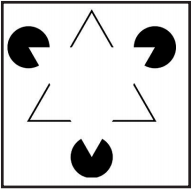
- 48State the name and type of the illusion.Necker cube
Ambiguous figure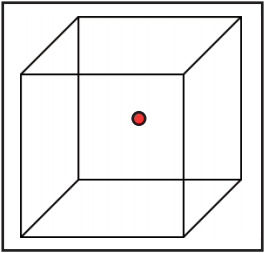
- 49State the name and type of the illusion.Hering illusion
Distortion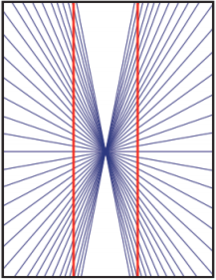
- 50State the name and type of the illusion.Ponzo illusion
Distortion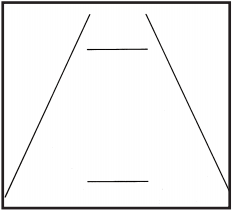
- 51SchemaA framework of knowledge about an object, event or group of people that can affect our perception and help us to organise information and recall what we have seen.
- 52Perceptual setThe tendency to notice some things more than others. This can be caused by experience, context or expectations.
- 53Independent variableThe factor that is changed by the researcher during an experiment to make two or more conditions.
- 54Dependent variableThe factor which is measured in an experiment.
- 55Palmer (1975) AimTo find out whether context would affect perception.
- 56Bartlett (1932) AimTo investigate how information changes with each reproduction and to find out why the information changes.
- 57Carmichael et al (1932) AimTo find out whether words shown with pictures would affect the way the pictures were remembered.
- 58What was the year of Bartlett?1932
- 59What was the year of Carmichael et al?1932
- 60What was the year of Palmer?1975
- 61Serial reproductionA task where a piece of information is passed from one participant to the next in a chain or 'series'. Differences between each version are measured.
- 62Repeated reproductionA task where the participant is given a story or a picture to remember. They then recall it several times after time delays. Differences between each version are measured.
- 63Palmer (1975) ConclusionExpectations affect perception. People have a perceptual set based on context which affects how accurately they recognise objects.
- 64Bartlett (1932) ConclusionUnfamiliar material changes when it is recalled. It becomes shorter, simpler and more stereotyped. This may be due to the effect of schema on memory.
- 65Carmichael et al (1932) ConclusionMemory for pictures is reconstructed. The verbal context in which drawings are learned affects recall because the memory of the word alters the way the picture is represented.
- 66Reconstructive memoryRecalled material is not just a 'copy' of what we see or hear. Information is stored and when it is remembered it is 'rebuilt', so can be affected by extra information and by ideas (like schemas) we might already have.
- 67ExperimentA research method which measures participants' performance in two or more conditions.
- 68Experimental (participant) designThe way that the participants are used in different conditions in an experiment. They may all do all conditions or different participants may do each condition.
- 69Independent groups designDifferent participants are used in each condition in an experiment.
- 70Repeated measures designThe same participants are used in all the conditions of an experiment.
- 71HypothesisA testable statement of the difference between the conditions in an experiment. It describes how the independent variable will affect the dependent variable.
- 72ControlsWays to keep variables constant in all conditions of an experiment.
- 73ModeAn average that is the most common score or response in a set.
- 74Descriptive statisticsWays to summarise results from a study. They can show a typical or average score or how spread out the results are.
- 75Bar chartA graph with separate bars. Usually there is one bar for each condition in an experiment.
- 76MedianAn average that is the middle number in a set of scores when they are put in order from smallest to largest.
- 77MeanAn average that is calculated by adding up all the scores in a set and dividing the number by the number of scores.
- 78RangeA way to show how spread out a set of results is by looking at the biggest and smallest scores.
- 79Ethical issuesPotential psychological or physical risks for people in experiments.
- 80Informed consentAn individual's right to know what will happen in an experiment, and its aims, before agreeing to participate.
- 81Right to withdrawA participant's right to leave a study at any time and their ability to do so.
- 82Ethical guidelinesAdvice to help psychologists solve ethical issues.
- 83EyewitnessSomebody who sees a crime or aspects of a crime scene and who helps the police to find out what has happened or to catch whoever was responsible.
- 84Allport & Postman (1945)Used a picture of two men talking in an underground station in a serial reproduction task. A black man wearing a suit was talking to a white man in overalls, who was holding a razor in one hand and is pointing with the other.
In more than half of the reproductions the black man was falsely recalled with the razor and in some he was reported to be 'threatening' the white man with it. These errors could happen if the participants had a schema that linked black people to crime. If this distortion applied to eyewitnesses, it would make them unreliable. - 85Boon & Davis (1987)They showed participants slides of a violent knife attack by a white man on the London Underground. Some participants then saw two white men fighting, others saw a fight between a black and a white man.
When asked to recognise the scene, many participants wrongly chose the image with the black man holding the knife. But they did not make the mistake when asked to describe the situation instead. This shows that some memory tasks are more likely to be affected by schema. For example, when an eyewitness makes a statement they are recalling information and should be quite accurate. But when asked to identify a person in a line-up (a recognition task) they may be less accurate. - 86Tuckey and Brewer (2003)Found out what people thought was typical of bank robberies. They used this to identify what was in a 'bank robbery schema'. They showed participants a video of a bank robbery that contained three kinds of facts. Ones that:
- Fitted the schema; e.g. male robbers, carry bags, escape in a car
- Were in the opposite of the schema; e.g. the robbers didn't carry guns
- Were irrelevant to the schema; e.g. wearing hats, what the getaway car was like.
Participants were asked about what they could recall immediately and then again several times over 12 weeks. Tuckey and Brewer found that they remembered the facts that fitted the schema, or were the opposite, very well. They only forgot things that were irrelevant to the schema. This suggests that eyewitness memory might benefit from schemas. - 87In terms of Freud's (1900) dream theory, what is repression?Repression means something being pushed into the unconscious by the conscious mind, though this is not deliberately done, which means someone would not know what 'dark secrets' they were repressing.
- 88After learning hypnotism, why did Freud come to reject it?He rejected hypnotism because the person could not remember the sessions, which he thought was important.
- 89Manifest contentWhat the dream is said to be about by the dreamer - the story the dreamer tells.
- 90Latent contentThe meaning underlying the dream. If the symbols from the manifest content are translated by an analyst, they can reveal unconscious thoughts.
- 91CondensationWhen many thoughts and elements from the unconscious are represented in the dream in one symbol.
- 92DisplacementWhen something that seems to be unimportant in the dream in made central, to shift attention from what is really important.
- 93Secondary elaborationHow the dreamer builds a story when telling what the dream is about, adding to and changing things, which makes analysis hard.
- 94What is the name of Freud's therapy?Psychoanalysis
- 95What kind of patients did Freud treat?Middle-class patients in the wealthy part of Vienna.
- 96What is the aim of psychoanalysis?To reveal unconscious wishes, desires and emotions to the patient, who, once knowing about the content of the unconscious, will no longer have psychological problems. As the desires are no longer hidden, they can be dealt with.
- 97What are the three unique research methods that are involved in psychoanalysis?- Slips of the tongue
- Free association
- Dream analysis - 98PsychoanalysisFreud's therapy, designed to help release unconscious thoughts.
- 99Free associationA method used by Freud in psychoanalysis where the patient is encouraged to express a flow of unconsciousness. The process helps to uncover links which can then be interpreted.
- 100Slips of the tongueWhen someone uses the wrong word for something. Freud analysed these slips to help uncover unconscious thoughts.
- 101Dream analysisA method used by Freud to help uncover unconscious thoughts, by analysing dreams and uncovering symbols.
- 102Qualitative dataData involving stories or attitudes
- 103ValidRefers to findings of studies and means that they are about real-life situations, real-life behaviour or feelings that are real.
- 104GeneralisableRefers to findings of studies and whether they can be said to be true of people other than those that were studied.
- 105SubjectiveWhere the researcher is somehow affecting the information that is gathered, perhaps by their interpretation.
- 106ObjectiveWhere the researcher's views do not affect the information that is gathered.
- 107What makes up the central nervous system (CNS)?The brain and the spinal column.
- 108What are the two types of neuron?Sensory neurons - receive messages from the senses (e.g. touch, light and sound)
Motor neurons - about muscle movement - 109What does the central nervous system (CNS) do?Processes information from the senses and sends responses for the relevant parts of the body to act upon.
- 110What are the four important features of a neuron?- Cell body
- Axon
- Terminal buttons
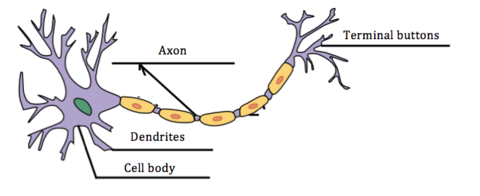
- Dendrites - 111Label the four important features (cell body, terminal buttons, axon & dendrites) on this neuron.A - Terminal buttons
B - Axon
C - Dendrites
D - Cell body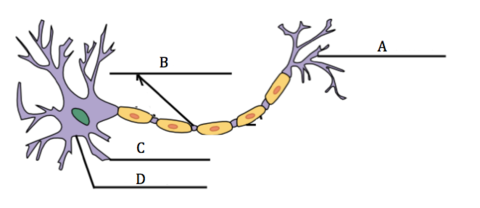
- 112How are brain messages sent using neurons?Messages in the brain are sent using electrical impulses and chemicals that are called neurotransmitters. Step 1 - Electrical impulse triggered from cell of one neuron then travels down the axon. (Impulse= action potential) Step 2 - When the impulse gets to the end of the axon it releases a chemical - the neurotransmitter - found in the terminal buttons at end of axon. Step 3 - Neurotransmitter has to cross synaptic gap to get to the dendrites of the next neuron to continue the message. Step 4 - The neurotransmitter, released by the impulse, goes to the gap - where it could be taken up by the dendrites or could be lost.
Step 5 - If the receptors at the dendrites of the next neuron are 'suitable' to receive the neurotransmitter that is in the gap, then the chemical gets picked up.
Step 6 - The neurotransmitter sets off an electrical signal and then drops it back into the synaptic gap where it can be taken back to be used again. Step 7 - The change in chemical balance (from the receptors) triggers an electrical impulse from the cell body which then travels down to end of axon.(Bk to1 - 113NeuronA cell in the body, including in the brain, that sends information using both electrical and chemical processes.
- 114AxonThe 'cable' that leads from a cell body of a neuron down to the terminal buttons that hold the neurotransmitter.
- 115ImpulseThe electrical signal that travels from the cell body of a neuron to the terminal buttons, where it releases a neurotransmitter.
- 116NeurotransmitterA chemical at the terminal button of a neuron, which is released by the impulse and then goes into the synaptic gap.
- 117Synaptic gapThe gap between the dendrites of one neuron and the next.
- 118Synaptic transmissionWhat happens when a neurotransmitter released by an impulse of one neuron goes across the synaptic gap and is taken up at the dendrites of another neuron.
- 119Who is responsible for the activation-synthesis theory of dreaming and what does the theory claim about dreaming?Hobson and McCarley (1977)
It says that dreams are random messages in the brain being interpreted to make a story. Messages are activated randomly, and then synthesised (put together) into a story.
They said that there is a dream state generator in the brain and this part of the brain that gives the dream state is switched on during REM sleep. - 120What is used to measure brain activity during REM sleep?An EEG (electroencephalograph)
- 121What happens during REM sleep?Sensory blockade - any incoming information from the senses (sight, sound, touch, taste and smell) is blocked.
Movement inhibition - physical movements are blocked and the body is paralysed.
Random activation - the neurons in the brain are activated because there are random impulses that 'give' information as if it were from the senses. - 122Activation-synthesis modelA model of dreaming proposed by Hobson and McCarley where the brain is active but no sensory information is coming into it. The brain puts the information it has together to make sense of it and this is the dream.
- 123Random activationDuring REM sleep, when neurons are active randomly not deliberately.
- 124Sensory blockadeDuring REM sleep, when no information enters through the senses (sight, sound, touch, taste and smell).
- 125Movement inhibitionThe state, during REM sleep, when the body is paralysed and there is no movement.
- 126REM sleepA stage of sleep that occurs about five times each night, where there is rapid eye movement (REM) which indicates that dreaming is taking place.
- 127SynthesisThe brain tries to make sense of the random activation of neurons - and this 'sense' is the dream.
- 128AimA statement of what the study is being carried out to find.
- 129Case studyA research method studying an individual or a small group and gathering in-depth and detailed information using different means.
- 130Qualitative dataData involving stories or attitudes
- 131Quantitative dataData that involves numbers and statistics, such as percentages.
- 132GeneralisabilityRefers to findings of studies and how far they can be said to be true of people other than those that were studied.
- 133ReliabilityRefers to whether findings from a study would be found again if the study was repeated. A study is reliable if the findings are replicated.
- 134SubjectivityRefers to research methods, where the researcher is somehow affecting the results, perhaps by their interpretation.
- 135ObjectivityRefers to research methods, where there is no bias, for example the researcher's own views have not affected the findings.
- 136PrivacyAn ethical guideline for which studies that involve people as participants, which ensures that their names must not be recorded and they must not be identifiable.
- 137ConfidentialityAn ethical guideline for studies that involve people as participants, which ensures that information gained must not be shared with others without permission. There are some occasions when confidentiality must be broken, however, if there are issues of safety for someone else.
- 138PhallicTerm used to refer to anything that is related or said to represent the male penis, or the term can refer to the penis.
- 139Oedipus complexThe idea that a boy from about the age of four years old will have unconscious feelings for his mother and want his father out of the way, though then fears his father and feels guilty too.
- 140False memoryAny memory that is not true and can be given by someone else 'remembering' an event and telling another person who then 'remembers' it as true.
Freud's definition refers more to false recovered memory, where a childhood memory (e.g of abuse) is suggested by the analyst and accepted, then later found not to be true. - 141What are the four categories of sleep disorders?- Insomnia
- Hypersomnia
- Circadian rhythm disorders
- Parasomnias - 142InsomniaThe most common sleep disorder. It means someone cannot go to sleep or cannot stay asleep.
- 143HypersomniaThis means people feel very sleepy at all times of the day.
- 144Circadian rhythm disordersCauses problems with the body clock.
- 145ParasomniasThese are disorders that occur when someone is asleep, such as nightmares, sleep-walking and sleep terrors.
- 146What are treatments of psychological sleep disorders?- Medication
- Cognitive behavioural therapy (CBT)
- Acupuncture
- Hypnotherapy - 147What are primary sleep disorders?Primary sleep disorders are not related to any other problems, but are problems in themselves.
E.g. problems going to sleep, problems staying asleep or problems with waking up. - 148What are secondary sleep disorders?Secondary sleep disorders stem from another problem, such as pain (keeping someone awake), jet lag or stress (affecting the person's sleeping patterns).
- 149NarcolepsyThis is a sleep disorder which means people can suddenly have attacks of sleep in the day. It is a brain disorder.
Informações
- Descrição
- Cue cards for the whole of unit 1 (topic A and B) psychology
- Criado por
- lilyquenya
- Visualizações
- 128
- Tags
- Avaliação