
Flashcards
Microbial Genetics
Flashcards do conjunto (26)
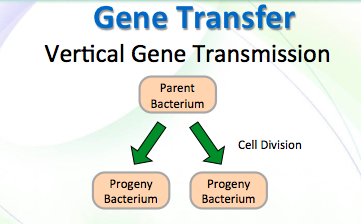
- 1Vertical Gene Transfer
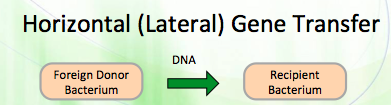
- 2Horizontal (Lateral) Gene Transfer
- 3Characteristic of the Bacterial Genome-Population is CLONAL b/c bacteria REPLICATE by CELL DIVISION
- 4How do bacteria introduce variety or diversity into their genome? (2 ways!)1.) Mutation (from existing genetic info.)
2.) Exogenous genetic info. (incorporating foreign DNA via horizontal (lateral) gene transfer)
*20-30% of total bacterial genome comes from exogenous genetic info. - 5Mechanisms for Acquiring Exogenous DNA (3 ways!)1. Transformation
2. Transduction
3. Conjugation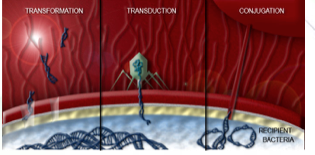
- 61. TRANSFORMATIONfree or "naked" DNA transferred
-DIRECT uptake of naked DNA
-NO donor bacterium required
-can happen two ways: with DNA fragments or with a PLASMID - 7Transformation with DNA Fragments: (Neisseria can do this naturally)With DNA fragments:
1. ds DNA binds to bacterial surface
2. nucleases degrade 1 strand
3. 1 DNA strand enters the cell
4. DNA integrates into chromosome by homologous recombination (or is degraded if unsuccessful)
*Homologous recombination: a type of genetic recombination in which nucleotide sequences are exchanged between two similar or identical molecules of DNA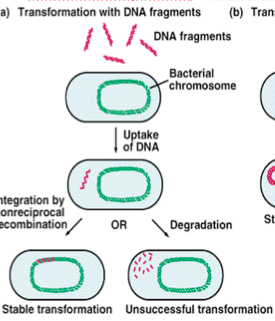
- 8Transformation with PLASMIDS:With Plasmid:
1. plasmid binds to bacterial surface
2. WHOLE plasmid is taken up by bacterium with ease
3. Stable transformation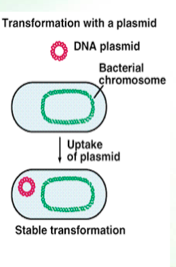
- 92. TRANSDUCTION-transfer of genetic information from donor to recipient by BACTERIOPHAGE
-DNA transferred via phage (can be lytic or lysogenic)
*Bacteriophage/phage = virus that infects bacteria - 10Bacteriophage or PhageCAPSID: head that surrounds and protects nucleic acid
SHEATH: hollow cylinder used to inject phage genomic material
TAIL FIBERS: used to attach to bacterial surface; determines SPECIFICITY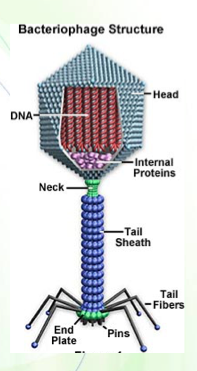
- 11BASIC steps of the Lytic Cycle of Phage1. Phage binds to bacterial
2. Injects viral nucleic acid (using the sheath)
3. Takes over host replication machinery for viral replication
4. Package/Assemble DNA into new phage heads
5. Lyse bacterial cell and release 100's of progeny (virions)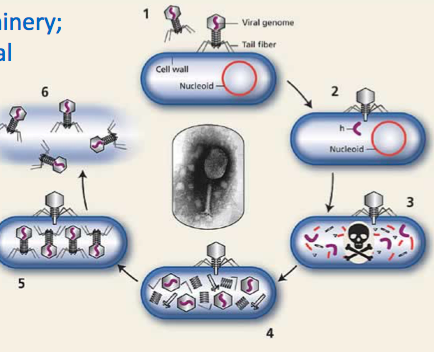
- 12GENERALIZED TRANSDUCTIONBACTERIAL DNA gets incorporated into phage head ACCIDENTALLY and is transferred to recipient bacterium (occasionally occurs)
-happens as a result of error during construction of phage particles - 13Lysogeny (an alternative to lyses/lytic)Phage incorporate their DNA into the bacterial chromosome
(becomes a prophage) - 14Plaque AssayLytic phage LYSE bacteria growing in a lawn and produce a clearing that is visible and countable on an agar plate
(creates plaques)
Pour-plate technique: mix phage and bacteria together, add to soft agar, and overlay onto an agar plate
-The SOFT agar (not as solid as
normal agar plate) allows released
phage progeny to migrate through
it to infect subsequent bacterial cells,
while the bacteria are prohibited
from moving (due to difference in
sizes between phage & bacteria)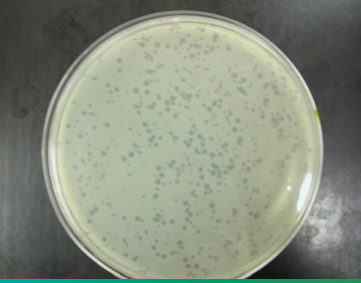
- 15Phage TherapyPrior to the advent of antibiotics, phage were used as antimicrobial agents
Since then, this practice has stopped everywhere except in the former Soviet Bloc
Today, with increasing antibiotic resistance among bacteria, the concept of “phage therapy” is being revisited
Although NOT approved for
HUMAN infections, phage therapy is
being employed in the U.S. for
FOOD safety
EX: (Intralytix; Listeria, EHEC &
Salmonella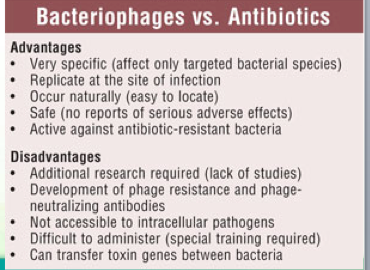
- 163. CONJUGATION"Bacterial SEX"
**requires DIRECT bacterium-to-bacterium contact
-differs in Gram + and Gram - bacteria
-mediated by conjugative PLASMID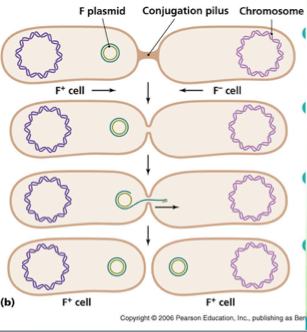
- 17Gram Positive (+) Bacterial ConjugationG+ form a MATING BRIDGE through SURFACE ADHESIONS
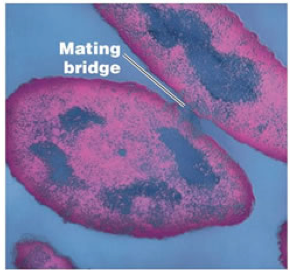
- 18Gram Negative (-) BacteriaG- have a sex (F) plus for INTIMATE contact
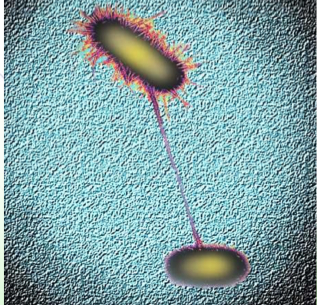
- 19CONJUGATION mediated by? example? HFr?Mediated by self-transmissible plasmid= CONJUGATIVE PLASMID,
Example: F PLASMID
F plasmid encodes for F pilus and genes
-needed for transfer of DNA
-Gaining the F plasmid = F+
If F plasmid incorporates into the chromosome = Hfr (high frequency recombinant),
which can then transfer even larger pieces of DNA to recipient - 20F+has the F gene (F plasmid that encodes for F plus and transfer genes)
can donate ONLY to F- - 21F-recipient for F+
-will become F+ after receiving the F plasmid from an F+ bacterium - 22Hfr (high frequency recombinant) Will the F- likely remain F- or become F+ after conjugation with an F+ HFr cell?It is more likely to remain F- because an incomplete F plasmid would be transferred.
(RARE for the whole plasmid to be transferred and for that cell to become a F+ HFr cell)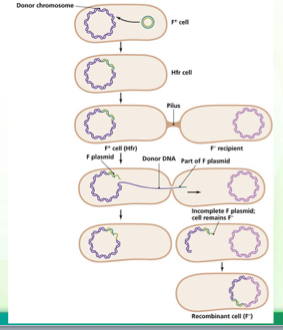
- 23GENOMIC ISLANDSLARGE, discrete DNA segments differing b/w closely related bacterial strains
(NON-CONSERVED)
Acquired via HORIZONTAL GENE TRANSFER
Recognizable by a SHIFT in GC-content
Harbor sequences involved in GENETIC MOBILITY (e.g. transposases, integrases etc.)
Often carry genes that offer a SELECTIVE ADVANTAGE, a benefit (e.g. antibiotic resistance, virulence-related genes etc.)
-Can have Pathogenicity islands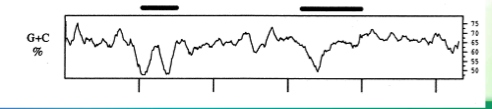
- 24Pathogenicity islandsgenomic islands that carry genes associated with causing disease (virulence associated genes)
MOST important: encodes for everything the bacterium needs to be PATHOGENIC
i.e., secretion systems, toxins, adhesins, invasins etc... - 25CONCLUSION*The NET effect of HORIZONTAL GENE TRANSFER (in addition to mutation & mobile elements) is the INCREASE in the genome's plasticity:
addition of EXOGENOUS DNA contributes to bacterial DIVERSIFICATION - 26SIGNIFICANCEBacterial genome= core genome (70-80%) + flexible gene pool
(20-30%)
Horizontal gene transfer leads to the introduction & stable inheritance of new genes
May acquire virulence factors, antibiotic-resistance genes etc.- make a “better” pathogen, alter niche, evade host response
Increase gene repertoire
Contributes to diversification & adaptation of bacteria
Provides genetic tools for modern day biotechnology & genetic engineering