
Mapa mental
Educational achievement- Ethnicity
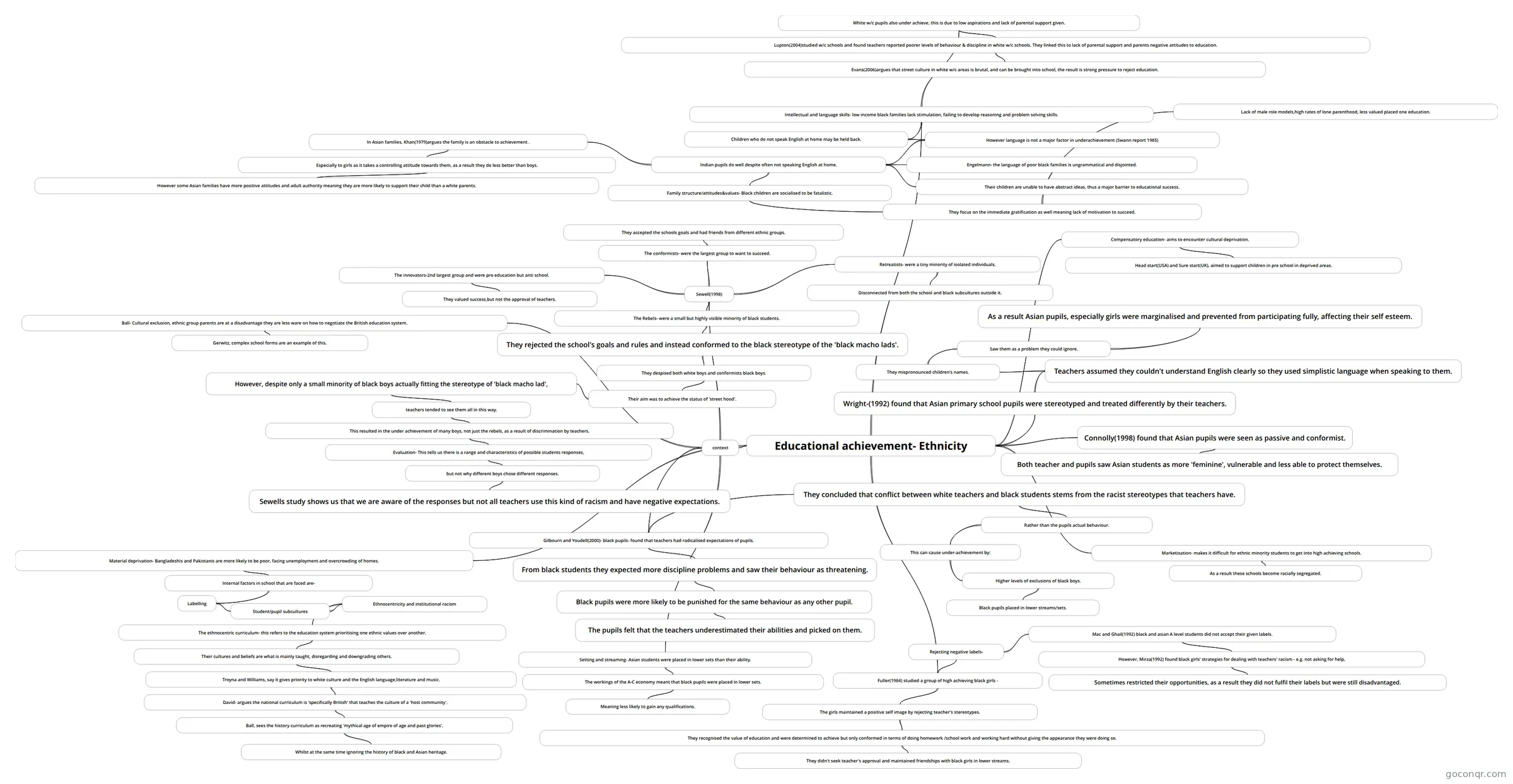
Mind map: Educational achievement and ethnicity
Conteúdo do mapa
Educational achievement- Ethnicity
context
- Sewell(1998)
- The conformists- were the largest group to want to succeed.
- They accepted the schools goals and had friends from different ethnic groups.
- The innovators-2nd largest group and were pro education but anti school.
- They valued success,but not the approval of teachers.
- Retreatists- were a tiny minority of isolated individuals.
- Disconnected from both the school and black subcultures outside it.
- The Rebels- were a small but highly visible minority of black students.
- They rejected the school's goals and rules and instead conformed to the black stereotype of the 'black macho lads'.
- They despised both white boys and conformists black boys.
- Their aim was to achieve the status of 'street hood'.
- However, despite only a small minority of black boys actually fitting the stereotype of 'black macho lad',
- teachers tended to see them all in this way.
- This resulted in the under achievement of many boys, not just the rebels, as a result of discrimination by teachers.
- Evaluation- This tells us there is a range and characteristics of possible students responses,
- but not why different boys chose different responses.
- Sewells study shows us that we are aware of the responses but not all teachers use this kind of racism and have negative expectations.
- but not why different boys chose different responses.
- Evaluation- This tells us there is a range and characteristics of possible students responses,
- This resulted in the under achievement of many boys, not just the rebels, as a result of discrimination by teachers.
- teachers tended to see them all in this way.
- However, despite only a small minority of black boys actually fitting the stereotype of 'black macho lad',
- Their aim was to achieve the status of 'street hood'.
- They despised both white boys and conformists black boys.
- They rejected the school's goals and rules and instead conformed to the black stereotype of the 'black macho lads'.
- The conformists- were the largest group to want to succeed.
- Gilbourn and Youdell(2000)- black pupils- found that teachers had radicalised expectations of pupils.
- From black students they expected more discipline problems and saw their behaviour as threatening.
- Black pupils were more likely to be punished for the same behaviour as any other pupil.
- The pupils felt that the teachers underestimated their abilities and picked on them.
- Black pupils were more likely to be punished for the same behaviour as any other pupil.
- They concluded that conflict between white teachers and black students stems from the racist stereotypes that teachers have.
- Rather than the pupils actual behaviour.
- This can cause under-achievement by:
- Higher levels of exclusions of black boys.
- Black pupils placed in lower streams/sets.
- Higher levels of exclusions of black boys.
- This can cause under-achievement by:
- Rather than the pupils actual behaviour.
- From black students they expected more discipline problems and saw their behaviour as threatening.
- Ball- Cultural exclusion, ethnic group parents are at a disadvantage they are less ware on how to negotiate the British education system.
- Gerwitz, complex school forms are an example of this.
- Setting and streaming- Asian students were placed in lower sets than their ability.
- The workings of the A-C economy meant that black pupils were placed in lower sets.
- Meaning less likely to gain any qualifications.
- The workings of the A-C economy meant that black pupils were placed in lower sets.
- Sewell(1998)
Wright-(1992) found that Asian primary school pupils were stereotyped and treated differently by their teachers.
- Teachers assumed they couldn't understand English clearly so they used simplistic language when speaking to them.
- They mispronounced children's names.
- Saw them as a problem they could ignore.
- As a result Asian pupils, especially girls were marginalised and prevented from participating fully, affecting their self esteem.
- Saw them as a problem they could ignore.
- They mispronounced children's names.
- Teachers assumed they couldn't understand English clearly so they used simplistic language when speaking to them.
Connolly(1998) found that Asian pupils were seen as passive and conformist.
- Both teacher and pupils saw Asian students as more 'feminine', vulnerable and less able to protect themselves.
Fuller(1984) studied a group of high achieving black girls -
- The girls maintained a positive self image by rejecting teacher's stereotypes.
- They recognised the value of education and were determined to achieve but only conformed in terms of doing homework /school work and working hard without giving the appearance they were doing so.
- They didn't seek teacher's approval and maintained friendships with black girls in lower streams.
- They recognised the value of education and were determined to achieve but only conformed in terms of doing homework /school work and working hard without giving the appearance they were doing so.
- Rejecting negative labels-
- Mac and Ghail(1992) black and asian A level students did not accept their given labels.
- However, Mirza(1992) found black girls' strategies for dealing with teachers' racism - e.g. not asking for help,
- Sometimes restricted their opportunities, as a result they did not fulfil their labels but were still disadvantaged.
- However, Mirza(1992) found black girls' strategies for dealing with teachers' racism - e.g. not asking for help,
- Mac and Ghail(1992) black and asian A level students did not accept their given labels.
- The girls maintained a positive self image by rejecting teacher's stereotypes.
Intellectual and language skills- low income black families lack stimulation, failing to develop reasoning and problem solving skills.
- Children who do not speak English at home may be held back.
- However language is not a major factor in underachievement (Swann report 1985)
- Indian pupils do well despite often not speaking English at home.
- Engelmann- the language of poor black families is ungrammatical and disjointed.
- Their children are unable to have abstract ideas, thus a major barrier to educational success.
- Family structure/attitudes&values- Black children are socialised to be fatalistic.
- They focus on the immediate gratification as well meaning lack of motivation to succeed.
- Lack of male role models,high rates of lone parenthood, less valued placed one education.
- They focus on the immediate gratification as well meaning lack of motivation to succeed.
- In Asian families, Khan(1979)argues the family is an obstacle to achievement .
- Especially to girls as it takes a controlling attitude towards them, as a result they do less better than boys.
- However some Asian families have more positive attitudes and adult authority meaning they are more likely to support their child than a white parents.
- Especially to girls as it takes a controlling attitude towards them, as a result they do less better than boys.
- Indian pupils do well despite often not speaking English at home.
- However language is not a major factor in underachievement (Swann report 1985)
- White w/c pupils also under achieve, this is due to low aspirations and lack of parental support given.
- Lupton(2004)studied w/c schools and found teachers reported poorer levels of behaviour & discipline in white w/c schools. They linked this to lack of parental support and parents negative attitudes to education.
- Evans(2006)argues that street culture in white w/c areas is brutal, and can be brought into school, the result is strong pressure to reject education.
- Lupton(2004)studied w/c schools and found teachers reported poorer levels of behaviour & discipline in white w/c schools. They linked this to lack of parental support and parents negative attitudes to education.
- Children who do not speak English at home may be held back.
Compensatory education- aims to encounter cultural deprivation.
- Head start(USA) and Sure start(UK), aimed to support children in pre school in deprived areas.
Material deprivation- Bangladeshis and Pakistanis are more likely to be poor, facing unemployment and overcrowding of homes.
- Internal factors in school that are faced are-
- Labelling
- Student/pupil subcultures
- Ethnocentricity and institutional racism
- The ethnocentric curriculum- this refers to the education system prioritising one ethnic values over another.
- Their cultures and beliefs are what is mainly taught, disregarding and downgrading others.
- Troyna and Williams, say it gives priority to white culture and the English language,literature and music.
- David- argues the national curriculum is 'specifically British' that teaches the culture of a 'host community'.
- Ball, sees the history curriculum as recreating 'mythical age of empire of age and past glories'.
- Whilst at the same time ignoring the history of black and Asian heritage.
- Ball, sees the history curriculum as recreating 'mythical age of empire of age and past glories'.
- David- argues the national curriculum is 'specifically British' that teaches the culture of a 'host community'.
- Troyna and Williams, say it gives priority to white culture and the English language,literature and music.
- Their cultures and beliefs are what is mainly taught, disregarding and downgrading others.
- The ethnocentric curriculum- this refers to the education system prioritising one ethnic values over another.
- Ethnocentricity and institutional racism
- Student/pupil subcultures
- Labelling
- Internal factors in school that are faced are-
Marketisation- makes it difficult for ethnic minority students to get into high achieving schools.
- As a result these schools become racially segregated.
Informações
- Descrição
- revision
- Criado por
- Tabby Neal
- Visualizações
- 9
- Avaliação
Mais sobre Ethnicity and Educational Achievement