
Mapa mental
Biology
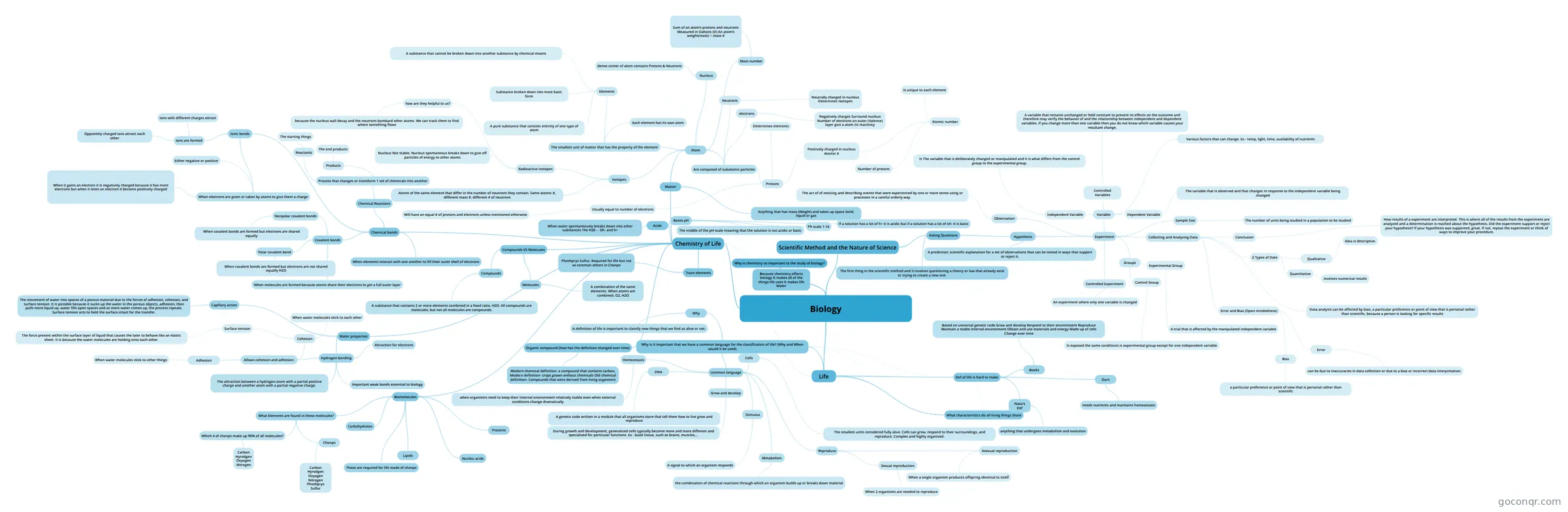
Mind map: Biology
Conteúdo do mapa
Biology
Life
- Def of life is hard to make
- Nasa's Def
- anything that undergoes metabolism and evolution
- Ours
- needs nutrients and maintains homeostasis
- Books
- Based on universal genetic code Grow and develop Respond to their environment Reproduce Maintain a stable internal environment Obtain and use materials and energy Made up of cells Change over time
- Nasa's Def
- What characteristics do all living things share
- Why is it important that we have a common language for the classification of life? (Why and When would it be used)
- common language
- DNA
- A genetic code written in a module that all organisms store that tell them how to live grow and reproduce
- Grow and develop
- During growth and development, generalized cells typically become more and more different and specialized for particular functions. Ex - build tissue, such as brains, muscles,...
- Stimulus
- A signal to which an organism responds
- Cells
- The smallest units considered fully alive. Cells can grow, respond to their surroundings, and reproduce. Complex and highly organized.
- Homeostasis
- when organisms need to keep their internal environment relatively stable even when external conditions change dramatically
- Reproduce
- Sexual reproduction
- When 2 organisms are needed to reproduce
- Asexual reproduction
- When a single organism produces offspring identical to itself
- Sexual reproduction
- Metabolism
- the combination of chemical reactions through which an organism builds up or breaks down material
- DNA
- Why
- A definition of life is important to classify new things that we find as alive or not.
- common language
- Def of life is hard to make
Chemistry of Life
- Matter
- Atom
- The smallest unit of matter that has the property of the element
- Elements
- Substance broken down into most basic form
- A substance that cannot be broken down into another substance by chemical means
- A pure substance that consists entirely of one type of atom
- Each element has its own atom
- Elements
- Are composed of subatomic particles
- Protons
- Positively charged in nucleus Atomic #
- Atomic number
- Number of protons
- Is unique to each element
- Atomic number
- Determines elements
- Usually equal to number of electrons
- Will have an equal # of protons and electrons unless mentioned otherwise
- Positively charged in nucleus Atomic #
- Neutrons
- Neutrally charged in nucleus Determines Isotopes
- electrons
- Negatively charges Surround nucleus Number of electrons on outer (Valence) layer give a atom its reactivity
- Protons
- Nucleus
- dense center of atom contains Protons & Neutrons
- Mass number
- Sum of an atom’s protons and neutrons Measured in Daltons (D) An atom’s weight(mass) = mass #
- Isotopes
- Atoms of the same element that differ in the number of neutrons they contain. Same atomic #, different mass #, different # of neutrons
- Radioactive isotopes
- Nucleus Not stable. Nucleus spontaneous breaks down to give off particles of energy to other atoms
- how are they helpful to us?
- because the nucleus wall decay and the neutrons bombard other atoms. We can track them to find where something flows
- The smallest unit of matter that has the property of the element
- Anything that has mass (Weight) and takes up space Solid, liquid or gas
- Atom
- Trace elements
- Phoshprys Sulfur, Required for life but not as common others in Chonps
- Compounds VS Molecules
- Molecules
- A combination of the same elements. When atoms are combined. O2, H2O
- Compounds
- A substance that contains 2 or more elements combined in a fixed ratio. H2O. All compounds are molecules, but not all molecules are compounds.
- Molecules
- Chemical bonds
- When elements interact with one another to fill their outer shell of electrons
- Covalent bonds
- When molecules are formed because atoms share their electrons to get a full outer layer
- Polar covalent bond
- When covalent bonds are formed but electrons are not shared equally H2O
- Nonpolar covalent bonds
- When covalent bonds are formed but electrons are shared equally
- Ionic bonds
- When electrons are given or taken by atoms to give them a charge
- Either negative or positive
- When it gains an electron it is negatively charged because it has more electrons but when it loses an electron it become positively charged
- Ions are formed
- Ions with different charges attract
- Oppositely charged ions attract each other
- When electrons are given or taken by atoms to give them a charge
- Chemical Reactions
- Process that changes or transform 1 set of chemicals into another
- Reactants
- The starting things
- Products
- The end products
- Reactants
- Process that changes or transform 1 set of chemicals into another
- Water properties
- Hydrogen bonding
- Important weak bonds essential to biology
- The attraction between a hydrogen atom with a partial positive charge and another atom with a partial negative charge.
- Allows cohesion and adhesion.
- Cohesion
- When water molecules stick to each other
- Surface tension
- The force present within the surface layer of liquid that causes the later to behave like an elastic sheet. It is because the water molecules are holding onto each other.
- Adhesion
- When water molecules stick to other things
- Cohesion
- Attraction for electrons
- Capillary action
- The movement of water into spaces of a porous material due to the forces of adhesion, cohesion, and surface tension. It is possible because it sucks up the water in the porous objects, adhesion, then pulls more liquid up, water fills open spaces and as more water comes up, the process repeats. Surface tension acts to hold the surface intact for the transfer.
- Hydrogen bonding
- Acids
- When water spontaneously breaks down into other substances The H20→ Oh- and h+
- Bases pH
- The middle of the pH scale meaning that the solution is not acidic or basic
- Ph scale 1-14
- If a solution has a lot of h+ it is acidic but if a solution has a lot of oh- it is basic
- Biomolecules
- These are required for life made of chonps
- Carbohydrates
- Lipids
- Nucleic acids
- Proteins
- What Elements are found in these molecules?
- Chonps
- Carbon Hyrodgen Oxyogen Nitrogen Phoshprys Sulfur
- Which 4 of chonps make up 96% of all molecules?
- Carbon Hyrodgen Oxyogen Nitrogen
- Chonps
- Organic compound (how has the definition changed over time)
- Modern chemical definition- a compound that contains carbon, Modern definition- crops grown without chemicals Old chemical definition- Compounds that were derived from living organisms
- Matter
Scientific Method and the Nature of Science
- Asking Questions
- Hypothesis
- Experiment
- Collecting and Analyzing Data
- Conclusion
- How results of a experiment are interpreted. This is where all of the results from the experiment are analyzed and a determination is reached about the hypothesis. Did the experiment support or reject your hypothesis? If your hypothesis was supported, great. If not, repeat the experiment or think of ways to improve your procedure.
- Error and Bias (Open mindedness)
- Bias
- a particular preference or point of view that is personal rather than scientific
- Error
- can be due to inaccuracies in data collection or due to a bias or incorrect data interpretation.
- Bias
- 2 Types of Date
- Qualitative
- data is descriptive.
- Quantitative
- involves numerical results
- Qualitative
- Data analysis can be affected by bias, a particular preference or point of view that is personal rather than scientific, because a person is looking for specific results
- Conclusion
- Controlled Experiment
- An experiment where only one variable is changed
- Variable
- Independent Variable
- Is The variable that is deliberately changed or manipulated and it is what differs from the control group to the experimental group.
- Dependent Variable
- The variable that is observed and that changes in response to the independent variable being changed
- Controlled Variables
- A variable that remains unchanged or held constant to prevent its effects on the outcome and therefore may verify the behavior of and the relationship between independent and dependent variables. If you change more than one variable then you do not know which variable causes your resultant change.
- Various factors that can change. Ex - temp, light, time, availability of nutrients
- Independent Variable
- Groups
- Control Group
- Is exposed the same conditions is experimental group except for one independent variable
- Experimental Group
- A trial that is affected by the manipulated independent variable
- Control Group
- Sample Size
- The number of units being studied in a population to be studied
- Observation
- The act of of noticing and describing events that were experienced by one or more sense using or processes in a careful orderly way.
- Collecting and Analyzing Data
- A prediction; scientific explanation for a set of observations that can be tested in ways that support or reject it.
- Experiment
- The first thing in the scientific method and it involves questioning a theory or law that already exist or trying to create a new one.
- Hypothesis
- Asking Questions
Why is chemistry so important to the study of biology?
- Because chemistry effects biology It makes all of the things life uses It makes life Water
Informações
- Descrição
- Mapa Mental sobre Biology, criado por Jake Lortz em 10-10-2017.
- Criado por
- Jake Lortz
- Visualizações
- 2
- Avaliação