
Mapa mental
Eric Birling
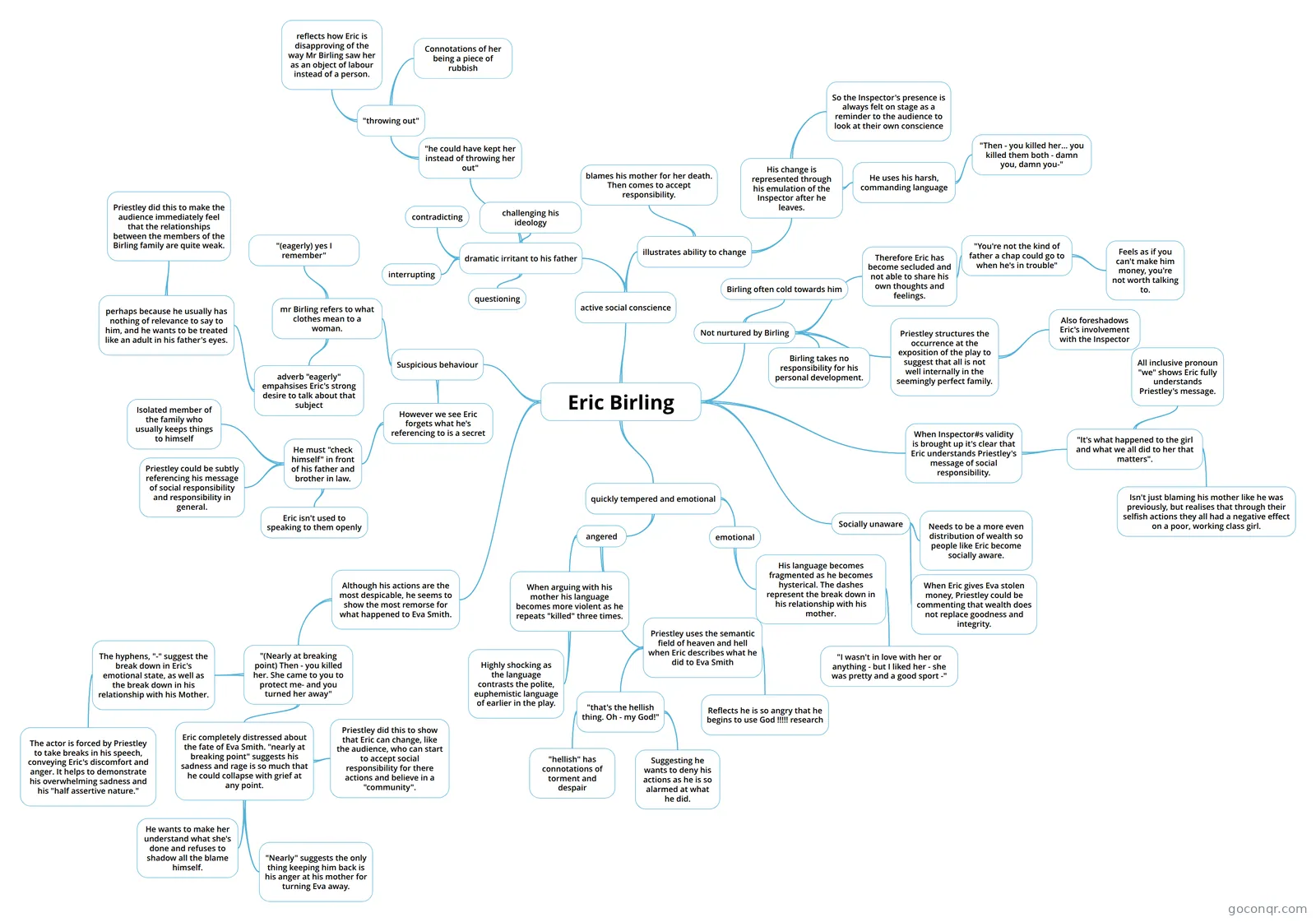
Mind map: Eric Birling An Inspector Calls
Conteúdo do mapa
Eric Birling
active social conscience
- dramatic irritant to his father
- challenging his ideology
- contradicting
- interrupting
- questioning
- "he could have kept her instead of throwing her out"
- "throwing out"
- Connotations of her being a piece of rubbish
- reflects how Eric is disapproving of the way Mr Birling saw her as an object of labour instead of a person.
- "throwing out"
- illustrates ability to change
- blames his mother for her death. Then comes to accept responsibility.
- His change is represented through his emulation of the Inspector after he leaves.
- He uses his harsh, commanding language
- "Then - you killed her... you killed them both - damn you, damn you-"
- So the Inspector's presence is always felt on stage as a reminder to the audience to look at their own conscience
- He uses his harsh, commanding language
- dramatic irritant to his father
quickly tempered and emotional
- emotional
- His language becomes fragmented as he becomes hysterical. The dashes represent the break down in his relationship with his mother.
- "I wasn't in love with her or anything - but I liked her - she was pretty and a good sport -"
- His language becomes fragmented as he becomes hysterical. The dashes represent the break down in his relationship with his mother.
- angered
- When arguing with his mother his language becomes more violent as he repeats "killed" three times.
- Highly shocking as the language contrasts the polite, euphemistic language of earlier in the play.
- Priestley uses the semantic field of heaven and hell when Eric describes what he did to Eva Smith
- "that's the hellish thing. Oh - my God!"
- "hellish" has connotations of torment and despair
- Suggesting he wants to deny his actions as he is so alarmed at what he did.
- Reflects he is so angry that he begins to use God !!!!! research
- "that's the hellish thing. Oh - my God!"
- When arguing with his mother his language becomes more violent as he repeats "killed" three times.
- emotional
Socially unaware
- When Eric gives Eva stolen money, Priestley could be commenting that wealth does not replace goodness and integrity.
- Needs to be a more even distribution of wealth so people like Eric become socially aware.
Suspicious behaviour
- mr Birling refers to what clothes mean to a woman.
- "(eagerly) yes I remember"
- adverb "eagerly" empahsises Eric's strong desire to talk about that subject
- perhaps because he usually has nothing of relevance to say to him, and he wants to be treated like an adult in his father's eyes.
- Priestley did this to make the audience immediately feel that the relationships between the members of the Birling family are quite weak.
- perhaps because he usually has nothing of relevance to say to him, and he wants to be treated like an adult in his father's eyes.
- However we see Eric forgets what he's referencing to is a secret
- He must "check himself" in front of his father and brother in law.
- Eric isn't used to speaking to them openly
- Isolated member of the family who usually keeps things to himself
- Priestley could be subtly referencing his message of social responsibility and responsibility in general.
- He must "check himself" in front of his father and brother in law.
- mr Birling refers to what clothes mean to a woman.
Not nurtured by Birling
- Birling often cold towards him
- Birling takes no responsibility for his personal development.
- Therefore Eric has become secluded and not able to share his own thoughts and feelings.
- "You're not the kind of father a chap could go to when he's in trouble"
- Feels as if you can't make him money, you're not worth talking to.
- "You're not the kind of father a chap could go to when he's in trouble"
- Priestley structures the occurrence at the exposition of the play to suggest that all is not well internally in the seemingly perfect family.
- Also foreshadows Eric's involvement with the Inspector
Although his actions are the most despicable, he seems to show the most remorse for what happened to Eva Smith.
- "(Nearly at breaking point) Then - you killed her. She came to you to protect me- and you turned her away"
- Eric completely distressed about the fate of Eva Smith. "nearly at breaking point" suggests his sadness and rage is so much that he could collapse with grief at any point.
- "Nearly" suggests the only thing keeping him back is his anger at his mother for turning Eva away.
- He wants to make her understand what she's done and refuses to shadow all the blame himself.
- Priestley did this to show that Eric can change, like the audience, who can start to accept social responsibility for there actions and believe in a "community".
- The hyphens, "-" suggest the break down in Eric's emotional state, as well as the break down in his relationship with his Mother.
- The actor is forced by Priestley to take breaks in his speech, conveying Eric's discomfort and anger. It helps to demonstrate his overwhelming sadness and his "half assertive nature."
- Eric completely distressed about the fate of Eva Smith. "nearly at breaking point" suggests his sadness and rage is so much that he could collapse with grief at any point.
- "(Nearly at breaking point) Then - you killed her. She came to you to protect me- and you turned her away"
When Inspector#s validity is brought up it's clear that Eric understands Priestley's message of social responsibility.
- "It's what happened to the girl and what we all did to her that matters".
- All inclusive pronoun "we" shows Eric fully understands Priestley's message.
- Isn't just blaming his mother like he was previously, but realises that through their selfish actions they all had a negative effect on a poor, working class girl.
- "It's what happened to the girl and what we all did to her that matters".
Informações
- Descrição
- GCSE English (Inspector) Mapa Mental sobre Eric Birling, criado por Jordan m em 16-02-2018.
- Criado por
- Jordan m
- Visualizações
- 15
- Avaliação