
Mapa mental
AP Psychology (8-10)
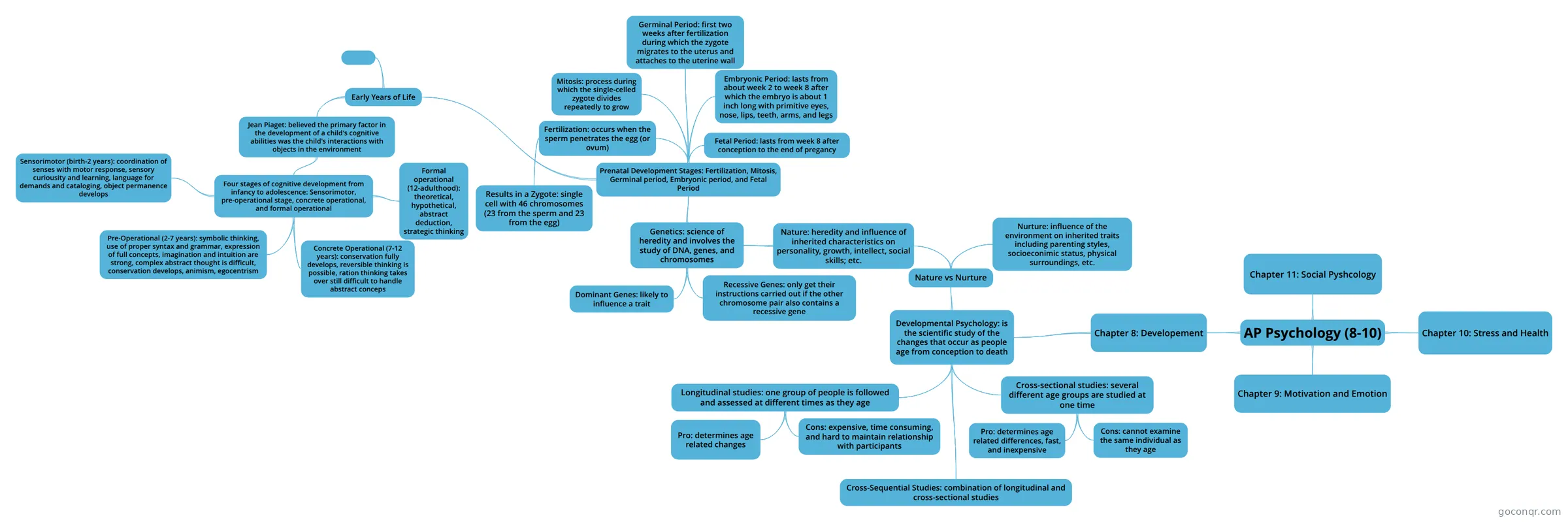
Mind map: AP Psychology chapters 8-10
Conteúdo do mapa
AP Psychology (8-10)
Chapter 9: Motivation and Emotion
Chapter 8: Developement
- Developmental Psychology: is the scientific study of the changes that occur as people age from conception to death
- Longitudinal studies: one group of people is followed and assessed at different times as they age
- Pro: determines age related changes
- Cons: expensive, time consuming, and hard to maintain relationship with participants
- Cross-Sequential Studies: combination of longitudinal and cross-sectional studies
- Cross-sectional studies: several different age groups are studied at one time
- Pro: determines age related differences, fast, and inexpensive
- Cons: cannot examine the same individual as they age
- Nature vs Nurture
- Scientists agree that development relies on 50% of both Nature and Nurture
- Nature: heredity and influence of inherited characteristics on personality, growth, intellect, social skills; etc.
- Genetics: science of heredity and involves the study of DNA, genes, and chromosomes
- Dominant Genes: likely to influence a trait
- Recessive Genes: only get their instructions carried out if the other chromosome pair also contains a recessive gene
- Prenatal Development Stages: Fertilization, Mitosis, Germinal period, Embryonic period, and Fetal Period
- Fertilization: occurs when the sperm penetrates the egg (or ovum)
- Results in a Zygote: single cell with 46 chromosomes (23 from the sperm and 23 from the egg)
- Germinal Period: first two weeks after fertilization during which the zygote migrates to the uterus and attaches to the uterine wall
- Placenta and Umbilical Cord develop; all differentiation and specialization begin
- Embryonic Period: lasts from about week 2 to week 8 after which the embryo is about 1 inch long with primitive eyes, nose, lips, teeth, arms, and legs
- Organs develop and Embryo is vulnerable
- Fetal Period: lasts from week 8 after conception to the end of pregancy
- Fetus grows and develops and organs function
- Mitosis: process during which the single-celled zygote divides repeatedly to grow
- Early Years of Life
- Brain triples in weight during the first two years of life, caused by the expansion of existing cells rather than the growth of new ones
- Jean Piaget: believed the primary factor in the development of a child's cognitive abilities was the child's interactions with objects in the environment
- Four stages of cognitive development from infancy to adolescence: Sensorimotor, pre-operational stage, concrete operational, and formal operational
- Sensorimotor (birth-2 years): coordination of senses with motor response, sensory curiousity and learning, language for demands and cataloging, object permanence develops
- Pre-Operational (2-7 years): symbolic thinking, use of proper syntax and grammar, expression of full concepts, imagination and intuition are strong, complex abstract thought is difficult, conservation develops, animism, egocentrism
- Concrete Operational (7-12 years): conservation fully develops, reversible thinking is possible, ration thinking takes over still difficult to handle abstract conceps
- Formal operational (12-adulthood): theoretical, hypothetical, abstract deduction, strategic thinking
- Four stages of cognitive development from infancy to adolescence: Sensorimotor, pre-operational stage, concrete operational, and formal operational
- Fertilization: occurs when the sperm penetrates the egg (or ovum)
- Genetics: science of heredity and involves the study of DNA, genes, and chromosomes
- Nurture: influence of the environment on inherited traits including parenting styles, socioeconimic status, physical surroundings, etc.
- Longitudinal studies: one group of people is followed and assessed at different times as they age
- Developmental Psychology: is the scientific study of the changes that occur as people age from conception to death
Chapter 10: Stress and Health
Chapter 11: Social Pyshcology
Informações
- Descrição
- 11th grade Psychology Mapa Mental sobre AP Psychology (8-10), criado por Andrea Crummy em 07-03-2018.
- Criado por
- Andrea Crummy
- Visualizações
- 22
- Tags
- Avaliação