
Mapa mental
Bio Chemistry
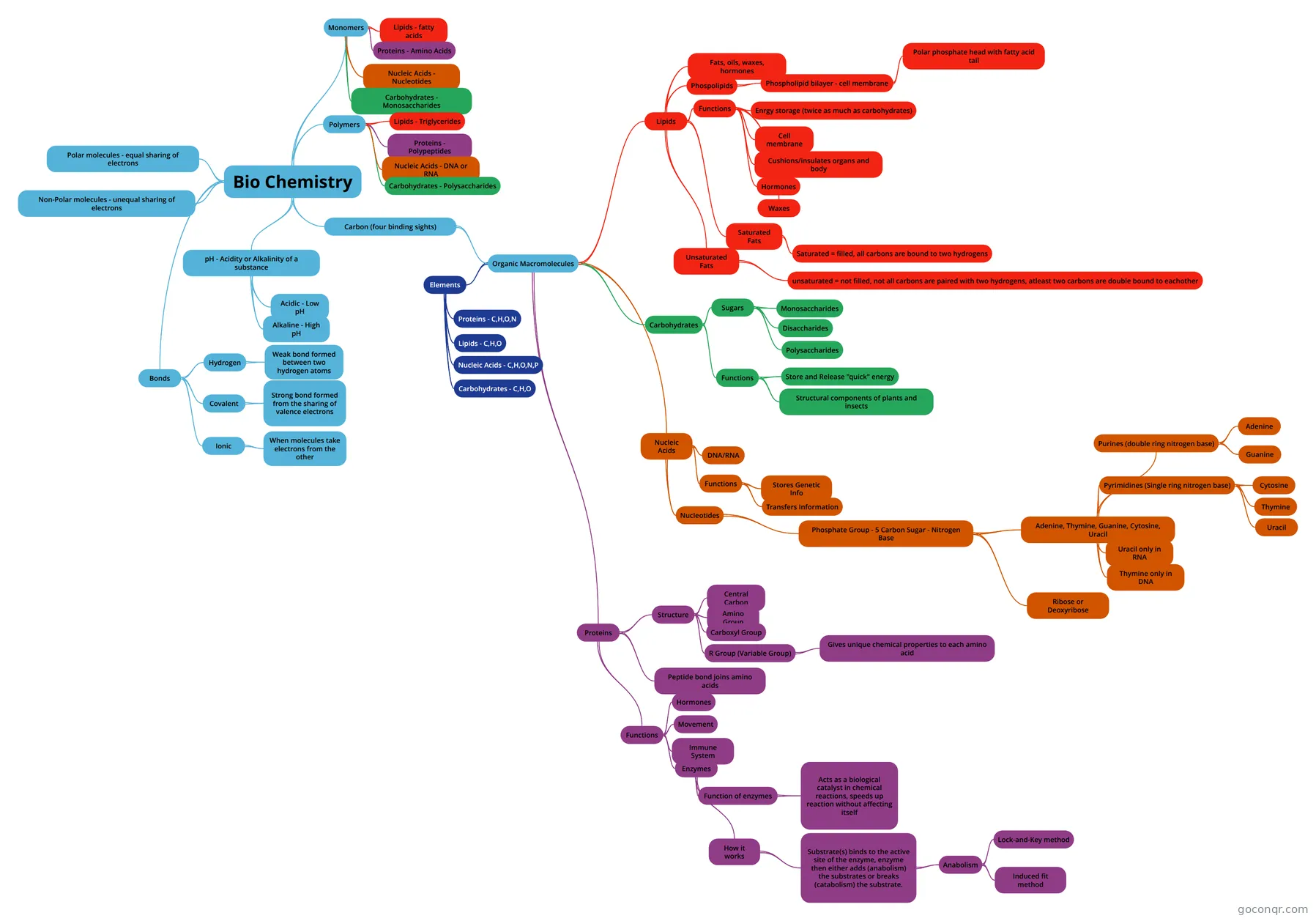
Mind map: biochemistry
Conteúdo do mapa
Bio Chemistry
Carbon (four binding sights)
- Organic Macromolecules
- Lipids
- Fats, oils, waxes, hormones
- Phospolipids
- Phospholipid bilayer - cell membrane
- Polar phosphate head with fatty acid tail
- Phospholipid bilayer - cell membrane
- Functions
- Enrgy storage (twice as much as carbohydrates)
- Cell membrane
- Cushions/insulates organs and body
- Hormones
- Waxes
- Saturated Fats
- Saturated = filled, all carbons are bound to two hydrogens
- Unsaturated Fats
- unsaturated = not filled, not all carbons are paired with two hydrogens, atleast two carbons are double bound to eachother
- Carbohydrates
- Sugars
- Monosaccharides
- Disaccharides
- Polysaccharides
- Functions
- Store and Release "quick" energy
- Structural components of plants and insects
- Sugars
- Nucleic Acids
- DNA/RNA
- Functions
- Stores Genetic Info
- Transfers Information
- Nucleotides
- Phosphate Group - 5 Carbon Sugar - Nitrogen Base
- Ribose or Deoxyribose
- Adenine, Thymine, Guanine, Cytosine, Uracil
- Thymine only in DNA
- Uracil only in RNA
- Purines (double ring nitrogen base)
- Adenine
- Guanine
- Pyrimidines (Single ring nitrogen base)
- Cytosine
- Thymine
- Uracil
- Phosphate Group - 5 Carbon Sugar - Nitrogen Base
- Proteins
- Functions
- Hormones
- Movement
- Immune System
- Enzymes
- Function of enzymes
- Acts as a biological catalyst in chemical reactions, speeds up reaction without affecting itself
- How it works
- Substrate(s) binds to the active site of the enzyme, enzyme then either adds (anabolism) the substrates or breaks (catabolism) the substrate.
- Anabolism
- Lock-and-Key method
- Induced fit method
- Anabolism
- Substrate(s) binds to the active site of the enzyme, enzyme then either adds (anabolism) the substrates or breaks (catabolism) the substrate.
- Function of enzymes
- Structure
- Central Carbon
- Amino Group
- Carboxyl Group
- R Group (Variable Group)
- Gives unique chemical properties to each amino acid
- Peptide bond joins amino acids
- Functions
- Elements
- Lipids - C,H,O
- Proteins - C,H,O,N
- Nucleic Acids - C,H,O,N,P
- Carbohydrates - C,H,O
- Lipids
- Organic Macromolecules
Monomers
- Lipids - fatty acids
- Proteins - Amino Acids
- Nucleic Acids - Nucleotides
- Carbohydrates - Monosaccharides
Polymers
- Lipids - Triglycerides
- Proteins - Polypeptides
- Nucleic Acids - DNA or RNA
- Carbohydrates - Polysaccharides
pH - Acidity or Alkalinity of a substance
- Acidic - Low pH
- Alkaline - High pH
Polar molecules - equal sharing of electrons
Non-Polar molecules - unequal sharing of electrons
Bonds
- Hydrogen
- Weak bond formed between two hydrogen atoms
- Covalent
- Strong bond formed from the sharing of valence electrons
- Ionic
- When molecules take electrons from the other
- Hydrogen