
Mapa mental
Week 7 Lecture Biology
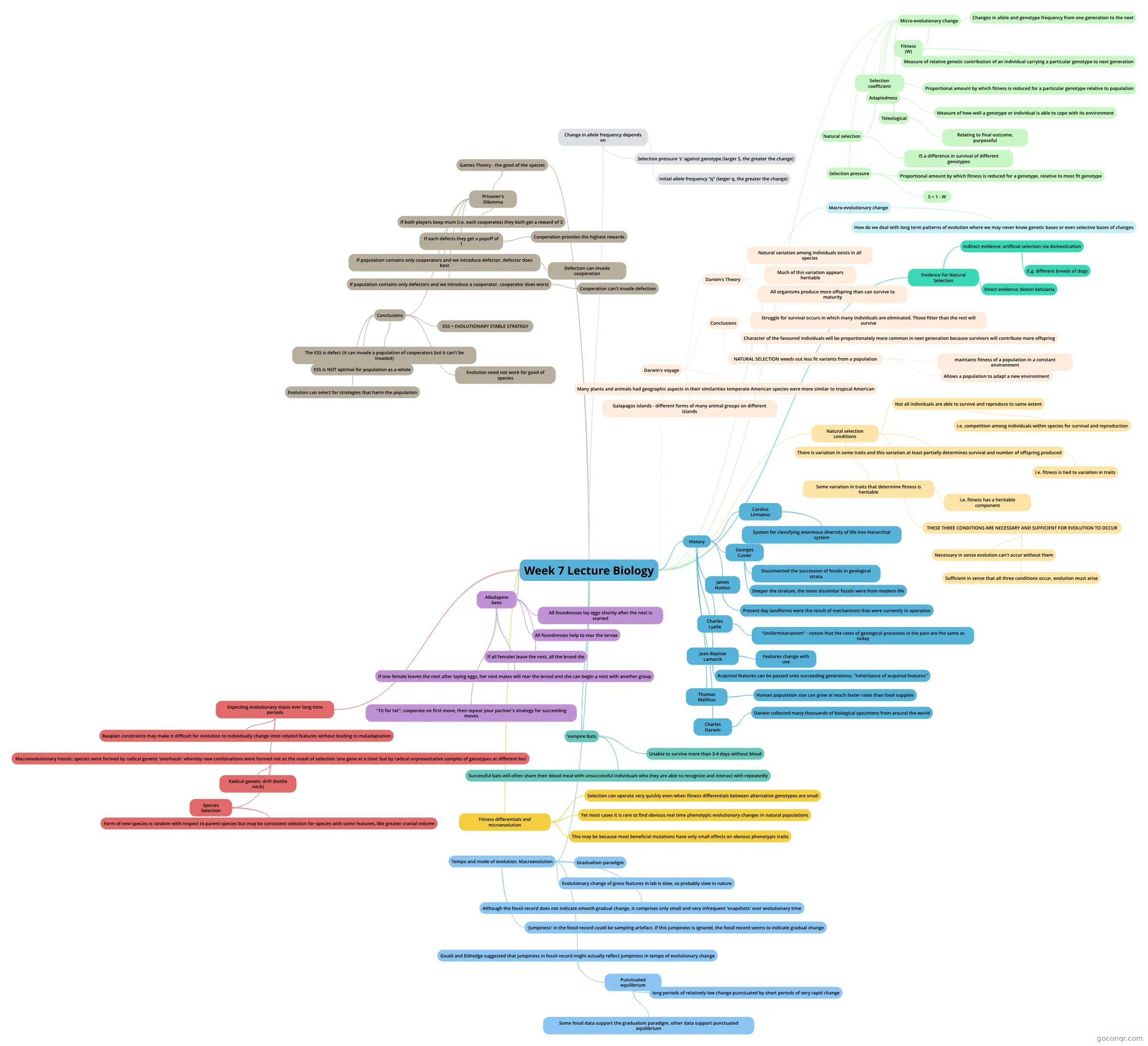
Mind map: Week 7 lecture biology evolution
Conteúdo do mapa
Week 7 Lecture Biology
History
- Carolus Linnaeus
- System for classifying enormous diversity of life into hierarchial system
- Georges Cuvier
- Documented the succession of fossils in geological strata
- Deeper the stratum, the more dissimilar fossils were from modern life
- James Hutton
- Present day landforms were the result of mechanisms that were currently in operation
- Charles Lyelle
- "Uniformitarianism" - notion that the rates of geological processes in the past are the same as today
- Jean Baptise Lamarck
- Features change with use
- Acquired features can be passed onto succeeding generations. "Inheritance of acquired features"
- Thomas Malthus
- Human population size can grow at much faster rates than food supplies
- Charles Darwin
- Darwin collected many thousands of biological specimens from around the world
- Carolus Linnaeus
Darwin's voyage
- Many plants and animals had geographic aspects in their similarities temperate American species were more similar to tropical American
- Galapagos islands - different forms of many animal groups on different islands
- Darwin's Theory
- Natural variation among individuals exists in all species
- Much of this variation appears heritable
- All organisms produce more offspring than can survive to maturity
- Conclusions
- Struggle for survival occurs in which many individuals are eliminated. Those fitter than the rest will survive
- Character of the favoured individuals will be proportionately more common in next generation because survivors will contribute more offspring
- NATURAL SELECTION weeds out less fit variants from a population
- maintains fitness of a population in a constant environment
- Allows a population to adapt a new environment
Natural selection conditions
- Not all individuals are able to survive and reproduce to same extent
- i.e. competition among individuals within species for survival and reproduction
- There is variation in some traits and this variation at least partially determines survival and number of offspring produced
- i.e. fitness is tied to variation in traits
- Some variation in traits that determine fitness is heritable
- i.e. fitness has a heritable component
- THESE THREE CONDITIONS ARE NECESSARY AND SUFFICIENT FOR EVOLUTION TO OCCUR
- Necessary in sense evolution can't occur without them
- Sufficient in sense that all three conditions occur, evolution must arise
- Not all individuals are able to survive and reproduce to same extent
Micro-evolutionary change
- Changes in allele and genotype frequency from one generation to the next
- Fitness (W)
- Measure of relative genetic contribution of an individual carrying a particular genotype to next generation
- Selection coefficient
- Proportional amount by which fitness is reduced for a particular genotype relative to population
- Adaptedness
- Measure of how well a genotype or individual is able to cope with its environment
- Teleological
- Relating to final outcome, purposeful
- Natural selection
- IS a difference in survival of different genotypes
- Selection pressure
- Proportional amount by which fitness is reduced for a genotype, relative to most fit genotype
- S = 1 - W
Macro-evolutionary change
- How do we deal with long term patterns of evolution where we may never know genetic bases or even selective bases of changes
Evidence for Natural Selection
- Indirect evidence: artificial selection via domestication
- E.g. different breeds of dogs
- Direct evidence: biston betularia
- Indirect evidence: artificial selection via domestication
Change in allele frequency depends on
- Selection pressure 's' against genotype (larger S, the greater the change)
- Initial allele frequency "q" (larger q, the greater the change)
Games Theory - the good of the species
- Prisoner's Dilemma
- If both players keep mum (i.e. each cooperates) they both get a reward of 3
- If each defects they get a payoff of 1
- Cooperation provides the highest rewards
- If population contains only cooperators and we introduce defector, defector does best
- Defection can invade cooperation
- If population contains only defectors and we introduce a cooperator, cooperator does worst
- Cooperation can't invade defection
- Conclusions
- ESS = EVOLUTIONARY STABLE STRATEGY
- The ESS is defect (it can invade a population of cooperators but it can't be invaded)
- ESS is NOT optimal for population as a whole
- Evolution can select for strategies that harm the population
- Evolution need not work for good of species
- Prisoner's Dilemma
Allodapine bees
- All foundresses lay eggs shortly after the nest is started
- All foundresses help to rear the larvae
- If all females leave the nest, all the brood die
- If one female leaves the nest after laying eggs, her nest mates will rear the brood and she can begin a nest with another group
- "Tit for tat": cooperate on first move, then repeat your partner's strategy for succeeding moves
Vampire Bats
- Unable to survive more than 3-4 days without blood
- Successful bats will often share their blood meal with unsuccessful individuals who they are able to recognize and interact with repeatedly
Fitness differentials and microevolution
- Selection can operate very quickly even when fitness differentials between alternative genotypes are small
- Yet most cases it is rare to find obvious real time phenotypic evolutionary changes in natural populations
- This may be because most beneficial mutations have only small effects on obvious phenotypic traits
Tempo and mode of evolution: Macroevolution
- Gradualism paradigm
- Evolutionary change of gross features in lab is slow, so probably slow in nature
- Although the fossil record does not indicate smooth gradual change, it comprises only small and very infrequent 'snapshots' over evolutionary time
- 'Jumpiness' in the fossil record could be sampling artefact. If this jumpiness is ignored, the fossil record seems to indicate gradual change
- Gould and Eldredge suggested that jumpiness in fossil record might actually reflect jumpiness in tempo of evolutionary change
- Punctuated equilibrium
- long periods of relatively low change punctuated by short periods of very rapid change
- Some fossil data support the gradualism paradigm, other data support punctuated equilibrium
- Punctuated equilibrium
Expecting evolutionary stasis over long time periods
- Bauplan constraints may make it difficult for evolution to individually change inter-related features without leading to maladaptation
- Macroevolutionary trends: species were formed by radical genetic 'overhauls' whereby new combinations were formed not as the result of selection 'one gene at a time' but by radical unpresentative samples of genotypes at different loci
- Radical genetic drift (bottle neck)
- Species Selection
- Form of new species is random with respect to parent species but may be consistent selection for species with some features, like greater cranial volume
Informações
- Descrição
- South Australian Certificate of Education (SACE) Biology Mapa Mental sobre Week 7 Lecture Biology, criado por Paras Chrysostomou em 10-09-2015.
- Criado por
- Paras Chrysostomou
- Visualizações
- 0
- Avaliação
Mais sobre History of Evolutionary Thought