
Mapa mental
Evolution
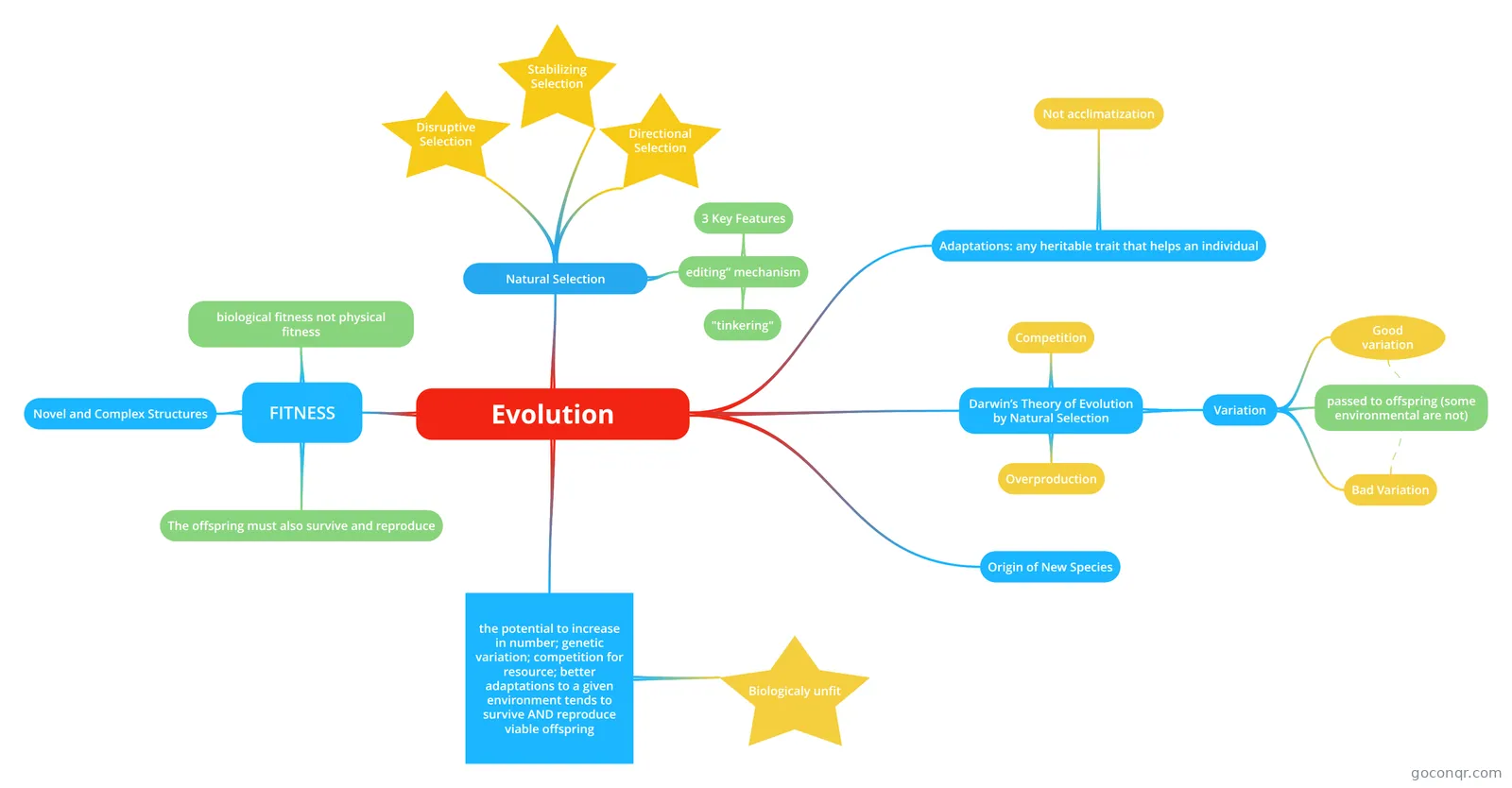
Mind map: Evolution
Conteúdo do mapa
Evolution
- the change in the genetic makeup (allele frequencies) of a population over time (over generations).
Natural Selection
- = the mechanism in which better-adapted individuals survive and reproduce more viable offspring (in other words they have greater fitness) natural selection can increase the “match” between a population and its environment
- Directional Selection
- occurs when one extreme of a phenotype is selected for
- Disruptive Selection
- = occurs when both extremes of a phenotype are selected for
- Stabilizing Selection
- Stabilizing Selection = occurs when the intermediate type is
- editing” mechanism
- NOT a “creating” mechanism. It can only work on existing variations, not create new ones. (Random mutations and sexual reproduction can create new variation)
- "tinkering"
- Evolution is like tinkering. New species come from the slight modification of existing ones.
- 3 Key Features
- Over time this “tinkering or editing” or evolution led to: 3 Key Features of the Natural World: organisms are suited for life in their environments the unity of life - organisms share many characteristics of life a rich diversity of life
the potential to increase in number; genetic variation; competition for resource; better adaptations to a given environment tends to survive AND reproduce viable offspring
- populations have the potential to increase in numbers genetic variation is the result of random mutations & sexual reproduction competition for resources impacts survival of individuals individuals with better adaptations to a given environment tend to survive AND reproduce viable offspring
- Biologicaly unfit
- if an individual does not produce offspring that reproduce they are not considered biologically unfit.
Darwin’s Theory of Evolution by Natural Selection
- Darwin observed that all populations produce more offspring than the environment can support and many offspring fail to survive and reproduce.
- Overproduction
- Variation
- Exists in All Populations - Darwin observed variation amongst individuals in a population individual’s phenotype and thus genotype varies some individuals are better suited to the environment at the time (due to their variation) and tend to survive and reproduce more offspring than others
- Bad Variation
- individuals with variations that are not as favorable tend to not reproduce or die thus not passing on their unfavorable characteristics to the next generation
- Good variation
- individuals with the best combination of variations will tend to outcompete others for the environment’s limited resources and thus tend to survive and reproduce
- passed to offspring (some environmental are not)
- these individuals tend to survive and reproduce thus adaptations accumulate in a population some phenotypic variation is not due to genes, but to environmental influences, eg. bodybuilders' muscles or tattoos cannot be passed onto offspring or some moth caterpillar’s different diets cause different phenotypes even though genotypes are the same.
- Competition
- for limited resources means not all survive. Natural selection favors the best-suited individuals at the time and is the mechanism that results in evolution. Natural selection acts on phenotypic variation.
Adaptations: any heritable trait that helps an individual
- thrive in its niche exploit needed resources survive reproduce Adaptations can be: structural (spines on cactus, camouflage, body shape, teeth shape) physiological (fat storage in camels, blood thinners in mosquitos, venom) behavioral (burrowing to avoid heat, being nocturnal, mating displays)
- Not acclimatization
- genetic adaptation with acclimatization. Acclimatization is when an individual adjusts its physiology to respond to a changing environment to maintain homeostasis
FITNESS
- a measure of reproductive success indicated by producing viable and fertile offspring (they also must survive and reproduce) if your offspring don’t survive to adulthood and don’t reproduce you are not as fit as another individual that had offspring that also had offspring
- The offspring must also survive and reproduce
- biological fitness not physical fitness
- DO NOT CONFUSE biological fitness with physical fitness or strength. Biological fitness refers to reproductive success, not strength or speed. Although these traits can contribute to biological fitness.
- Novel and Complex Structures
- evolve gradually from very simple structures at every stage of evolution, a structure benefits the organism by contributing to its survival and reproductive success (may not be the most complex, but it gets the job done at the time)
Origin of New Species
- affected by small-scale factors like mutation, gene flow, genetic drift, and natural selection AND large-scale factors like continental drift, mass extinctions, adaptive radiations
Informações
- Descrição
- AP Biology Mapa Mental sobre Evolution, criado por Veronica Mullen - 2024 em 13-03-2023.
- Criado por
- Veronica Mullen - 2024
- Visualizações
- 0
- Avaliação