
Mapa mental
Enzyme Activity and Bioenergetics
Conteúdo do mapa
Enzyme Activity and Bioenergetics
Kinetics
- Zeroth order: Rate = k[A]^0
- First order: Rate = k[A]^1
- Second order: Rate = k[A]^2
- Rate determining step has highest transition state energy
General Properties of Enzymes
- Accelerate reaction rates, sometimes as much as 10^5-10^14
- DO NOT CHANGE K VALUE!!
- Lower activation energy
- Have a capacity for regulation
- Reaction specificity
- Produce products in very high yields
- Specificity determined by structure
- Classified according to rxn type
- Lyases
- Cleaves C--C, C--O, C--N or other bonds by elimination, leaving double bonds or rings, or addition of groups to double bonds
- Isomerases
- Transfer of groups within molecules to yield isomeric forms
- Ligases
- Formation of C--C, C--s, C--O, and C--N bonds by condensation reactions coupled to cleavage of ATP
- Oxidoreductases
- Transfer electrons (hydride ions or H atoms)
- Transferases
- Group transfer reactions
- Hydrolases
- Hydrolysis reactions, transfers functional groups to water
- Lyases
- Must be under mild conditions
- Require cofactors often
- Inorganics are essential ions or cofactors, organics are coenzymes
- Apoenzyme is inactive form w/out cofactor, holoenzyme (is whole) is active with cofactor
Mechanisms of Enzymes
- Binding Energy
- Ask Woolridge
- Enzymes preferentially bind to the transition state
- General Acid-Base Catalysis
- Proton transfers are most common (10^2-10^5 rate enhancement)
- AA residues can serve as catalysts
- "Specific" involves H+ or OH- that diffuses into the catalytic center
- "General" involves acids and bases other than H+ and OH-
- Covalent Catalysis
- Involves transient covalent bonds forming between enzyme and substrate
- AAs that can do acid-base can do this as well
- Metal Ion Catalysis
- Mediate redox rxns
- Stabilize charges
- Ionize water
- Binding Energy
Enzyme Kinematics
- E + S -><- ES --> E + P
- ES is Michaelis complex of enzyme and substrate
- v = Vmax[S]/Km + [S]
- What is Km?
- A constant derived from the rate constants. Under true Michaelis-Menten conditions is an estimate of the dissociation constant of E from S
- SMALL Km MEANS TIGHT BINDING
- BIG Km MEANS WEAK BINDING
- What is Vmax
- Constant at a given [E]
- Theoretical max rate of the reaction but NEVER ACTUALLY REACHED (asymptotically approached as [S] increases)
- What is kcat?
- A turnover number, the number of substrate molecules converted to product/enzyme molecule/unit of time when E is saturated with S
- k2 = kcat = Vmax/Et
- Catalytic efficiency measures how "perfect" the enzyme is
- Measures how the enzyme performs when [S] is low
- kcat/Km
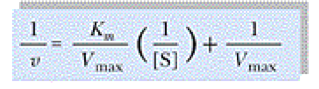
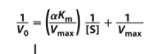
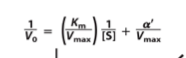
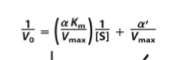
- Lineweaver-Burk
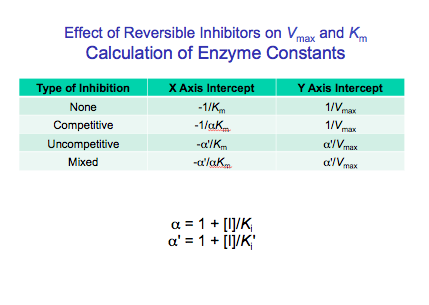
- x-intercept = -1/Km, y-intercept = 1/Vmax, slope = Km/Vmax
- E + S -><- ES --> E + P
Enzyme Inhibition
- Reversible Inhibitors
- Can bind to and dissociate from the enzyme, often structural analogs and used as drugs
- Noncovalent
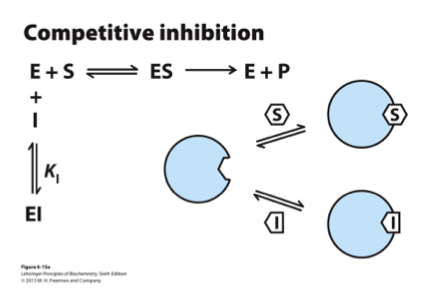
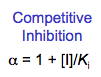
- Competitive
- I binds only to E not to ES
- I and S bind at same site
- I does not affect catalysis
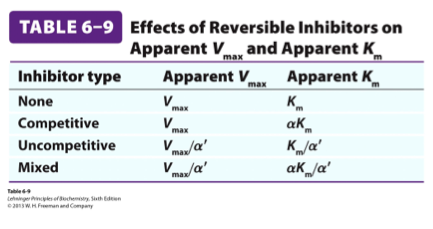
- Michaelis Menten Effects
- Km increases
- Vmax is unchanged
- Lines with different slopes but same y-intercept
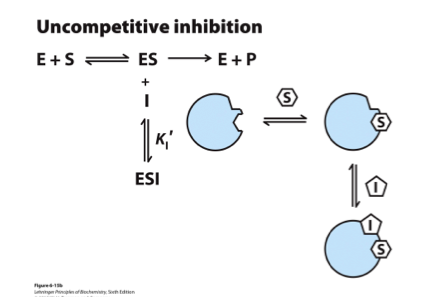
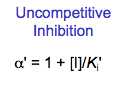
- Uncompetitive
- I binds only to ES not to S
- I and S bind sites are different
- I does not affect substrate binding, but inhibits catalytic function
- Michaelis Menten Effects
- Km and Vmax decrease
- Ratio of Km to Vmax is same, so slope is same
- Parallel lines on Lineburker-Weaver plot
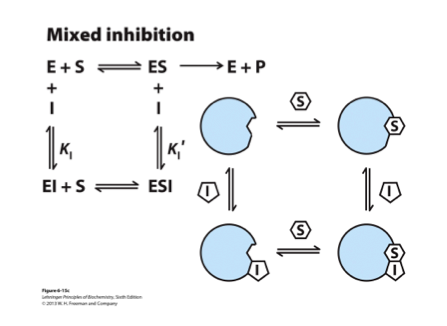
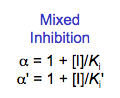
- Mixed
- I binds at E and ES
- I and S bind at different sites
- I binds enzyme with or without substrate
- Binding inhibits both substrate binding and catalysis
- Michaelis Menten Effects
- Vmax decreases
- Km can increase or decrease (unchanged in extreme cases of noncompetitive
- Wacky lines, x-intercept, y-intercept and slope are all different
- Becomes noncompetitive in extreme cases
- Competitive
- Irreversible Inhibitors
- Permanently shut off enzyme, often toxins but sometimes used as drugs
- Covalent
- Go over!
- Reversible Inhibitors
Bioenergetics
- Most reactions are heterolytic
- Catabolism breaks things down
- Anabolism builds molecules up
- Metabolic pathways are series of connected sequential enzymatic pathways
- Compartmentalized
- Catabolic converge on acetyl-CoA
- Anabolic diverge from few metabolites
- Anabolism and catabolism are not just the reverse of each other!
- High energy molecules
- PEP and 1,3-BPG are the highest
- PEP
- Largest free energy hydrolysis
- Hydrolysis yields enol form of pyruvate which tautomerizes to the keto form
- 1,3-BPG
- Mixed anhydrides or acetyl phosphates
- Bond strain, electrostatics, and resonance create high energy
- PEP
- ATP is mid level, good for transporting P groups
- Large negative free energy change on hydrolysis due to
- Relief of electrostatic repulsion
- Stabilization of products by ionization
- Stabilization of products by resonance
- Entropy factors
- Greater degree of hydration of prodcuts
- Large negative free energy change on hydrolysis due to
- Thioesters like acetyl CoA
- Orbital overlap between carbonyl and sulfur is not as good as resonance between oxygen and carbonyl in esters
- PEP and 1,3-BPG are the highest
- Free energy changes are concentration dependent
- Redox Reactions
- Reduced compounds serve as fuel which electrons can be stripped off of during oxidation
- Transfer of electrons is often accompanied by the transfer of protons and hydride
- NAD and NADP are common redox cofactors
- Flavin cofactors use molecular oxygen as ultimate electron acceptor, tightly bound to proteins and allow single electron transfer
Imagens e arquivos do mapa
Informações
- Descrição
- A web of the workings of enzymes, inhibitors, high energy molecules, bioenergetics, and kinematics
- Criado por
- Sarah Emslie
- Visualizações
- 85
- Tags
- Avaliação