
Mapa mental
Konrad Lorenz (1935)
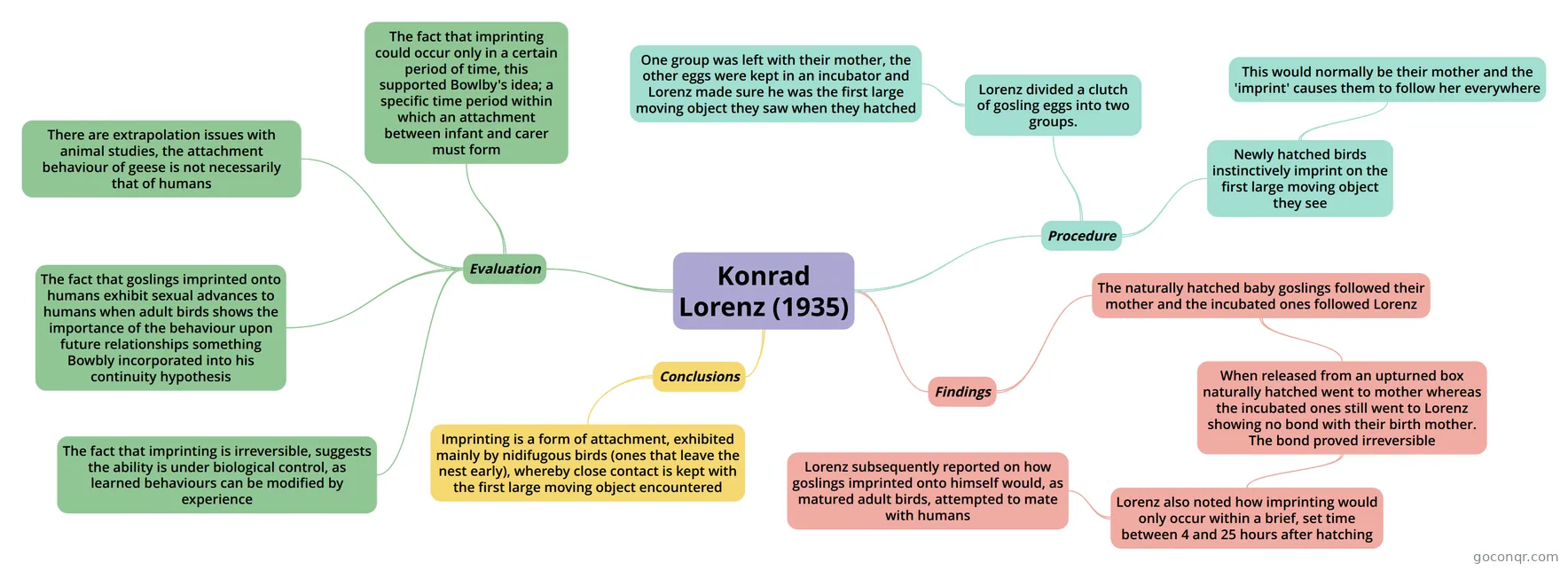
Mind map: Konrad Lorenz 1935 imprinting study
Conteúdo do mapa
Konrad Lorenz (1935)
Procedure
- Newly hatched birds instinctively imprint on the first large moving object they see
- This would normally be their mother and the 'imprint' causes them to follow her everywhere
- Lorenz divided a clutch of gosling eggs into two groups.
- One group was left with their mother, the other eggs were kept in an incubator and Lorenz made sure he was the first large moving object they saw when they hatched
- Newly hatched birds instinctively imprint on the first large moving object they see
Findings
- The naturally hatched baby goslings followed their mother and the incubated ones followed Lorenz
- When released from an upturned box naturally hatched went to mother whereas the incubated ones still went to Lorenz showing no bond with their birth mother. The bond proved irreversible
- Lorenz also noted how imprinting would only occur within a brief, set time between 4 and 25 hours after hatching
- Lorenz subsequently reported on how goslings imprinted onto himself would, as matured adult birds, attempted to mate with humans
- Lorenz also noted how imprinting would only occur within a brief, set time between 4 and 25 hours after hatching
- When released from an upturned box naturally hatched went to mother whereas the incubated ones still went to Lorenz showing no bond with their birth mother. The bond proved irreversible
- The naturally hatched baby goslings followed their mother and the incubated ones followed Lorenz
Conclusions
- Imprinting is a form of attachment, exhibited mainly by nidifugous birds (ones that leave the nest early), whereby close contact is kept with the first large moving object encountered
Evaluation
- The fact that imprinting is irreversible, suggests the ability is under biological control, as learned behaviours can be modified by experience
- The fact that imprinting could occur only in a certain period of time, this supported Bowlby's idea; a specific time period within which an attachment between infant and carer must form
- There are extrapolation issues with animal studies, the attachment behaviour of geese is not necessarily that of humans
- The fact that goslings imprinted onto humans exhibit sexual advances to humans when adult birds shows the importance of the behaviour upon future relationships something Bowbly incorporated into his continuity hypothesis
Informações
- Descrição
- Animal studies of attachment
- Criado por
- sienna.a.wells
- Visualizações
- 66
- Avaliação