
Mapa mental
Ecology
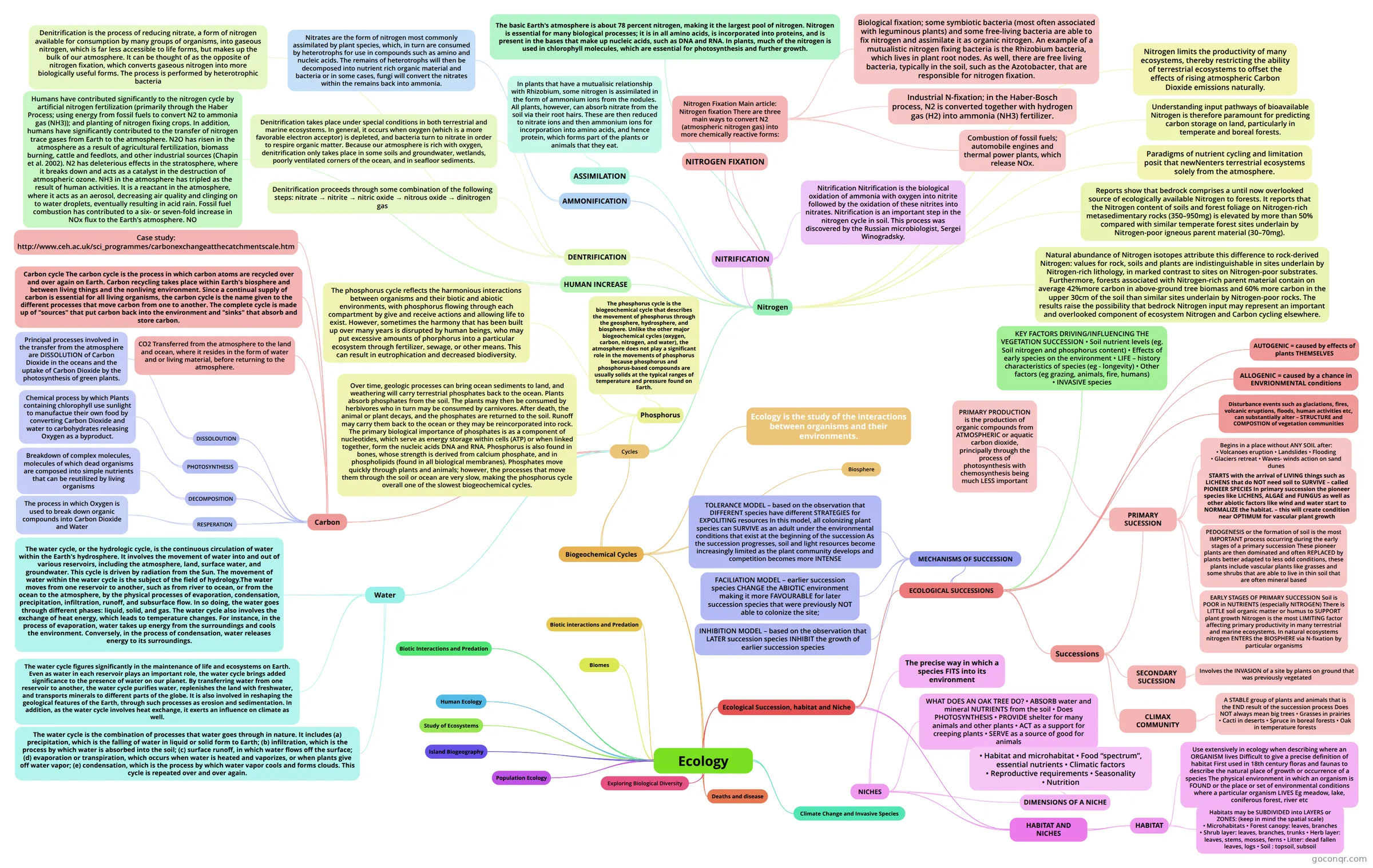
Mind map: Ecology
Conteúdo do mapa
Ecology
Island Biogeography
Exploring Biological Diversity
Climate Change and Invasive Species
Study of Ecosystems
Ecological Succession, habitat and Niche
- ECOLOGICAL SUCCESSIONS
- Disturbance events such as glaciations, fires, volcanic eruptions, floods, human activities etc, can substantially alter – STRUCTURE and COMPOSTION of vegetation communities
- ALLOGENIC = caused by a chance in ENVRIONMENTAL conditions
- AUTOGENIC = caused by effects of plants THEMSELVES
- Successions
- PRIMARY SUCESSION
- Begins in a place without ANY SOIL after: • Volcanoes eruption • Landslides • Flooding • Glaciers retreat • Waves- winds action on sand dunes
- STARTS with the arrival of LIVING things such as LICHENS that do NOT need soil to SURVIVE – called PIONEER SPECIES In primary succession the pioneer species like LICHENS, ALGAE and FUNGUS as well as other abiotic factors like wind and water start to NORMALIZE the habitat. – this will create condition near OPTIMUM for vascular plant growth
- PEDOGENESIS or the formation of soil is the most IMPORTANT process occurring during the early stages of a primary succession These pioneer plants are then dominated and often REPLACED by plants better adapted to less odd conditions, these plants include vascular plants like grasses and some shrubs that are able to live in thin soil that are often mineral based
- EARLY STAGES OF PRIMARY SUCCESSION Soil is POOR in NUTRIENTS (especially NITROGEN) There is LITTLE soil organic matter or humus to SUPPORT plant growth Nitrogen is the most LIMITING factor affecting primary productivity in many terrestrial and marine ecosystems. In natural ecosystems nitrogen ENTERS the BIOSPHERE via N-fixation by particular organisms
- PRIMARY PRODUCTION is the production of organic compounds from ATMOSPHERIC or aquatic carbon dioxide, principally through the process of photosynthesis with chemosynthesis being much LESS important
- SECONDARY SUCESSION
- Involves the INVASION of a site by plants on ground that was previously vegetated
- CLIMAX COMMUNITY
- A STABLE group of plants and animals that is the END result of the succession process Does NOT always mean big trees • Grasses in prairies • Cacti in deserts • Spruce in boreal forests • Oak in temperature forests
- PRIMARY SUCESSION
- KEY FACTORS DRIVING/INFLUENCING THE VEGETATION SUCCESSION • Soil nutrient levels (eg. Soil nitrogen and phosphorus content) • Effects of early species on the environment • LIFE – history characteristics of species (eg - longevity) • Other factors (eg grazing, animals, fire, humans) • INVASIVE species
- MECHANISMS OF SUCCESSION
- FACILIATION MODEL – earlier succession species CHANGE the ABIOTIC environment making it more FAVOURABLE for later succession species that were previously NOT able to colonize the site;
- TOLERANCE MODEL – based on the observation that DIFFERENT species have different STRATEGIES for EXPOLITING resources In this model, all colonizing plant species can SURVIVE as an adult under the environmental conditions that exist at the beginning of the succession As the succession progresses, soil and light resources become increasingly limited as the plant community develops and competition becomes more INTENSE
- INHIBITION MODEL – based on the observation that LATER succession species INHIBIT the growth of earlier succession species
- HABITAT AND NICHES
- NICHES
- The precise way in which a species FITS into its environment
- WHAT DOES AN OAK TREE DO? • ABSORB water and mineral NUTRIENTS from the soil • Does PHOTOSYNTHESIS • PROVIDE shelter for many animals and other plants • ACT as a support for creeping plants • SERVE as a source of good for animals
- DIMENSIONS OF A NICHE
- • Habitat and microhabitat • Food “spectrum”, essential nutrients • Climatic factors • Reproductive requirements • Seasonality • Nutrition
- HABITAT
- Use extensively in ecology when describing where an ORGANISM lives Difficult to give a precise definition of habitat First used in 18th century floras and faunas to describe the natural place of growth or occurrence of a species The physical environment in which an organism is FOUND or the place or set of environmental conditions where a particular organism LIVES Eg meadow, lake, coniferous forest, river etc
- Habitats may be SUBDIVIDED into LAYERS or ZONES: (keep in mind the spatial scale) • Microhabitats • Forest canopy: leaves, branches • Shrub layer: leaves, branches, trunks • Herb layer: leaves, stems, mosses, ferns • Litter: dead fallen leaves, logs • Soil : topsoil, subsoil
- NICHES
- ECOLOGICAL SUCCESSIONS
Biogeochemical Cycles
- Cycles
- Water
- The water cycle, or the hydrologic cycle, is the continuous circulation of water within the Earth's hydrosphere. It involves the movement of water into and out of various reservoirs, including the atmosphere, land, surface water, and groundwater. This cycle is driven by radiation from the Sun. The movement of water within the water cycle is the subject of the field of hydrology.The water moves from one reservoir to another, such as from river to ocean, or from the ocean to the atmosphere, by the physical processes of evaporation, condensation, precipitation, infiltration, runoff, and subsurface flow. In so doing, the water goes through different phases: liquid, solid, and gas. The water cycle also involves the exchange of heat energy, which leads to temperature changes. For instance, in the process of evaporation, water takes up energy from the surroundings and cools the environment. Conversely, in the process of condensation, water releases energy to its surroundings.
- The water cycle figures significantly in the maintenance of life and ecosystems on Earth. Even as water in each reservoir plays an important role, the water cycle brings added significance to the presence of water on our planet. By transferring water from one reservoir to another, the water cycle purifies water, replenishes the land with freshwater, and transports minerals to different parts of the globe. It is also involved in reshaping the geological features of the Earth, through such processes as erosion and sedimentation. In addition, as the water cycle involves heat exchange, it exerts an influence on climate as well.
- The water cycle is the combination of processes that water goes through in nature. It includes (a) precipitation, which is the falling of water in liquid or solid form to Earth; (b) infiltration, which is the process by which water is absorbed into the soil; (c) surface runoff, in which water flows off the surface; (d) evaporation or transpiration, which occurs when water is heated and vaporizes, or when plants give off water vapor; (e) condensation, which is the process by which water vapor cools and forms clouds. This cycle is repeated over and over again.
- Carbon
- CO2 Transferred from the atmosphere to the land and ocean, where it resides in the form of water and or living material, before returning to the atmosphere.
- DISSOLOUTION
- Principal processes involved in the transfer from the atmosphere are DISSOLUTION of Carbon Dioxide in the oceans and the uptake of Carbon Dioxide by the photosynthesis of green plants.
- PHOTOSYNTHESIS
- Chemical process by which Plants containing chlorophyll use sunlight to manufactue their own food by converting Carbon Dioxide and water to carbohydrates releasing Oxygen as a byproduct.
- Carbon cycle The carbon cycle is the process in which carbon atoms are recycled over and over again on Earth. Carbon recycling takes place within Earth's biosphere and between living things and the nonliving environment. Since a continual supply of carbon is essential for all living organisms, the carbon cycle is the name given to the different processes that move carbon from one to another. The complete cycle is made up of "sources" that put carbon back into the environment and "sinks" that absorb and store carbon.
- DECOMPOSITION
- Breakdown of complex molecules, molecules of which dead organisms are composed into simple nutrients that can be reutilized by living organisms
- RESPERATION
- The process in which Oxygen is used to break down organic compounds into Carbon Dioxide and Water
- Case study: http://www.ceh.ac.uk/sci_programmes/carbonexchangeatthecatchmentscale.htm
- Phosphorus
- The phosphorus cycle is the biogeochemical cycle that describes the movement of phosphorus through the geosphere, hydrosphere, and biosphere. Unlike the other major biogeochemical cycles (oxygen, carbon, nitrogen, and water), the atmosphere does not play a significant role in the movements of phosphorus because phosphorus and phosphorus-based compounds are usually solids at the typical ranges of temperature and pressure found on Earth.
- The phosphorus cycle reflects the harmonious interactions between organisms and their biotic and abiotic environments, with phosphorus flowing through each compartment by give and receive actions and allowing life to exist. However, sometimes the harmony that has been built up over many years is disrupted by human beings, who may put excessive amounts of phorphorus into a particular ecosystem through fertilizer, sewage, or other means. This can result in eutrophication and decreased biodiversity.
- Over time, geologic processes can bring ocean sediments to land, and weathering will carry terrestrial phosphates back to the ocean. Plants absorb phosphates from the soil. The plants may then be consumed by herbivores who in turn may be consumed by carnivores. After death, the animal or plant decays, and the phosphates are returned to the soil. Runoff may carry them back to the ocean or they may be reincorporated into rock. The primary biological importance of phosphates is as a component of nucleotides, which serve as energy storage within cells (ATP) or when linked together, form the nucleic acids DNA and RNA. Phosphorus is also found in bones, whose strength is derived from calcium phosphate, and in phospholipids (found in all biological membranes). Phosphates move quickly through plants and animals; however, the processes that move them through the soil or ocean are very slow, making the phosphorus cycle overall one of the slowest biogeochemical cycles.
- Nitrogen
- Nitrogen limits the productivity of many ecosystems, thereby restricting the ability of terrestrial ecosystems to offset the effects of rising atmospheric Carbon Dioxide emissions naturally.
- Understanding input pathways of bioavailable Nitrogen is therefore paramount for predicting carbon storage on land, particularly in temperate and boreal forests.
- Paradigms of nutrient cycling and limitation posit that newNenters terrestrial ecosystems solely from the atmosphere.
- Reports show that bedrock comprises a until now overlooked source of ecologically available Nitrogen to forests. It reports that the Nitrogen content of soils and forest foliage on Nitrogen-rich metasedimentary rocks (350–950mg) is elevated by more than 50% compared with similar temperate forest sites underlain by Nitrogen-poor igneous parent material (30–70mg).
- Natural abundance of Nitrogen isotopes attribute this difference to rock-derived Nitrogen: values for rock, soils and plants are indistinguishable in sites underlain by Nitrogen-rich lithology, in marked contrast to sites on Nitrogen-poor substrates. Furthermore, forests associated with Nitrogen-rich parent material contain on average 42%more carbon in above-ground tree biomass and 60% more carbon in the upper 30cm of the soil than similar sites underlain by Nitrogen-poor rocks. The results raise the possibility that bedrock Nitrogen input may represent an important and overlooked component of ecosystem Nitrogen and Carbon cycling elsewhere.
- The basic Earth's atmosphere is about 78 percent nitrogen, making it the largest pool of nitrogen. Nitrogen is essential for many biological processes; it is in all amino acids, is incorporated into proteins, and is present in the bases that make up nucleic acids, such as DNA and RNA. In plants, much of the nitrogen is used in chlorophyll molecules, which are essential for photosynthesis and further growth.
- Nitrogen Fixation Main article: Nitrogen fixation There are three main ways to convert N2 (atmospheric nitrogen gas) into more chemically reactive forms:
- Biological fixation; some symbiotic bacteria (most often associated with leguminous plants) and some free-living bacteria are able to fix nitrogen and assimilate it as organic nitrogen. An example of a mutualistic nitrogen fixing bacteria is the Rhizobium bacteria, which lives in plant root nodes. As well, there are free living bacteria, typically in the soil, such as the Azotobacter, that are responsible for nitrogen fixation.
- Industrial N-fixation; in the Haber-Bosch process, N2 is converted together with hydrogen gas (H2) into ammonia (NH3) fertilizer.
- Combustion of fossil fuels; automobile engines and thermal power plants, which release NOx.
- NITROGEN FIXATION
- NITRIFICATION
- Nitrification Nitrification is the biological oxidation of ammonia with oxygen into nitrite followed by the oxidation of these nitrites into nitrates. Nitrification is an important step in the nitrogen cycle in soil. This process was discovered by the Russian microbiologist, Sergei Winogradsky.
- ASSIMILATION
- In plants that have a mutualisic relationship with Rhizobium, some nitrogen is assimilated in the form of ammonium ions from the nodules. All plants, however, can absorb nitrate from the soil via their root hairs. These are then reduced to nitrate ions and then ammonium ions for incorporation into amino acids, and hence protein, which forms part of the plants or animals that they eat.
- AMMONIFICATION
- Nitrates are the form of nitrogen most commonly assimilated by plant species, which, in turn are consumed by heterotrophs for use in compounds such as amino and nucleic acids. The remains of heterotrophs will then be decomposed into nutrient rich organic material and bacteria or in some cases, fungi will convert the nitrates within the remains back into ammonia.
- DENTRIFICATION
- Denitrification is the process of reducing nitrate, a form of nitrogen available for consumption by many groups of organisms, into gaseous nitrogen, which is far less accessible to life forms, but makes up the bulk of our atmosphere. It can be thought of as the opposite of nitrogen fixation, which converts gaseous nitrogen into more biologically useful forms. The process is performed by heterotrophic bacteria
- Denitrification takes place under special conditions in both terrestrial and marine ecosystems. In general, it occurs when oxygen (which is a more favorable electron acceptor) is depleted, and bacteria turn to nitrate in order to respire organic matter. Because our atmosphere is rich with oxygen, denitrification only takes place in some soils and groundwater, wetlands, poorly ventilated corners of the ocean, and in seafloor sediments.
- Denitrification proceeds through some combination of the following steps: nitrate → nitrite → nitric oxide → nitrous oxide → dinitrogen gas
- HUMAN INCREASE
- Humans have contributed significantly to the nitrogen cycle by artificial nitrogen fertilization (primarily through the Haber Process; using energy from fossil fuels to convert N2 to ammonia gas (NH3)); and planting of nitrogen fixing crops. In addition, humans have significantly contributed to the transfer of nitrogen trace gases from Earth to the atmosphere. N2O has risen in the atmosphere as a result of agricultural fertilization, biomass burning, cattle and feedlots, and other industrial sources (Chapin et al. 2002). N2 has deleterious effects in the stratosphere, where it breaks down and acts as a catalyst in the destruction of atmospheric ozone. NH3 in the atmosphere has tripled as the result of human activities. It is a reactant in the atmosphere, where it acts as an aerosol, decreasing air quality and clinging on to water droplets, eventually resulting in acid rain. Fossil fuel combustion has contributed to a six- or seven-fold increase in NOx flux to the Earth's atmosphere. NO
- Water
- Biosphere
- Ecology is the study of the interactions between organisms and their environments.
- Cycles
Biomes
Population Ecology
Human Ecology
Biotic Interactions and Predation
Biotic interactions and Predation
Deaths and disease
Informações
- Descrição
- Mapa Mental sobre Ecology, criado por Joshua Cat em 27-12-2013.
- Criado por
- Joshua Cat
- Visualizações
- 47
- Avaliação