
Mapa mental
B3 - Molecules of Life section
Conteúdo do mapa
B3 - Molecules of Life section
Cell Structure
- Ribosomes
- Some cell structures are too small to be seen with the light microscope. Ribosomes are like this.
- They can only be seen using an electron microscope.
- They are found in the cytoplasm and are the site of protein synthesis.
- Some cell structures are too small to be seen with the light microscope. Ribosomes are like this.
- Mitochondria
- Mitochondria are tiny structures found in cells (one is called a mitochondrion).
- Respiration, the chemical reaction that releases energy from glucose, happens in mitochondria.
- This provides energy for life process such as movement and growth.
- Tissues and organs that need a lot of energy have large numbers of mitochondria in their cells. For example, liver cells and muscle cells contain a lot of mitochondria.
- Ribosomes
DNA and genetic code
- Chromonsomes
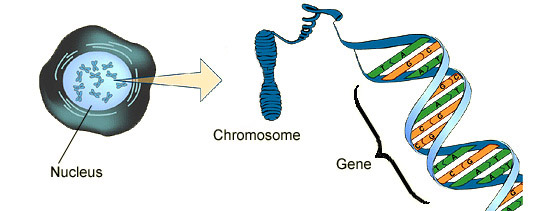
- The cell's nucleus contains chromosomes.
- These are long, coiled molecules of DNA, divided up into regions called genes.
- The diagram shows the relationship between the cell, its nucleus, chromosomes in the nucleus, and genes.
- DNA
- The information contained in genes is in the form of coded instructions called the genetic code.
- The genetic code controls cell activity, which means that it also controls some characteristics of the organism.
- DNA controls the production of different proteins.
- These are needed for the growth and repair of cells.
- The information contained in genes is in the form of coded instructions called the genetic code.
- Chromonsomes
Structure of DNA
- Discovery
- Two scientists, James Watson and Francis Crick, worked out the structure of DNA.
- By using data from other scientists they were able to build a model of DNA.
- The data they used showed that bases occurred in pairs. Further x-ray data showed that there were two chains wound into a double helix.
- A Double Helix
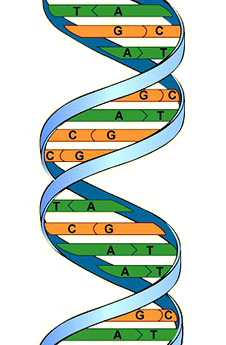
- Each strand of DNA is made of chemicals called bases.
- There are four different types of bases, shown as A, T, C and G in the diagram. In DNA, two strands coil together to form a double helix.
- There are chemical cross-links between the two strands, formed by pairs of bases.
- Each strand of DNA is made of chemicals called bases.
- Genes and Proteins
- Each gene in a molecule of DNA contains:
- A different sequence of bases
- Codes for a particular protein
- Proteins are made in the cytoplasm of a cell, not in the nucleus.
- Genes cannot leave the nucleus, so a copy of the gene is needed.
- This copy is able to leave the nucleus to go into the cytoplasm so that proteins can be made by the cell.
- Genes cannot leave the nucleus, so a copy of the gene is needed.
- Proteins are made in the cytoplasm of a cell, not in the nucleus.
- Each gene in a molecule of DNA contains:
- Discovery
Making Proteins
- Complementary base pairs
- The four bases of DNA are A, T, C and G.
- They always pair up in a particular way, called complementary base pairing: A – T and G – C
- The four bases of DNA are A, T, C and G.
- The DNA base code
- Protein structure is determined by the DNA base code.
- Proteins are made from lots of amino acids joined together.
- Each amino acid is coded by the sequence (order) of three bases. For example, GGT codes are found in glycine but TCA codes are found in serine, a different amino acid.
- The sequence of bases determines the sequence of amino acids in a protein molecule.
- DNA controls the functions of a cell by controlling its production of proteins. Some of these proteins are enzymes.
- Messenger RNA (mRNA)
- Ribosomes are the site of protein synthesis.
- They are found in the cytoplasm but DNA is found in the nucleus.
- The genetic code needed to make a particular protein is carried from the DNA to the ribosomes by a molecule called mRNA.
- Making:
- mRNA from DNA is called transcription
- Proteins from mRNA is called translation
- Complementary base pairs
Imagens e arquivos do mapa
Informações
- Descrição
- Mapa Mental sobre B3 - Molecules of Life section, criado por Francesca Floris em 12-01-2014.
- Criado por
- Francesca Floris · jan 2014
- Atualizado
- 19 fev 2016
- Visualizações
- 152
- Tags
- Avaliação