
Mapa mental
Evolution - Evidence
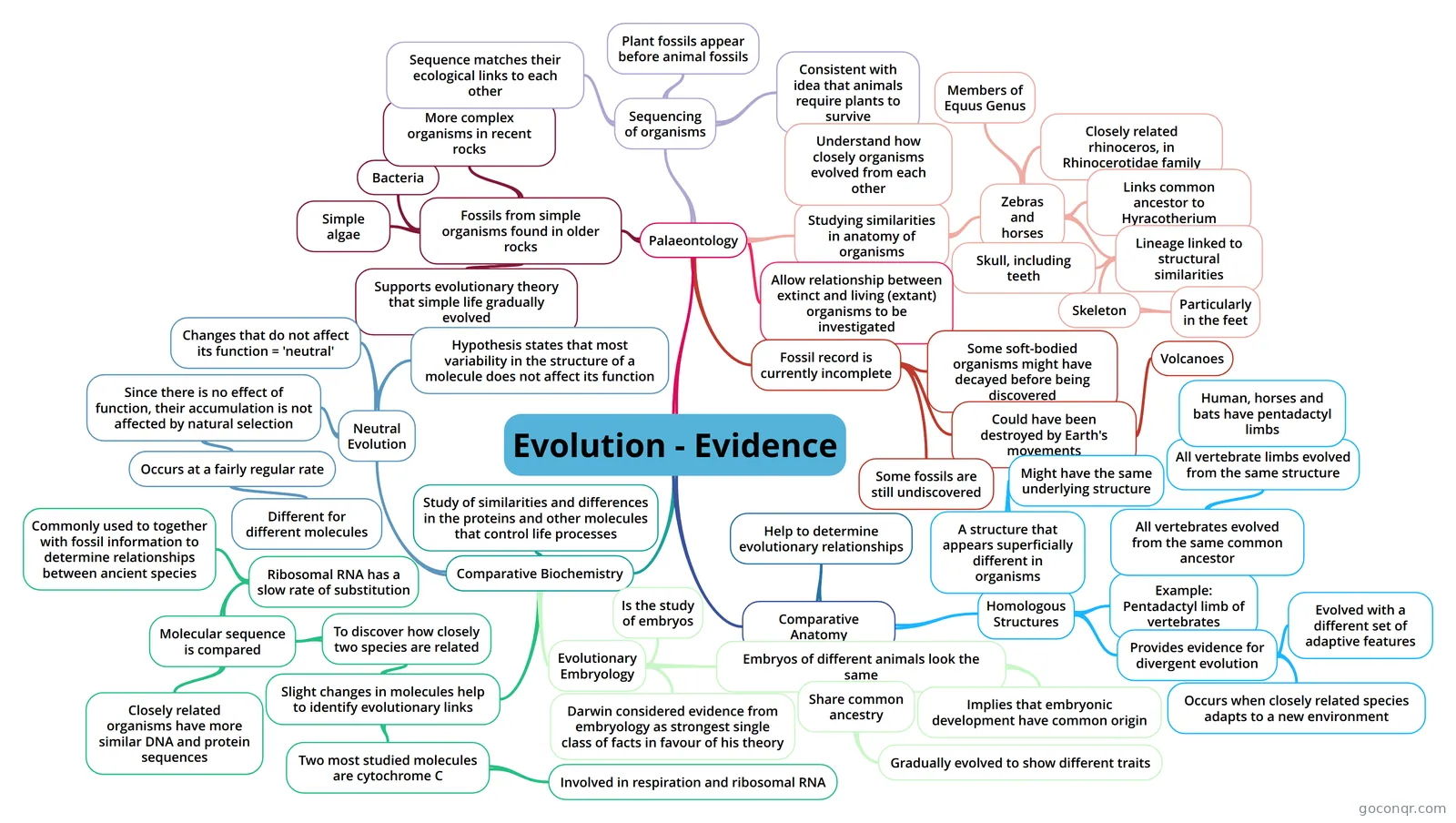
Mind map: Evolution evidence
Conteúdo do mapa
Evolution - Evidence
Palaeontology
- Fossils from simple organisms found in older rocks
- Bacteria
- Simple algae
- More complex organisms in recent rocks
- Supports evolutionary theory that simple life gradually evolved
- Sequencing of organisms
- Sequence matches their ecological links to each other
- Plant fossils appear before animal fossils
- Consistent with idea that animals require plants to survive
- Studying similarities in anatomy of organisms
- Understand how closely organisms evolved from each other
- Zebras and horses
- Members of Equus Genus
- Closely related rhinoceros, in Rhinocerotidae family
- Links common ancestor to Hyracotherium
- Lineage linked to structural similarities
- Skull, including teeth
- Skeleton
- Particularly in the feet
- Allow relationship between extinct and living (extant) organisms to be investigated
- Fossil record is currently incomplete
- Some soft-bodied organisms might have decayed before being discovered
- Could have been destroyed by Earth's movements
- Volcanoes
- Some fossils are still undiscovered
- Fossils from simple organisms found in older rocks
Comparative Anatomy
- Help to determine evolutionary relationships
- Homologous Structures
- A structure that appears superficially different in organisms
- Might have the same underlying structure
- Example: Pentadactyl limb of vertebrates
- All vertebrates evolved from the same common ancestor
- All vertebrate limbs evolved from the same structure
- Human, horses and bats have pentadactyl limbs
- All vertebrate limbs evolved from the same structure
- All vertebrates evolved from the same common ancestor
- Provides evidence for divergent evolution
- Evolved with a different set of adaptive features
- Occurs when closely related species adapts to a new environment
- A structure that appears superficially different in organisms
Comparative Biochemistry
- Study of similarities and differences in the proteins and other molecules that control life processes
- Evolutionary Embryology
- Is the study of embryos
- Embryos of different animals look the same
- Implies that embryonic development have common origin
- Share common ancestry
- Gradually evolved to show different traits
- Darwin considered evidence from embryology as strongest single class of facts in favour of his theory
- Slight changes in molecules help to identify evolutionary links
- Two most studied molecules are cytochrome C
- Involved in respiration and ribosomal RNA
- To discover how closely two species are related
- Molecular sequence is compared
- Closely related organisms have more similar DNA and protein sequences
- Ribosomal RNA has a slow rate of substitution
- Commonly used to together with fossil information to determine relationships between ancient species
- Molecular sequence is compared
- Two most studied molecules are cytochrome C
- Neutral Evolution
- Hypothesis states that most variability in the structure of a molecule does not affect its function
- Changes that do not affect its function = 'neutral'
- Since there is no effect of function, their accumulation is not affected by natural selection
- Occurs at a fairly regular rate
- Different for different molecules
- Occurs at a fairly regular rate
Informações
- Descrição
- AS - Level Biology Mapa Mental sobre Evolution - Evidence, criado por The Flob M em 14-03-2016.
- Criado por
- The Flob M
- Visualizações
- 0
- Avaliação
Mais sobre Evidence for Evolution