
Mapa mental
SC NICHES
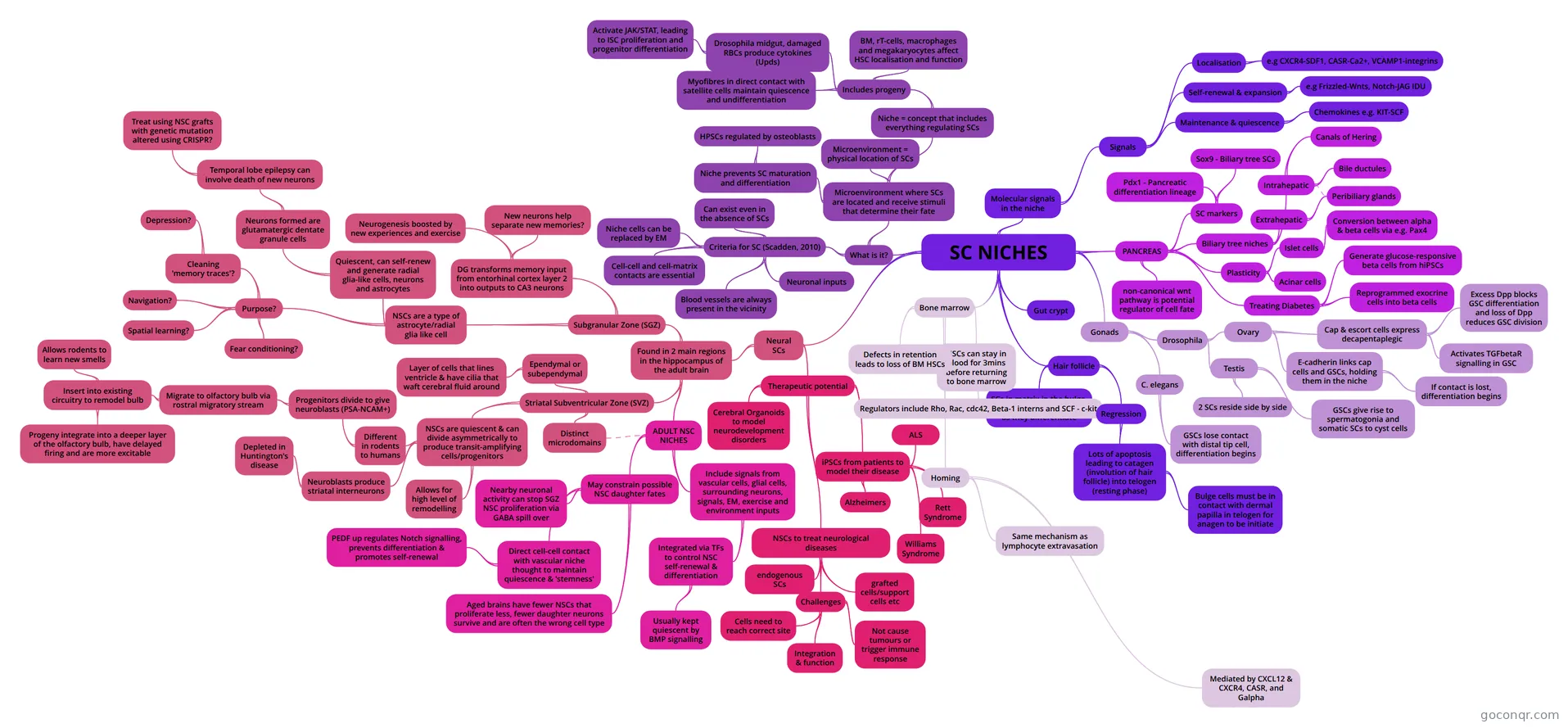
Mind map: SC niches
Conteúdo do mapa
SC NICHES
PANCREAS
- Biliary tree niches
- Intrahepatic
- Canals of Hering
- Bile ductules
- Extrahepatic
- Peribiliary glands
- Intrahepatic
- SC markers
- Sox9 - Biliary tree SCs
- Progeny traced using creER LacZ reporter system. Sox9 promoter is activated in biliary tree lineage and drives expression of creER, which cuts out a STOP codon allowing expression of LacZ, which produces beta galactosidase (turns blue when x-gal is introduced)
- Pdx1 - Pancreatic differentiation lineage
- Sox9 - Biliary tree SCs
- non-canonical wnt pathway is potential regulator of cell fate
- identified using RNAseq
- Plasticity
- Islet cells
- Evidence of interconversion between beta and alpha cells involving a few genes (e.g.Pax4) which could be useful in developing clinical treatments for type 2 diabetes
- Conversion between alpha & beta cells via e.g. Pax4
- Acinar cells
- Animal subject to pancreatic duct ligation (where pancreatic duct is tied off) to test acinara cell plasticity. Cells converted to embryonic-type multi potent progenitor cells --> acing cells and duct cells Duct cells may also turn on expression of Neurogenin3+ and differentiate into endocrine cells (e.g. alpha/beta). Plasticity would be beneficial in an injury situation in repairing tissues
- Islet cells
- Treating Diabetes
- Generate glucose-responsive beta cells from hiPSCs
- Melton et al (2014) generated glucose-reponsive beta cells from hPSCs in vitro, using key genes to drive differentiation. Transplanted into diabetic mice and glucose regulation was restored
- Reprogrammed exocrine cells into beta cells
- Melton et al (2008) reprogrammed adult pancreatic exocrine cells into beta cells by reexpressing key developmental regulators (Ngn3, Pdx1 & Mafa) Cells strongly resembled Beta cells, although were not located in the islets Location of reprogrammed beta cells does not matter as long as they are able to produce insulin
- Generate glucose-responsive beta cells from hiPSCs
- Biliary tree niches
What is it?
- Microenvironment where SCs are located and receive stimuli that determine their fate
- Not just the physical location, includes the extrinsic signals that interact to influence SC behaviour
- Microenvironment = physical location of SCs
- Niche = concept that includes everything regulating SCs
- Includes progeny
- Myofibres in direct contact with satellite cells maintain quiescence and undifferentiation
- Drosophila midgut, damaged RBCs produce cytokines (Upds)
- Activate JAK/STAT, leading to ISC proliferation and progenitor differentiation
- BM, rT-cells, macrophages and megakaryocytes affect HSC localisation and function
- Includes progeny
- Niche prevents SC maturation and differentiation
- Schoefield (1978) hypothesised that the presence of a SC in a niche prevented its maturation and assured its continued proliferation as a SC. "its progeny, unless they can occupy a similar SC niche, are 1st generation colony-forming cells, which proliferate and mature to acquire a high probability of differentiation.
- HPSCs regulated by osteoblasts
- Scadden et al (2003), transgenic mice with more or less osteoblasts had more or less HPSCs, demonstrating that there is an extrinsic regulation of SCs
- Criteria for SC (Scadden, 2010)
- Can exist even in the absence of SCs
- Niche cells can be replaced by EM
- Cell-cell and cell-matrix contacts are essential
- Blood vessels are always present in the vicinity
- Neuronal inputs
- Microenvironment where SCs are located and receive stimuli that determine their fate
Gonads
- Drosophila
- Ovary
- E-cadherin links cap cells and GSCs, holding them in the niche
- If contact is lost, differentiation begins
- Cap & escort cells express decapentaplegic
- Escort cells = inner germarium sheath cells decapentaplegic = BMP2/4 homolog
- Activates TGFbetaR signalling in GSC
- transforming growth factor, controls cell division
- Excess Dpp blocks GSC differentiation and loss of Dpp reduces GSC division
- Xie et al 1998
- E-cadherin links cap cells and GSCs, holding them in the niche
- Testis
- 2 SCs reside side by side
- GSCs give rise to spermatogonia and somatic SCs to cyst cells
- Ovary
- C. elegans
- GSCs lose contact with distal tip cell, differentiation begins
- Drosophila
Bone marrow
- HSCs can stay in blood for 3mins before returning to bone marrow
- very small numbers of HSCs in peripheral blood at any given time, but there is more in the morning/evening as it follows circadian rhythm
- Homing
- Same mechanism as lymphocyte extravasation
- Capture, rolling, slow rolling, firm adhesion, transmigration
- Mediated by CXCL12 & CXCR4, CASR, and Galpha
- CXCL12 - SDF1, produced by osteoblasts and bone marrow stroma CXCR4 - TM glycoprotein that binds to collagen, osteopontin and selecting CASR = calcium sensing receptor, necessary for HSC localisation by endosteal surface Galpha - necessary for HSC extravasation into BM space
- Same mechanism as lymphocyte extravasation
- Defects in retention leads to loss of BM HSCs
- Regulators include Rho, Rac, cdc42, Beta-1 interns and SCF - c-kit
- In the clinic it is important to break these interactions to force the cells to circulate Done by G-CSF, which changes osteoblast shape and has proteases that cut SCF, untethering SCs
- Regulators include Rho, Rac, cdc42, Beta-1 interns and SCF - c-kit
- HSCs can stay in blood for 3mins before returning to bone marrow
Hair follicle
- SCs in matrix in the bulge, move upwards in layers as they differentiate
- Regression
- Lots of apoptosis leading to catagen (involution of hair follicle) into telogen (resting phase)
- Bulge cells must be in contact with dermal papilla in telogen for anagen to be initiate
- Lots of apoptosis leading to catagen (involution of hair follicle) into telogen (resting phase)
Gut crypt
Molecular signals in the niche
- Signals
- Localisation
- e.g CXCR4-SDF1, CASR-Ca2+, VCAMP1-integrins
- Maintenance & quiescence
- Chemokines e.g. KIT-SCF
- Self-renewal & expansion
- e.g Frizzled-Wnts, Notch-JAG IDU
- Localisation
- Signals
Neural SCs
- Neural SCs = tissue-specific SCs of the brain that generate neurons & oligodendrocytes and astrocytes
- Found in 2 main regions in the hippocampus of the adult brain
- Current theory is that the brain should not have too much division as there is a high risk of cancer, however new neurons ARE made in the SGZ and SVZ
- Striatal Subventricular Zone (SVZ)
- NSCs are quiescent & can divide asymmetrically to produce transit-amplifying cells/progenitors
- Different in rodents to humans
- Progenitors divide to give neuroblasts (PSA-NCAM+)
- Migrate to olfactory bulb via rostral migratory stream
- Insert into existing circuitry to remodel bulb
- Allows rodents to learn new smells
- Progeny integrate into a deeper layer of the olfactory bulb, have delayed firing and are more excitable
- Insert into existing circuitry to remodel bulb
- Migrate to olfactory bulb via rostral migratory stream
- Progenitors divide to give neuroblasts (PSA-NCAM+)
- Neuroblasts produce striatal interneurons
- Depleted in Huntington's disease
- Allows for high level of remodelling
- Despite risk of cancer
- Different in rodents to humans
- Ependymal or subependymal
- Layer of cells that lines ventricle & have cilia that waft cerebral fluid around
- One theory is that wafting occurs only at night whilst we sleep and clears waste from the brain
- Layer of cells that lines ventricle & have cilia that waft cerebral fluid around
- Distinct microdomains
- Adult NSCs are thought to reside in distinct microdomains, giving cell information on its location as specific signals make it become different neuron types
- NSCs are quiescent & can divide asymmetrically to produce transit-amplifying cells/progenitors
- Subgranular Zone (SGZ)
- Dentate gyrus in the hippocampus
- DG transforms memory input from entorhinal cortex layer 2 into outputs to CA3 neurons
- New neurons help separate new memories?
- Neurogenesis boosted by new experiences and exercise
- Chronic stress can reduce the number of new neurons in the hippocampus
- NSCs are a type of astrocyte/radial glia like cell
- Markers are e.g. GFAP+, nestin+, Sox2+
- Quiescent, can self-renew and generate radial glia-like cells, neurons and astrocytes
- Neurons formed are glutamatergic dentate granule cells
- Temporal lobe epilepsy can involve death of new neurons
- as well as other changes to the niche e.g improper excitation, too many being born and too many dying.
- Treat using NSC grafts with genetic mutation altered using CRISPR?
- NSC grafts could be used to treat this by using CRISPR to correct the genetic mutation causing the epilepsy and grafting the NSCs back int=
- Temporal lobe epilepsy can involve death of new neurons
- Neurons formed are glutamatergic dentate granule cells
- Purpose?
- One study suggested that 700 new hippocampal neurons are made a day
- Spatial learning?
- Fear conditioning?
- Cleaning 'memory traces'?
- Depression?
- SSRIs have been shown to increase hippocampus neurogenesis in rodents, and ECT increases neurogenesis in animal models. Depression may be due to getting 'stuck' in a depressive memory. Usually, unless the brain thinks a memore=y is worth remembering, the cells will die. It has been suggested that autistic people may have different hippocampus where all the cells survive.
- Depression?
- Navigation?
- ADULT NSC NICHES
- Include signals from vascular cells, glial cells, surrounding neurons, signals, EM, exercise and environment inputs
- Integrated via TFs to control NSC self-renewal & differentiation
- Usually kept quiescent by BMP signalling
- Integrated via TFs to control NSC self-renewal & differentiation
- May constrain possible NSC daughter fates
- Direct cell-cell contact with vascular niche thought to maintain quiescence & 'stemness'
- PEDF up regulates Notch signalling, prevents differentiation & promotes self-renewal
- PEDF = Pigment Epithelium-Derived Factor Mad ein capillaries in NSCs
- PEDF up regulates Notch signalling, prevents differentiation & promotes self-renewal
- Nearby neuronal activity can stop SGZ NSC proliferation via GABA spill over
- Lack/decrease in spillover = not enough functional neurons so activates proliferation
- Aged brains have fewer NSCs that proliferate less, fewer daughter neurons survive and are often the wrong cell type
- Direct cell-cell contact with vascular niche thought to maintain quiescence & 'stemness'
- Include signals from vascular cells, glial cells, surrounding neurons, signals, EM, exercise and environment inputs
- Therapeutic potential
- iPSCs from patients to model their disease
- Also to test treatments and grow/engineer replacement cells
- ALS
- One group took cells from an Amyotrophic lateral sclerosis (ALS-type of motor neurone disease) and generated iPSCs. found that motor neurons in the spine and motor cortex were dying but do not yet know why. Embryoid bodies formed were treated with a Shh & RA agonist and grown on laminin. Cells differentiated into motor neurons and expressed MN-specific TFs
- Another study tested 2 drugs to see why they had no effect Could be used by Biopharma to HTP screen small molecule drugs and to try understand their affect on diseased cells
- Rett Syndrome
- Progressive neurological disorder in X-linked gene encoding MeCP2. Normal development until 18 months, then motor decline, regression, weak muscles, seizures and autistic behaviour.
- Marchetto et al (2010) developed iPSCs from skin biopsies and found that the neurons have less spines and synapses than WT, altered Ca signals and electrophysiology changes. Recent study found that the number of synapses could be rescued by adding Choline
- Williams Syndrome
- Leads to hyper social behaviour and altered linguistic & cognitive abilities Cortical neurons developed from reprogrammed cells are affected, appeared to fire more often and had more dendritic spikes. Want receptor Fz9 also affected
- Alzheimers
- Kondo et al (2013) pushed iPSCs to neurons affected in Azheimers and tested potential drugs on the model to see which are most likely to work in that patient BIG step towards personalised medicine
- Cerebral Organoids to model neurodevelopment disorders
- Microcephaly modelled using this approach Study found that there were less neuronal daughters of NSCs
- NSCs to treat neurological diseases
- endogenous SCs
- grafted cells/support cells etc
- Challenges
- Cells need to reach correct site
- Integration & function
- Not cause tumours or trigger immune response
- iPSCs from patients to model their disease
Informações
- Descrição
- Biochemistry (SCRA) Mapa Mental sobre SC NICHES, criado por Alice Paterson em 29-12-2016.
- Criado por
- Alice Paterson
- Visualizações
- 2
- Avaliação