
Mapa mental
HIV + AIDS
Conteúdo do mapa
HIV + AIDS
ORIGIN + ITS VARIATION
- Today (2012)
- Data from World Health Organisation Highest in Sub-Saharan Africa (25 million) Then S+S.E. Asia
- Total adults+children estimated living with HIV : 35.3 million
- Children <15: 3.3 million
- Especially severe More skewed Less Mother->child transmission via blood delivery Drugs required before + after delivery - more available in developed countries
- Newly infected with HIV : 2.3 million
- PRIMATES
- Simian Immunodeficiency Virus (SIVs)
- In natural hosts, often non-pathogenic
- Chimpanzee
- SIVcpz -> HIV-1 M
- Gorilla
- SIVgor -> HIV-1 O
- From chimpanzee -> gorilla -> human
- SIVgor -> HIV-1 O
- Sooty Mangaby
- SIVsm -> HIV-2
- From "pets" to humans again
- SIVsm -> HIV-2
- How do jumps occur?
- Genetic similarity
- Phylogenetic tree of HIVs + SIVs based on sequencing data
- Cut Hunter Theory
- SIVcpz transmission by direct exposure to infected animal blood - BUSH MEAT
- Viral spread favoured by social, economic + behavioural changs in early 20th century
- Today: Simian Foamy Virus, Camaroon
- SIVcpz transmission by direct exposure to infected animal blood - BUSH MEAT
- Genetic similarity
- Simian Immunodeficiency Virus (SIVs)
- WHEN?
- HIV-1 origin: 1912
- range: 1920-1935
- 1st available virus isolate: 1952 (Kinshasa)
- 1st HIV-1 seroconversion (infection): 1959 (Kinshasa)
- Seroconversion = development of detectable specific antibodies to microorganisms in the blood serum as a result of infection or immunization.
- 1st 5 reported cases of AIDS: 1981 (USA)
- No. deaths directly due to AIDS 2007: >24 million
- No. people infected with HIV-1 2008: ~33 million
- epidemic: 1908
- From samples (1960) recovered from hospital in Congo
- HIV-1 origin: 1912
- VARIATION
- Group M
- >90% of cases Further divided into subtypes A-K
- "MAJOR" worldwide
- Group N
- Discovered in 1998 only in Cameroon
- "NEW"
- Group O
- "OUTLIER" West Central Africa
- increasing travel -> subtype distribution changing. Potential for mixed or superinfections
- i.e. HIV-infected individual becoming infected with another strain -> viral recombination e.g. circulating recombinant forms (CRF)
- Group M
- Today (2012)
HIV LIFE CYCLE
- STRUCTURE
- Viral envelope
- Lipid bilayer
- Env proteins
- Protruding from envelope Heterodimers of SU3TM3
- Gag proteins
- Inside envelope
- p17 proteins
- between envelope and core
- Viral Core
- Contains 2000 copies of viral protein p24 Each p24 surrounds 2 single strands of HIV RNA Each RNA contains copy of HIV'S 9 genes 3 of these: gag, pol, env - encode info to make structural proteins for new virions
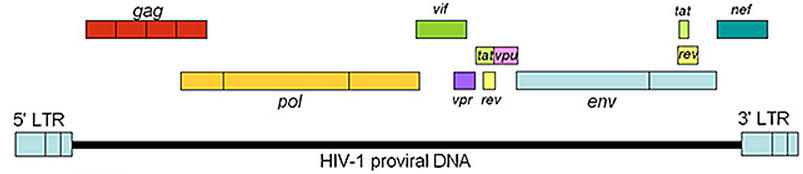
- GENETIC MAP
- Long Terminal Repeats
- promote transcription
- group specific antigen proteins
- virion infectivity factor
- polymerase
- protease, reverse transcriptase, integrase
- vpr
- weak transcriptional factor
- NUCLEAR LOCALISATION SIGNAL
- rev
- regulator virion proteins: promote export of viral RNAs from nucleus TRANSACTIVATING
- tat
- transactivator protein: regulates viral transcription
- env
- type-specific envelope proteins
- vpu
- required for efficient budding
- nef
- negative regulatory factor: important for virulence
- Long Terminal Repeats
- Viral envelope
- RETROVIRUS
- Composed of RNA Uses REVERSE TRANSCRIPTASE to convert RNA -> DNA (encoded by pol) Belongs to LENTIVIRUS (slow virus - delay in onset of symptoms)
- lentivirus (slow virus) - late onset of symptoms
- STRUCTURE
HIV-1 INFECTION
- CD8+T cells produced -> reduce viral load -> neutalising antibodies too -> BUT 10E10 virus particles + 10E9 infected T cells -> CD4+ T cells reduce and HIV load increases -> lymphoproliferation-associated immune system weakens -> canot replace lost T cells -> fall in CD4+ T cell increases more rapidly
VIRAL RESERVOIRS + LATENCY
ANTIRETROVIRALS
Imagens e arquivos do mapa
Informações
- Descrição
- undergraduate Infection Mapa Mental sobre HIV + AIDS, criado por Janine Brierley em 17-04-2014.
- Criado por
- Janine Brierley
- Visualizações
- 49
- Avaliação