
Mapa mental
B3 Topic 3
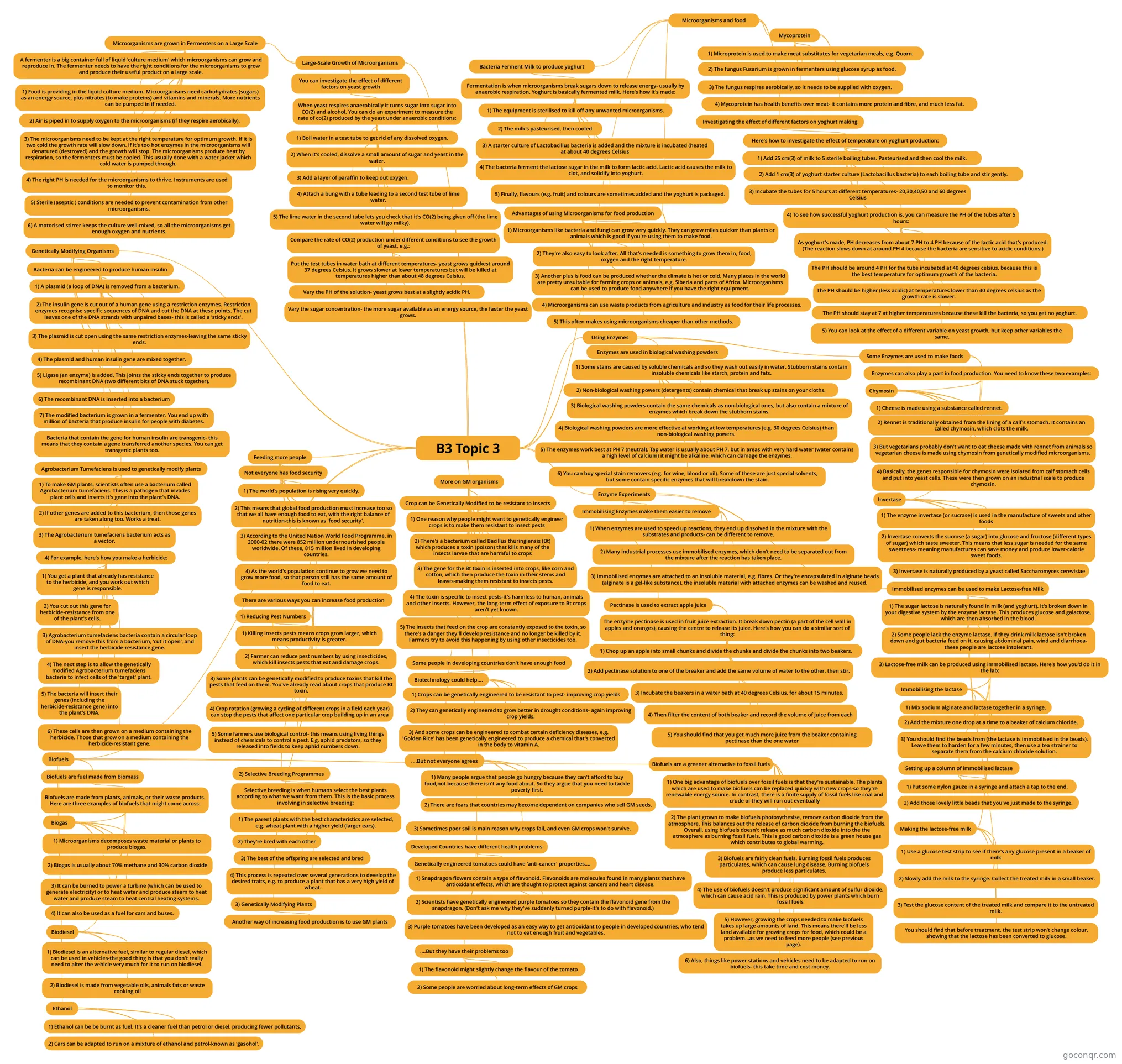
Mind map: B3 Topic 3
Conteúdo do mapa
B3 Topic 3
Large-Scale Growth of Microorganisms
- Microorganisms are grown in Fermenters on a Large Scale
- A fermenter is a big container full of liquid 'culture medium' which microorganisms can grow and reproduce in. The fermenter needs to have the right conditions for the microorganisms to grow and produce their useful product on a large scale.
- 1) Food is providing in the liquid culture medium. Microorganisms need carbohydrates (sugars) as an energy source, plus nitrates (to make proteins) and vitamins and minerals. More nutrients can be pumped in if needed.
- 2) Air is piped in to supply oxygen to the microorganisms (if they respire aerobically).
- 3) The microorganisms need to be kept at the right temperature for optimum growth. If it is two cold the growth rate will slow down. If it's too hot enzymes in the microorganisms will denatured (destroyed) and the growth will stop. The microorganisms produce heat by respiration, so the fermenters must be cooled. This usually done with a water jacket which cold water is pumped through.
- 4) The right PH is needed for the microorganisms to thrive. Instruments are used to monitor this.
- 5) Sterile (aseptic ) conditions are needed to prevent contamination from other microorganisms.
- 6) A motorised stirrer keeps the culture well-mixed, so all the microorganisms get enough oxygen and nutrients.
- You can investigate the effect of different factors on yeast growth
- When yeast respires anaerobically it turns sugar into sugar into CO(2) and alcohol. You can do an experiment to measure the rate of co(2) produced by the yeast under anaerobic conditions:
- 1) Boil water in a test tube to get rid of any dissolved oxygen.
- 2) When it's cooled, dissolve a small amount of sugar and yeast in the water.
- 3) Add a layer of paraffin to keep out oxygen.
- 4) Attach a bung with a tube leading to a second test tube of lime water.
- 5) The lime water in the second tube lets you check that it's CO(2) being given off (the lime water will go milky).
- Compare the rate of CO(2) production under different conditions to see the growth of yeast, e.g.:
- Put the test tubes in water bath at different temperatures- yeast grows quickest around 37 degrees Celsius. It grows slower at lower temperatures but will be killed at temperatures higher than about 48 degrees Celsius.
- Vary the PH of the solution- yeast grows best at a slightly acidic PH.
- Vary the sugar concentration- the more sugar available as an energy source, the faster the yeast grows.
- When yeast respires anaerobically it turns sugar into sugar into CO(2) and alcohol. You can do an experiment to measure the rate of co(2) produced by the yeast under anaerobic conditions:
- Microorganisms are grown in Fermenters on a Large Scale
Microorganisms and food
- Mycoprotein
- 1) Microprotein is used to make meat substitutes for vegetarian meals, e.g. Quorn.
- 2) The fungus Fusarium is grown in fermenters using glucose syrup as food.
- 3) The fungus respires aerobically, so it needs to be supplied with oxygen.
- 4) Mycoprotein has health benefits over meat- it contains more protein and fibre, and much less fat.
- Bacteria Ferment Milk to produce yoghurt
- Fermentation is when microorganisms break sugars down to release energy- usually by anaerobic respiration. Yoghurt is basically fermented milk. Here's how it's made:
- 1) The equipment is sterilised to kill off any unwanted microorganisms.
- 2) The milk's pasteurised, then cooled
- 3) A starter culture of Lactobacillus bacteria is added and the mixture is incubated (heated at about 40 degrees Celsius
- 4) The bacteria ferment the lactose sugar in the milk to form lactic acid. Lactic acid causes the milk to clot, and solidify into yoghurt.
- 5) Finally, flavours (e.g. fruit) and colours are sometimes added and the yoghurt is packaged.
- Fermentation is when microorganisms break sugars down to release energy- usually by anaerobic respiration. Yoghurt is basically fermented milk. Here's how it's made:
- Investigating the effect of different factors on yoghurt making
- Here's how to investigate the effect of temperature on yoghurt production:
- 1) Add 25 cm(3) of milk to 5 sterile boiling tubes. Pasteurised and then cool the milk.
- 2) Add 1 cm(3) of yoghurt starter culture (Lactobacillus bacteria) to each boiling tube and stir gently.
- 3) Incubate the tubes for 5 hours at different temperatures- 20,30,40,50 and 60 degrees Celsius
- 4) To see how successful yoghurt production is, you can measure the PH of the tubes after 5 hours:
- As yoghurt's made, PH decreases from about 7 PH to 4 PH because of the lactic acid that's produced. (The reaction slows down at around PH 4 because the bacteria are sensitive to acidic conditions.)
- The PH should be around 4 PH for the tube incubated at 40 degrees celsius, because this is the best temperature for optimum growth of the bacteria.
- The PH should be higher (less acidic) at temperatures lower than 40 degrees celsius as the growth rate is slower.
- The PH should stay at 7 at higher temperatures because these kill the bacteria, so you get no yoghurt.
- 5) You can look at the effect of a different variable on yeast growth, but keep other variables the same.
- Here's how to investigate the effect of temperature on yoghurt production:
- Advantages of using Microorganisms for food production
- 1) Microorganisms like bacteria and fungi can grow very quickly. They can grow miles quicker than plants or animals which is good if you're using them to make food.
- 2) They're also easy to look after. All that's needed is something to grow them in, food, oxygen and the right temperature.
- 3) Another plus is food can be produced whether the climate is hot or cold. Many places in the world are pretty unsuitable for farming crops or animals, e.g. Siberia and parts of Africa. Microorganisms can be used to produce food anywhere if you have the right equipment.
- 4) Microorganisms can use waste products from agriculture and industry as food for their life processes.
- 5) This often makes using microorganisms cheaper than other methods.
- Mycoprotein
Using Enzymes
- Enzymes are used in biological washing powders
- 1) Some stains are caused by soluble chemicals and so they wash out easily in water. Stubborn stains contain insoluble chemicals like starch, protein and fats.
- 2) Non-biological washing powers (detergents) contain chemical that break up stains on your cloths.
- 3) Biological washing powders contain the same chemicals as non-biological ones, but also contain a mixture of enzymes which break down the stubborn stains.
- 4) Biological washing powders are more effective at working at low temperatures (e.g. 30 degrees Celsius) than non-biological washing powers.
- 5) The enzymes work best at PH 7 (neutral). Tap water is usually about PH 7, but in areas with very hard water (water contains a high level of calcium) it might be alkaline, which can damage the enzymes.
- 6) You can buy special stain removers (e.g. for wine, blood or oil). Some of these are just special solvents, but some contain specific enzymes that will breakdown the stain.
- Some Enzymes are used to make foods
- Enzymes can also play a part in food production. You need to know these two examples:
- Chymosin
- 1) Cheese is made using a substance called rennet.
- 2) Rennet is traditionally obtained from the lining of a calf's stomach. It contains an called chymosin, which clots the milk.
- 3) But vegetarians probably don't want to eat cheese made with rennet from animals so vegetarian cheese is made using chymosin from genetically modified microorganisms.
- 4) Basically, the genes responsible for chymosin were isolated from calf stomach cells and put into yeast cells. These were then grown on an industrial scale to produce chymosin.
- Invertase
- 1) The enzyme invertase (or sucrase) is used in the manufacture of sweets and other foods
- 2) Invertase converts the sucrose (a sugar) into glucose and fructose (different types of sugar) which taste sweeter. This means that less sugar is needed for the same sweetness- meaning manufactures can save money and produce lower-calorie sweet foods.
- 3) Invertase is naturally produced by a yeast called Saccharomyces cerevisiae
- Chymosin
- Enzymes can also play a part in food production. You need to know these two examples:
- Enzymes are used in biological washing powders
Enzyme Experiments
- Immobilising Enzymes make them easier to remove
- 1) When enzymes are used to speed up reactions, they end up dissolved in the mixture with the substrates and products- can be different to remove.
- 2) Many industrial processes use immobilised enzymes, which don't need to be separated out from the mixture after the reaction has taken place.
- 3) Immobilised enzymes are attached to an insoluble material, e.g. fibres. Or they're encapsulated in alginate beads (alginate is a gel-like substance). the insoluble material with attached enzymes can be washed and reused.
- Immobilised enzymes can be used to make Lactose-free Milk
- 1) The sugar lactose is naturally found in milk (and yoghurt). It's broken down in your digestive system by the enzyme lactase. This produces glucose and galactose, which are then absorbed in the blood.
- 2) Some people lack the enzyme lactase. If they drink milk lactose isn't broken down and gut bacteria feed on it, causing abdominal pain, wind and diarrhoea- these people are lactose intolerant.
- 3) Lactose-free milk can be produced using immobilised lactase. Here's how you'd do it in the lab:
- Immobilising the lactase
- 1) Mix sodium alginate and lactase together in a syringe.
- 2) Add the mixture one drop at a time to a beaker of calcium chloride.
- 3) You should find the beads from (the lactase is immobilised in the beads). Leave them to harden for a few minutes, then use a tea strainer to separate them from the calcium chloride solution.
- Setting up a column of immobilised lactase
- 1) Put some nylon gauze in a syringe and attach a tap to the end.
- 2) Add those lovely little beads that you've just made to the syringe.
- Making the lactose-free milk
- 1) Use a glucose test strip to see if there's any glucose present in a beaker of milk
- 2) Slowly add the milk to the syringe. Collect the treated milk in a small beaker.
- 3) Test the glucose content of the treated milk and compare it to the untreated milk.
- Immobilising the lactase
- You should find that before treatment, the test strip won't change colour, showing that the lactose has been converted to glucose.
- Pectinase is used to extract apple juice
- The enzyme pectinase is used in fruit juice extraction. It break down pectin (a part of the cell wall in apples and oranges), causing the centre to release its juice. Here's how you can do a similar sort of thing:
- 1) Chop up an apple into small chunks and divide the chunks and divide the chunks into two beakers.
- 2) Add pectinase solution to one of the breaker and add the same volume of water to the other, then stir.
- 3) Incubate the beakers in a water bath at 40 degrees Celsius, for about 15 minutes.
- 4) Then filter the content of both beaker and record the volume of juice from each
- 5) You should find that you get much more juice from the beaker containing pectinase than the one water
- The enzyme pectinase is used in fruit juice extraction. It break down pectin (a part of the cell wall in apples and oranges), causing the centre to release its juice. Here's how you can do a similar sort of thing:
- Immobilising Enzymes make them easier to remove
Genetically Modifying Organisms
- Bacteria can be engineered to produce human insulin
- 1) A plasmid (a loop of DNA) is removed from a bacterium.
- 2) The insulin gene is cut out of a human gene using a restriction enzymes. Restriction enzymes recognise specific sequences of DNA and cut the DNA at these points. The cut leaves one of the DNA strands with unpaired bases- this is called a 'sticky ends'.
- 3) The plasmid is cut open using the same restriction enzymes-leaving the same sticky ends.
- 4) The plasmid and human insulin gene are mixed together.
- 5) Ligase (an enzyme) is added. This joints the sticky ends together to produce recombinant DNA (two different bits of DNA stuck together).
- 7) The modified bacterium is grown in a fermenter. You end up with million of bacteria that produce insulin for people with diabetes.
- Bacteria that contain the gene for human insulin are transgenic- this means that they contain a gene transferred another species. You can get transgenic plants too.
- 6) The recombinant DNA is inserted into a bacterium
- Agrobacterium Tumefaciens is used to genetically modify plants
- 1) To make GM plants, scientists often use a bacterium called Agrobacterium tumefaciens. This is a pathogen that invades plant cells and inserts it's gene into the plant's DNA.
- 2) If other genes are added to this bacterium, then those genes are taken along too. Works a treat.
- 3) The Agrobacterium tumefaciens bacterium acts as a vector.
- 4) For example, here's how you make a herbicide:
- 1) You get a plant that already has resistance to the herbicide, and you work out which gene is responsible.
- 2) You cut out this gene for herbicide-resistance from one of the plant's cells.
- 3) Agrobacterium tumefaciens bacteria contain a circular loop of DNA-you remove this from a bacterium, 'cut it open', and insert the herbicide-resistance gene.
- 4) The next step is to allow the genetically modified Agrobacterium tumefaciens bacteria to infect cells of the 'target' plant.
- 5) The bacteria will insert their genes (including the herbicide-resistance gene) into the plant's DNA.
- 6) These cells are then grown on a medium containing the herbicide. Those that grow on a medium containing the herbicide-resistant gene.
- Bacteria can be engineered to produce human insulin
More on GM organisms
- Crop can be Genetically Modified to be resistant to insects
- 1) One reason why people might want to genetically engineer crops is to make them resistant to insect pests
- 2) There's a bacterium called Bacillus thuringiensis (Bt) which produces a toxin (poison) that kills many of the insects larvae that are harmful to crops
- 3) The gene for the Bt toxin is inserted into crops, like corn and cotton, which then produce the toxin in their stems and leaves-making them resistant to insects pests.
- 4) The toxin is specific to insect pests-it's harmless to human, animals and other insects. However, the long-term effect of exposure to Bt crops aren't yet known.
- 5) The insects that feed on the crop are constantly exposed to the toxin, so there's a danger they'll develop resistance and no longer be killed by it. Farmers try to avoid this happening by using other insecticides too.
- Some people in developing countries don't have enough food
- Biotechnology could help....
- 1) Crops can be genetically engineered to be resistant to pest- improving crop yields
- 2) They can genetically engineered to grow better in drought conditions- again improving crop yields.
- 3) And some crops can be engineered to combat certain deficiency diseases, e.g. 'Golden Rice' has been genetically engineered to produce a chemical that's converted in the body to vitamin A.
- Biotechnology could help....
- ....But not everyone agrees
- 1) Many people argue that people go hungry because they can't afford to buy food,not because there isn't any food about. So they argue that you need to tackle poverty first.
- 2) There are fears that countries may become dependent on companies who sell GM seeds.
- 3) Sometimes poor soil is main reason why crops fail, and even GM crops won't survive.
- Developed Countries have different health problems
- Genetically engineered tomatoes could have 'anti-cancer' properties....
- 1) Snapdragon flowers contain a type of flavonoid. Flavonoids are molecules found in many plants that have antioxidant effects, which are thought to protect against cancers and heart disease.
- 2) Scientists have genetically engineered purple tomatoes so they contain the flavonoid gene from the snapdragon. (Don't ask me why they've suddenly turned purple-it's to do with flavonoid.)
- 3) Purple tomatoes have been developed as an easy way to get antioxidant to people in developed countries, who tend not to eat enough fruit and vegetables.
- ....But they have their problems too
- 1) The flavonoid might slightly change the flavour of the tomato
- 2) Some people are worried about long-term effects of GM crops
- Genetically engineered tomatoes could have 'anti-cancer' properties....
- Crop can be Genetically Modified to be resistant to insects
Feeding more people
- Not everyone has food security
- 1) The world's population is rising very quickly.
- 2) This means that global food production must increase too so that we all have enough food to eat, with the right balance of nutrition-this is known as 'food security'.
- 3) According to the United Nation World Food Programme, in 2000-02 there were 852 million undernourished people worldwide. Of these, 815 million lived in developing countries.
- 4) As the world's population continue to grow we need to grow more food, so that person still has the same amount of food to eat.
- There are various ways you can increase food production
- 1) Reducing Pest Numbers
- 1) Killing insects pests means crops grow larger, which means productivity is greater.
- 2) Farmer can reduce pest numbers by using insecticides, which kill insects pests that eat and damage crops.
- 3) Some plants can be genetically modified to produce toxins that kill the pests that feed on them. You've already read about crops that produce Bt toxin.
- 4) Crop rotation (growing a cycling of different crops in a field each year) can stop the pests that affect one particular crop building up in an area
- 5) Some farmers use biological control- this means using living things instead of chemicals to control a pest. E.g. aphid predators, so they released into fields to keep aphid numbers down.
- 2) Selective Breeding Programmes
- Selective breeding is when humans select the best plants according to what we want from them. This is the basic process involving in selective breeding:
- 1) The parent plants with the best characteristics are selected, e.g. wheat plant with a higher yield (larger ears).
- 2) They're bred with each other
- 3) The best of the offspring are selected and bred
- 4) This process is repeated over several generations to develop the desired traits, e.g. to produce a plant that has a very high yield of wheat.
- Selective breeding is when humans select the best plants according to what we want from them. This is the basic process involving in selective breeding:
- 3) Genetically Modifying Plants
- Another way of increasing food production is to use GM plants
- 1) Reducing Pest Numbers
- Not everyone has food security
Biofuels
- Biofuels are fuel made from Biomass
- Biofuels are made from plants, animals, or their waste products. Here are three examples of biofuels that might come across:
- Biogas
- 1) Microorganisms decomposes waste material or plants to produce biogas.
- 2) Biogas is usually about 70% methane and 30% carbon dioxide
- 3) It can be burned to power a turbine (which can be used to generate electricity) or to heat water and produce steam to heat water and produce steam to heat central heating systems.
- 4) It can also be used as a fuel for cars and buses.
- Biodiesel
- 1) Biodiesel is an alternative fuel, similar to regular diesel, which can be used in vehicles-the good thing is that you don't really need to alter the vehicle very much for it to run on biodiesel.
- 2) Biodiesel is made from vegetable oils, animals fats or waste cooking oil
- Biogas
- Biofuels are made from plants, animals, or their waste products. Here are three examples of biofuels that might come across:
- Ethanol
- 1) Ethanol can be be burnt as fuel. It's a cleaner fuel than petrol or diesel, producing fewer pollutants.
- 2) Cars can be adapted to run on a mixture of ethanol and petrol-known as 'gasohol'.
- Biofuels are a greener alternative to fossil fuels
- 1) One big advantage of biofuels over fossil fuels is that they're sustainable. The plants which are used to make biofuels can be replaced quickly with new crops-so they're renewable energy source. In contrast, there is a finite supply of fossil fuels like coal and crude oi-they will run out eventually
- 2) The plant grown to make biofuels photosythesise, remove carbon dioxide from the atmosphere. This balances out the release of carbon dioxide from burning the biofuels. Overall, using biofuels doesn't release as much carbon dioxide into the the atmosphere as burning fossil fuels. This is good carbon dioxide is a green house gas which contributes to global warming.
- 3) Biofuels are fairly clean fuels. Burning fossil fuels produces particulates, which can cause lung disease. Burning biofuels produce less particulates.
- 4) The use of biofuels doesn't produce significant amount of sulfur dioxide, which can cause acid rain. This is produced by power plants which burn fossil fuels
- 5) However, growing the crops needed to make biofuels takes up large amounts of land. This means there'll be less land available for growing crops for food, which could be a problem...as we need to feed more people (see previous page).
- 6) Also, things like power stations and vehicles need to be adapted to run on biofuels- this take time and cost money.
- Biofuels are fuel made from Biomass
Informações
- Descrição
- GCSE Biology (B3) Mapa Mental sobre B3 Topic 3, criado por Rhys Evans em 10-04-2017.
- Criado por
- Rhys Evans
- Visualizações
- 0
- Avaliação