
Mapa mental
Evolution
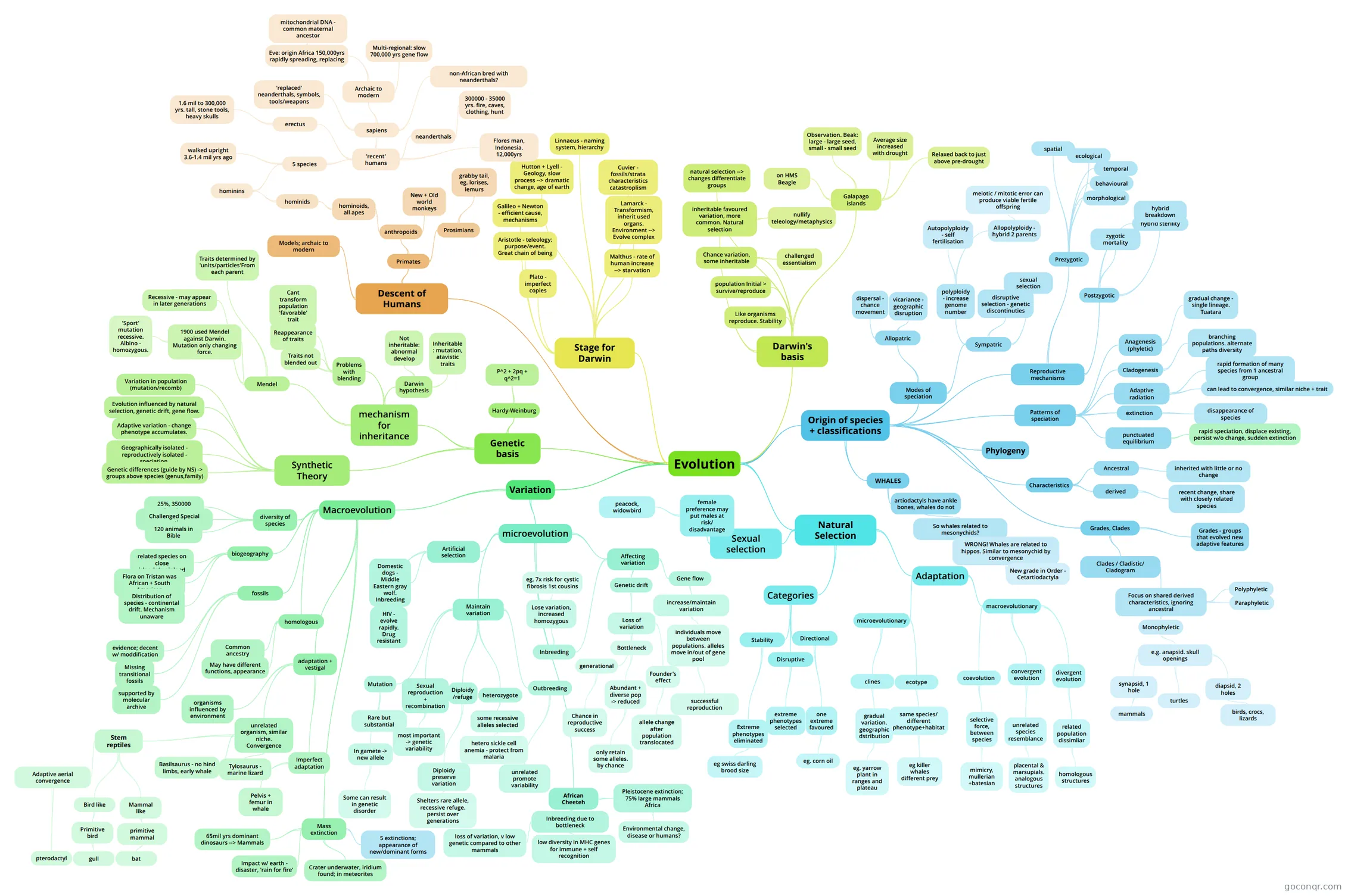
Mind map: Evolution
Conteúdo do mapa
Evolution
- Population units
Stage for Darwin
- Plato - imperfect copies
- Aristotle - teleology: purpose/event. Great chain of being
- Galileo + Newton - efficient cause, mechanisms
- Hutton + Lyell - Geology, slow process --> dramatic change, age of earth
- Cuvier - fossils/strata characteristics catastroplism
- Lamarck - Transformism, inherit used organs. Environment --> Evolve complex
- Malthus - rate of human increase --> starvation
- Linnaeus - naming system, hierarchy
Variation
- Macroevolution
- patterns in species/speciation
- diversity of species
- 25%, 350000 beetles
- Challenged Special creation
- 120 animals in Bible
- Not science, no classfication
- biogeography
- particular kinds of organisms in particular areas. geographical distribution of species.
- related species on close islands/mainland
- Flora on Tristan was African + South American
- Distribution of species - continental drift. Mechanism unaware
- fossils
- evidence; decent w/ moddification
- unlike Cuvier who believed catastrophism
- Missing transitional fossils
- supported by molecular archive
- reconstruct evolutionary relationships w/ DNA +genome
- evidence; decent w/ moddification
- homologous
- Common ancestry
- May have different functions, appearance
- adaptation + vestigal
- organisms influenced by environment
- unrelated organism, similar niche. Convergence
- Basilsaurus - no hind limbs, early whale
- Tylosaurus - marine lizard
- Stem reptiles
- Mammal like
- primitive mammal
- bat
- primitive mammal
- Bird like
- Primitive bird
- gull
- Primitive bird
- Adaptive aerial convergence
- pterodactyl
- Mammal like
- Imperfect adaptation
- Pelvis + femur in whale
- Mass extinction
- 65mil yrs dominant dinosaurs --> Mammals
- adaptive radiation. Niches left by dinosaurs filled by birds and mammals
- Impact w/ earth - disaster, 'rain for fire'
- storms, tsunamis, cold and darkness, greenhouse warming, acid rain and global fire
- 5 extinctions; appearance of new/dominant forms
- Crater underwater, iridium found; in meteorites
- 65mil yrs dominant dinosaurs --> Mammals
- microevolution
- Artificial selection
- Domestic dogs - Middle Eastern gray wolf. Inbreeding
- HIV - evolve rapidly. Drug resistant
- drug resistant strain - 100% of population in a few weeks
- Maintain variation
- Mutation
- Source of genetic novelty. Random - no benefit to cell Most are silent
- In gamete -> new allele
- Some can result in genetic disorder
- Rare but substantial
- Sexual reproduction + recombination
- most important -> genetic variability
- Diploidy /refuge
- Diploidy preserve variation
- Shelters rare allele, recessive refuge. persist over generations
- Diploidy preserve variation
- Outbreeding
- unrelated promote variability
- heterozygote
- some recessive alleles selected
- hetero sickle cell anemia - protect from malaria
- some recessive alleles selected
- Mutation
- Affecting variation
- Genetic drift
- Loss of variation
- Bottleneck
- Abundant + diverse pop -> reduced
- only retain some alleles. by chance
- Abundant + diverse pop -> reduced
- Founder's effect
- allele change after population translocated
- generational
- Evident in small populations
- Chance in reproductive success
- Bottleneck
- Loss of variation
- Gene flow
- increase/maintain variation
- individuals move between populations. alleles move in/out of gene pool
- successful reproduction
- individuals move between populations. alleles move in/out of gene pool
- increase/maintain variation
- Inbreeding
- Matter of degree -common in humans Incest - 1st order cousins
- Lose variation, increased homozygous
- eg. 7x risk for cystic fibrosis 1st cousins
- Genetic drift
- African Cheeteh
- Pleistocene extinction; 75% large mammals Africa
- Environmental change, disease or humans?
- Inbreeding due to bottleneck
- defect sperm, breeding difficulties
- loss of variation, v low genetic compared to other mammals
- low diversity in MHC genes for immune + self recognition
- Could not recognise other cheetahs from self. Successful autograft and allograft.
- Pleistocene extinction; 75% large mammals Africa
- Artificial selection
- Macroevolution
Genetic basis
- mechanism for inheritance
- Problems with blending
- Also thought inheritance by blood
- Cant transform population 'favorable' trait
- Reappearance of traits
- Traits not blended out
- Mendel
- Traits determined by 'units/particles'From each parent
- Recessive - may appear in later generations
- 1900 used Mendel against Darwin. Mutation only changing force.
- Explaining new species and complex forms
- 'Sport' mutation recessive. Albino - homozygous.
- Darwin hypothesis
- Darwin had no mechanism for heredity
- Inheritable : mutation, atavistic traits
- Atavistic traits: silenced but not lost, e.g. dolphin hind limbs
- Not inheritable: abnormal develop
- Problems with blending
- Synthetic Theory
- Variation in population (mutation/recomb)
- Not by needs of organism/ acquired adaptations.
- Evolution influenced by natural selection, genetic drift, gene flow.
- Characterized by changes in gene frequency.
- Adaptive variation - change phenotype accumulates.
- Geographically isolated - reproductively isolated - speciation.
- Genetic differences (guide by NS) -> groups above species (genus,family)
- Variation in population (mutation/recomb)
- Hardy-Weinburg
- No: mutation, gene flow, natural selection, genetic drift. Panmictic, random mating.
- P^2 + 2pq + q^2=1
- mechanism for inheritance
Natural Selection
- Environment + Heritability. Genotypes differ is fitness. Fitness - rate of genotype increase relative
- Categories
- Stability
- Extreme phenotypes eliminated
- eg swiss darling brood size
- Extreme phenotypes eliminated
- Disruptive
- extreme phenotypes selected
- Directional
- one extreme favoured
- eg. corn oil
- one extreme favoured
- Stability
- Sexual selection
- female preference may put males at risk/ disadvantage
- peacock, widowbird
- female preference may put males at risk/ disadvantage
- Adaptation
- microevolutionary
- clines
- gradual variation. geographic dstribution
- eg. yarrow plant in ranges and plateau
- gradual variation. geographic dstribution
- ecotype
- same species/ different phenotype+habitat
- eg killer whales different prey
- same species/ different phenotype+habitat
- clines
- macroevolutionary
- coevolution
- selective force, between species
- mimicry, mullerian +batesian
- selective force, between species
- convergent evolution
- adaptive radiation after mass extinction, leading to convergent evolution
- unrelated species resemblance
- adapting to common enivronment
- placental & marsupials. analogous structures
- divergent evolution
- related population dissimliar
- homologous structures
- related population dissimliar
- coevolution
- microevolutionary
Origin of species + classifications
- Modes of speciation
- BY biological species concept. Species - population that can interbreed with ach other
- Allopatric
- geographically isolated
- dispersal - chance movement
- vicariance - geographic disruption
- Sympatric
- without isolation
- polyploidy - increase genome number
- hybridisation
- Autopolyploidy - self fertilisation
- Allopolyploidy - hybrid 2 parents
- meiotic / mitotic error can produce viable fertile offspring
- sexual selection
- disruptive selection - genetic discontinuties
- Patterns of speciation
- leads to macroevolution
- Anagenesis (phyletic)
- gradual change - single lineage. Tuatara
- Cladogenesis
- branching populations. alternate paths diversity
- Adaptive radiation
- rapid formation of many species from 1 ancestral group
- can lead to convergence, similar niche + trait
- extinction
- fossil show steady extinction, bursts of mass extinction
- disappearance of species
- punctuated equilibrium
- challenged darwin's gradual
- rapid speciation, displace existing, persist w/o change, sudden extinction
- Reproductive mechanisms
- Prezygotic
- may breakdown if in captivity
- spatial
- ecological
- temporal
- behavioural
- morphological
- Postzygotic
- zygotic mortality
- hybrid sterility
- hybrid cannot reproduce
- hybrid breakdown
- hybrid offsprings cannot reproduce
- Prezygotic
- Phylogeny
- evolutionary relationships among organisms.
- Grades, Clades
- Classifications - similarities in characters should to hoomlogous
- Grades - groups that evolved new adaptive features
- Traditional taxonomy relied on morphological similarities based on grades
- Clades / Cladistic/ Cladogram
- focus on shared derived characteristics, ignoring ancestral
- Focus on shared derived characteristics, ignoring ancestral
- Monophyletic
- e.g. anapsid. skull openings
- diapsid, 2 holes
- birds, crocs, lizards
- synapsid, 1 hole
- mammals
- turtles
- diapsid, 2 holes
- e.g. anapsid. skull openings
- Polyphyletic
- Paraphyletic
- Monophyletic
- Characteristics
- Ancestral
- inherited with little or no change
- derived
- recent change, share with closely related species
- Ancestral
- WHALES
- artiodactyls have ankle bones, whales do not
- artiodactyls - cows, camels, deer, hippos
- So whales related to mesonychids?
- like hyenas with hooves, meat eating
- WRONG! Whales are related to hippos. Similar to mesonychid by convergence
- fossils of transitional whale with ankle bone
- New grade in Order - Cetartiodactyla
- suborder - cetacea
- artiodactyls have ankle bones, whales do not
- Modes of speciation
Darwin's basis
- Hypothetico-deductive method observation -> speculate pattern -> further observation.
- Like organisms reproduce. Stability
- population Initial > survive/reproduce
- Chance variation, some inheritable
- Modern species from ancestral forms
- challenged essentialism
- inheritable favoured variation, more common. Natural selection
- mechanism for evolution - natural selection
- nullify teleology/metaphysics
- natural selection --> changes differentiate groups
- Galapago islands
- on HMS Beagle
- Observation. Beak: large - large seed, small - small seed
- Average size increased with drought
- Relaxed back to just above pre-drought
Descent of Humans
- Primates
- Prosimians
- grabby tail, eg. lorises, lemurs
- anthropoids
- hominoids, all apes
- hominids
- greater apes
- hominins
- humans
- 5 species
- Austalopithecus afarensis, A. africanus, A. robustus, A. boisei Homo habilis
- 'recent' humans
- erectus
- 1.6 mil to 300,000 yrs. tall, stone tools, heavy skulls
- neanderthals
- 300000 - 35000 yrs. fire, caves, clothing, hunt
- sapiens
- 'replaced' neanderthals, symbols, tools/weapons
- Archaic to modern
- Eve: origin Africa 150,000yrs rapidly spreading, replacing
- cladogenesis
- mitochondrial DNA - common maternal ancestor
- African expansion
- Multi-regional: slow 700,000 yrs gene flow
- Eve: origin Africa 150,000yrs rapidly spreading, replacing
- non-African bred with neanderthals?
- Flores man, Indonesia. 12,000yrs
- erectus
- walked upright 3.6-1.4 mil yrs ago
- hominids
- New + Old world monkeys
- hominoids, all apes
- Prosimians
- Models; archaic to modern
- Primates
Informações
- Descrição
- Mapa Mental sobre Evolution, criado por 79chlo em 11-05-2014.
- Criado por
- 79chlo
- Visualizações
- 47
- Avaliação