
Mapa mental
Psychology
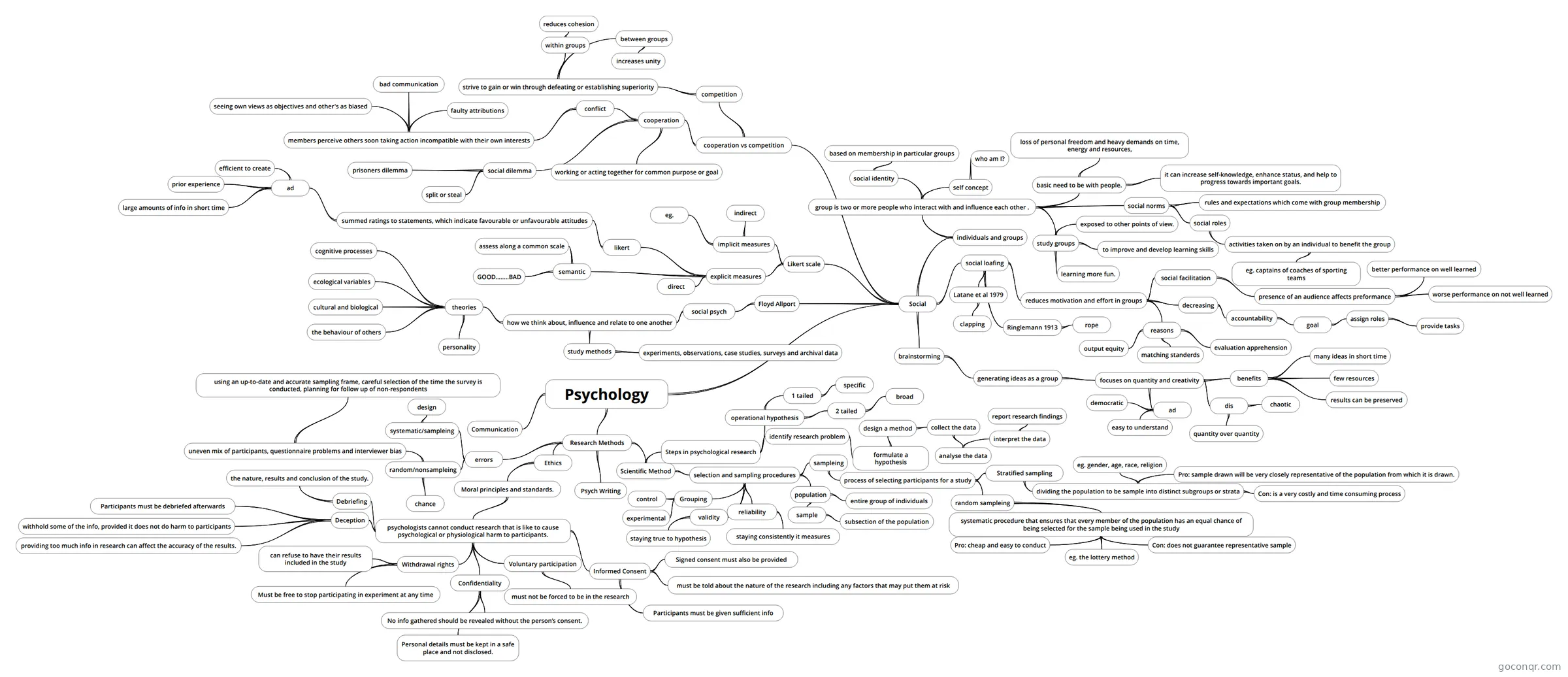
Mind map: Psychology mind map
Conteúdo do mapa
Psychology
Research Methods
- Ethics
- Moral principles and standards.
- psychologists cannot conduct research that is like to cause psychological or physiological harm to participants.
- Confidentiality
- No info gathered should be revealed without the person’s consent.
- Personal details must be kept in a safe place and not disclosed.
- Voluntary participation
- must not be forced to be in the research
- Withdrawal rights
- Must be free to stop participating in experiment at any time
- can refuse to have their results included in the study
- Informed Consent
- Participants must be given sufficient info
- must be told about the nature of the research including any factors that may put them at risk
- Signed consent must also be provided
- Deception
- providing too much info in research can affect the accuracy of the results.
- withhold some of the info, provided it does not do harm to participants
- Participants must be debriefed afterwards
- Debriefing
- the nature, results and conclusion of the study.
- Confidentiality
- psychologists cannot conduct research that is like to cause psychological or physiological harm to participants.
- Moral principles and standards.
- Scientific Method
- Steps in psychological research
- identify research problem
- formulate a hypothesis
- design a method
- collect the data
- analyse the data
- interpret the data
- report research findings
- interpret the data
- analyse the data
- collect the data
- design a method
- formulate a hypothesis
- operational hypothesis
- 1 tailed
- specific
- 2 tailed
- broad
- 1 tailed
- identify research problem
- selection and sampling procedures
- sampleing
- process of selecting participants for a study
- random sampleing
- systematic procedure that ensures that every member of the population has an equal chance of being selected for the sample being used in the study
- eg. the lottery method
- Pro: cheap and easy to conduct
- Con: does not guarantee representative sample
- systematic procedure that ensures that every member of the population has an equal chance of being selected for the sample being used in the study
- Stratified sampling
- dividing the population to be sample into distinct subgroups or strata
- eg. gender, age, race, religion
- Pro: sample drawn will be very closely representative of the population from which it is drawn.
- Con: is a very costly and time consuming process
- dividing the population to be sample into distinct subgroups or strata
- random sampleing
- process of selecting participants for a study
- population
- entire group of individuals
- sample
- subsection of the population
- Grouping
- control
- experimental
- reliability
- staying consistently it measures
- validity
- staying true to hypothesis
- sampleing
- Steps in psychological research
- Psych Writing
- errors
- systematic/sampleing
- design
- random/nonsampleing
- chance
- uneven mix of participants, questionnaire problems and interviewer bias
- using an up-to-date and accurate sampling frame, careful selection of the time the survey is conducted, planning for follow up of non-respondents
- systematic/sampleing
- Ethics
Social
- individuals and groups
- group is two or more people who interact with and influence each other .
- basic need to be with people.
- it can increase self-knowledge, enhance status, and help to progress towards important goals.
- loss of personal freedom and heavy demands on time, energy and resources,
- study groups
- exposed to other points of view.
- learning more fun.
- to improve and develop learning skills
- social norms
- rules and expectations which come with group membership
- social roles
- activities taken on by an individual to benefit the group
- eg. captains of coaches of sporting teams
- activities taken on by an individual to benefit the group
- self concept
- who am I?
- social identity
- based on membership in particular groups
- basic need to be with people.
- group is two or more people who interact with and influence each other .
- cooperation vs competition
- competition
- strive to gain or win through defeating or establishing superiority
- within groups
- reduces cohesion
- between groups
- increases unity
- within groups
- strive to gain or win through defeating or establishing superiority
- cooperation
- working or acting together for common purpose or goal
- conflict
- members perceive others soon taking action incompatible with their own interests
- bad communication
- faulty attributions
- seeing own views as objectives and other's as biased
- members perceive others soon taking action incompatible with their own interests
- social dilemma
- prisoners dilemma
- split or steal
- competition
- social loafing
- reduces motivation and effort in groups
- social facilitation
- presence of an audience affects preformance
- better performance on well learned
- worse performance on not well learned
- presence of an audience affects preformance
- reasons
- output equity
- evaluation apprehension
- matching standerds
- decreasing
- accountability
- goal
- assign roles
- provide tasks
- assign roles
- goal
- accountability
- social facilitation
- Ringlemann 1913
- rope
- Latane et al 1979
- clapping
- reduces motivation and effort in groups
- brainstorming
- generating ideas as a group
- focuses on quantity and creativity
- benefits
- many ideas in short time
- few resources
- results can be preserved
- ad
- democratic
- easy to understand
- dis
- quantity over quantity
- chaotic
- benefits
- focuses on quantity and creativity
- generating ideas as a group
- Floyd Allport
- social psych
- how we think about, influence and relate to one another
- theories
- the behaviour of others
- cognitive processes
- ecological variables
- cultural and biological
- personality
- study methods
- experiments, observations, case studies, surveys and archival data
- theories
- how we think about, influence and relate to one another
- social psych
- Likert scale
- implicit measures
- indirect
- eg.
- explicit measures
- direct
- likert
- summed ratings to statements, which indicate favourable or unfavourable attitudes
- ad
- efficient to create
- prior experience
- large amounts of info in short time
- ad
- summed ratings to statements, which indicate favourable or unfavourable attitudes
- semantic
- assess along a common scale
- GOOD........BAD
- implicit measures
- individuals and groups
Communication
Informações
- Descrição
- Psychology WACE Unit 1
- Criado por
- jess hyland
- Visualizações
- 6
- Avaliação
Mais sobre Research Ethics and Guidelines