
Mapa mental
Evolution
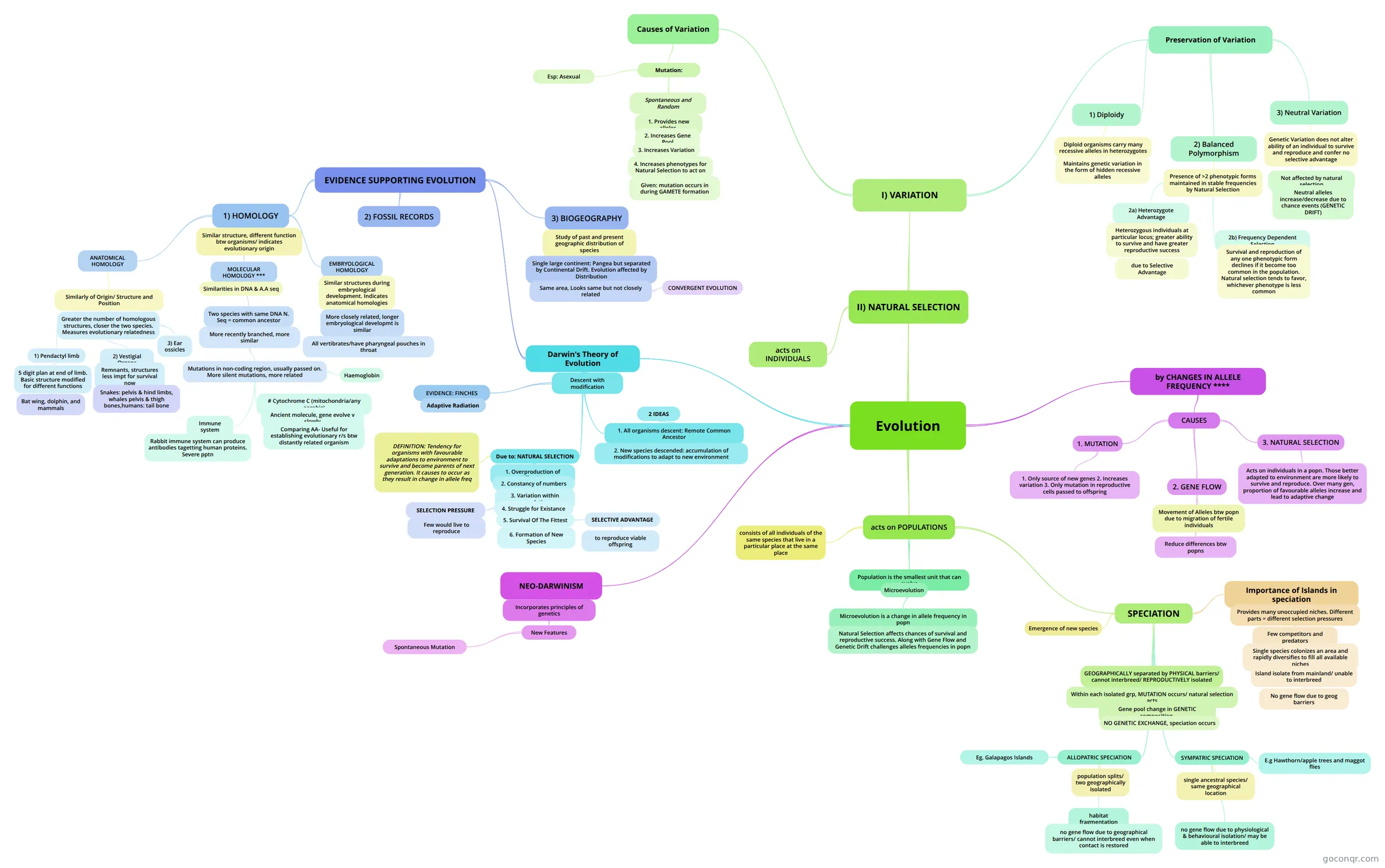
Mind map: Evolution
Conteúdo do mapa
Evolution
Darwin's Theory of Evolution
- Descent with modification
- EVIDENCE: FINCHES
- Adaptive Radiation
- EVIDENCE: FINCHES
- Due to: NATURAL SELECTION
- 1. Overproduction of Offspring
- 2. Constancy of numbers
- 3. Variation within population
- 4. Struggle for Existance
- SELECTION PRESSURE
- Few would live to reproduce
- 5. Survival Of The Fittest
- SELECTIVE ADVANTAGE
- to reproduce viable offspring
- 6. Formation of New Species
- SELECTIVE ADVANTAGE
- SELECTION PRESSURE
- 4. Struggle for Existance
- 3. Variation within population
- 2. Constancy of numbers
- DEFINITION: Tendency for organisms with favourable adaptations to environment to survive and become parents of next generation. It causes to occur as they result in change in allele freq
- 1. Overproduction of Offspring
- 1. All organisms descent: Remote Common Ancestor
- 2. New species descended: accumulation of modifications to adapt to new environment
- 2 IDEAS
- EVIDENCE SUPPORTING EVOLUTION
- 1) HOMOLOGY
- ANATOMICAL HOMOLOGY
- Similarly of Origin/ Structure and Position
- Greater the number of homologous structures, closer the two species. Measures evolutionary relatedness
- 1) Pendactyl limb
- 5 digit plan at end of limb. Basic structure modified for different functions
- Bat wing, dolphin, and mammals
- 5 digit plan at end of limb. Basic structure modified for different functions
- 2) Vestigial Organs
- Remnants, structures less impt for survival now
- Snakes: pelvis & hind limbs, whales pelvis & thigh bones,humans: tail bone
- Remnants, structures less impt for survival now
- 3) Ear ossicles
- 1) Pendactyl limb
- Greater the number of homologous structures, closer the two species. Measures evolutionary relatedness
- Similarly of Origin/ Structure and Position
- EMBRYOLOGICAL HOMOLOGY
- Similar structures during embryological development. Indicates anatomical homologies
- More closely related, longer embryological developmt is similar
- All vertibrates/have pharyngeal pouches in throat
- Similar structure, different function btw organisms/ indicates evolutionary origin
- MOLECULAR HOMOLOGY ***
- Similarities in DNA & A.A seq
- Two species with same DNA N. Seq = common ancestor
- More recently branched, more similar
- Mutations in non-coding region, usually passed on. More silent mutations, more related
- # Cytochrome C (mitochondria/any aerobic)
- Ancient molecule, gene evolve v slowly
- Comparing AA- Useful for establishing evolutionary r/s btw distantly related organism
- Ancient molecule, gene evolve v slowly
- Haemoglobin
- Immune system
- Rabbit immune system can produce antibodies tagetting human proteins. Severe pptn
- # Cytochrome C (mitochondria/any aerobic)
- Mutations in non-coding region, usually passed on. More silent mutations, more related
- More recently branched, more similar
- ANATOMICAL HOMOLOGY
- 3) BIOGEOGRAPHY
- Study of past and present geographic distribution of species
- Single large continent: Pangea but separated by Continental Drift. Evolution affected by Distribution
- Same area, Looks same but not closely related
- CONVERGENT EVOLUTION
- Same area, Looks same but not closely related
- 2) FOSSIL RECORDS
- 1) HOMOLOGY
- Descent with modification
II) NATURAL SELECTION
- I) VARIATION
- Causes of Variation
- Mutation:
- 1. Provides new alleles.
- 2. Increases Gene Pool
- 3. Increases Variation
- 4. Increases phenotypes for Natural Selection to act on
- Given: mutation occurs in during GAMETE formation
- 4. Increases phenotypes for Natural Selection to act on
- 3. Increases Variation
- 2. Increases Gene Pool
- Spontaneous and Random
- Esp: Asexual
- 1. Provides new alleles.
- Mutation:
- Preservation of Variation
- 1) Diploidy
- Diploid organisms carry many recessive alleles in heterozygotes
- Maintains genetic variation in the form of hidden recessive alleles
- Diploid organisms carry many recessive alleles in heterozygotes
- 2) Balanced Polymorphism
- Presence of >2 phenotypic forms maintained in stable frequencies by Natural Selection
- 2a) Heterozygote Advantage
- Heterozygous individuals at particular locus; greater ability to survive and have greater reproductive success
- due to Selective Advantage
- Heterozygous individuals at particular locus; greater ability to survive and have greater reproductive success
- 2b) Frequency Dependent Selection
- Survival and reproduction of any one phenotypic form declines if it become too common in the population. Natural selection tends to favor, whichever phenotype is less common
- 2a) Heterozygote Advantage
- Presence of >2 phenotypic forms maintained in stable frequencies by Natural Selection
- 3) Neutral Variation
- Genetic Variation does not alter ability of an individual to survive and reproduce and confer no selective advantage
- Not affected by natural selection
- Neutral alleles increase/decrease due to chance events (GENETIC DRIFT)
- Not affected by natural selection
- Genetic Variation does not alter ability of an individual to survive and reproduce and confer no selective advantage
- 1) Diploidy
- Causes of Variation
- acts on INDIVIDUALS
- I) VARIATION
NEO-DARWINISM
- Incorporates principles of genetics
- New Features
- Spontaneous Mutation
- New Features
- Incorporates principles of genetics
acts on POPULATIONS
- consists of all individuals of the same species that live in a particular place at the same place
- Population is the smallest unit that can evolve
- Microevolution
- Microevolution is a change in allele frequency in popn
- Natural Selection affects chances of survival and reproductive success. Along with Gene Flow and Genetic Drift challenges alleles frequencies in popn
- SPECIATION
- Emergence of new species
- GEOGRAPHICALLY separated by PHYSICAL barriers/ cannot interbreed/ REPRODUCTIVELY isolated
- Within each isolated grp, MUTATION occurs/ natural selection acts
- Gene pool change in GENETIC composition.
- NO GENETIC EXCHANGE, speciation occurs
- ALLOPATRIC SPECIATION
- population splits/ two geographically isolated
- Eg. Galapagos Islands
- habitat fragmentation
- no gene flow due to geographical barriers/ cannot interbreed even when contact is restored
- SYMPATRIC SPECIATION
- single ancestral species/ same geographical location
- E.g Hawthorn/apple trees and maggot flies
- no gene flow due to physiological & behavioural isolation/ may be able to interbreed
- Importance of Islands in speciation
- Provides many unoccupied niches. Different parts = different selection pressures
- Few competitors and predators
- Single species colonizes an area and rapidly diversifies to fill all available niches
- Island isolate from mainland/ unable to interbreed
- No gene flow due to geog barriers
- Island isolate from mainland/ unable to interbreed
- Single species colonizes an area and rapidly diversifies to fill all available niches
- Few competitors and predators
- Provides many unoccupied niches. Different parts = different selection pressures
by CHANGES IN ALLELE FREQUENCY ****
- CAUSES
- 1. MUTATION
- 1. Only source of new genes 2. Increases variation 3. Only mutation in reproductive cells passed to offspring
- 2. GENE FLOW
- Reduce differences btw popns
- Movement of Alleles btw popn due to migration of fertile individuals
- 3. NATURAL SELECTION
- Acts on individuals in a popn. Those better adapted to environment are more likely to survive and reproduce. Over many gen, proportion of favourable alleles increase and lead to adaptive change
- 1. MUTATION
- CAUSES
Informações
- Descrição
- Mapa Mental sobre Evolution, criado por heartsandkisses em 28-05-2014.
- Criado por
- heartsandkisses
- Visualizações
- 21
- Avaliação
Mais sobre History of Evolutionary Thought