
Mapa mental
(Chapter 3) The Developing Brain - Social Brain Structures & Functions
Conteúdo do mapa
(Chapter 3) The Developing Brain - Social Brain Structures & Functions
1. Plastic patterns of Neural Organization
- The brain is plastic
- Neural tissue has the capacity to adapt to the world by changing how its functions are organized.
- A slower rate of maturation favors larger brains: Enriched environment is associated with growth of existing brain cells and thus an increase in brain size
- The nervous system’s potential for physical or chemical change that enhances its adaptability to environmental change and its ability to compensate for injury.
- A slower rate of maturation favors larger brains: Enriched environment is associated with growth of existing brain cells and thus an increase in brain size
- Neural tissue has the capacity to adapt to the world by changing how its functions are organized.
- The pattern of glucose merabolism
- Neonatal period: Low in most of the Cerebral Cortes, but high metabolic activity in the Limbic System - emotional development
- Frontal Cortex: the last brain area to display an increase in glucose activity (%6-8 moths)
- Phenotypic Plasticity
- Individual genotype (genetic makeup) interacts with the environment to elicit a specific phenotype from a large genetic repertoire of possibilities
- Critical and sensitive periods
- Period of exuberant neural growth
- Critical Period
- A time when a particular part of the body is most easily influenced or vulnerable to the lack of stimulation or to environmental effects
- Prenatal exposure to substance, exposure to light during the first few months of life (at least 6 months)
- Sensitive Period
- The broad windows of opportunity for certain types of learning; less precise and a longer time period compared to critical period.
- First 18 months: the right hemisphere has high growth rates
- Sensory and motor capabilities. Basic structure of attachment & emotional regulation
- The left hemisphere: slow growth, some reserved for later language development
- At the end of the 1st year: Corpus callosum begins to develop - integration of the hemispheres
- During the 2nd year: LH - Language development. Locomotion allow the exploration of social & physical world
- The brain is plastic
2. Overview of Human Brain Function and Structure
- The brain primary function is to produce behavior (movement)
- To do so it must: a) Receive info (stimulus) @ the world, objects around us. Otherwise the brain can't produce an appropriate response
- Organs of the nervous system receive info from the world & converted into biological activity that produces perception, or subjective experiences of reality
- PLASTIC: neural tissue has the capacity to adapt to the world by changing how its functions are organized
- Organs of the nervous system receive info from the world & converted into biological activity that produces perception, or subjective experiences of reality
- To do so it must: a) Receive info (stimulus) @ the world, objects around us. Otherwise the brain can't produce an appropriate response
- The brain primary function is to produce behavior (movement)
3. Functional Organization of the Nervous System
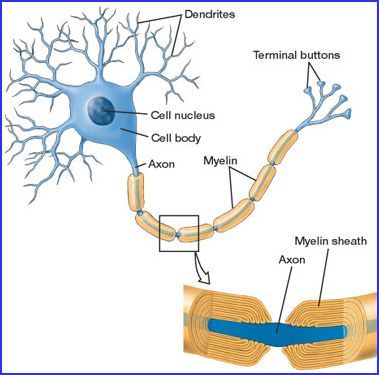
- 1.NEURONS: Basic units of the NS.
- 2. GLIAL CELLS:
- Role in construction , organization & maintenance of neural system
- Aprox 100 billion
- Role in construction , organization & maintenance of neural system
- Aprx 80 billion
- Myelination: Indicator of maturity of a neural network
- 2. GLIAL CELLS:
- 1. Central Nervous System (CNS)
- 2. Pheripheral Nervous System (PNS)
- Somatic Nervous system
- Transmit sensation, produces movement
- Cranial Nerves & Spinal Nerves
- Automatic NS
- Balance Internal functions - For rest and digest
- Sympathetic division (Arousing)
- Parasympathetic division (calming)
- Sympathetic division (Arousing)
- Balance Internal functions - For rest and digest
- Enteric NS
- Controls the gut
- mostly operates autonomously
- Somatic Nervous system
- Brain & Spinal Cord
- Direction of neural info
- Afferent
- Efferent
- 2. Pheripheral Nervous System (PNS)
- 1.NEURONS: Basic units of the NS.
4. Surface features of the brain
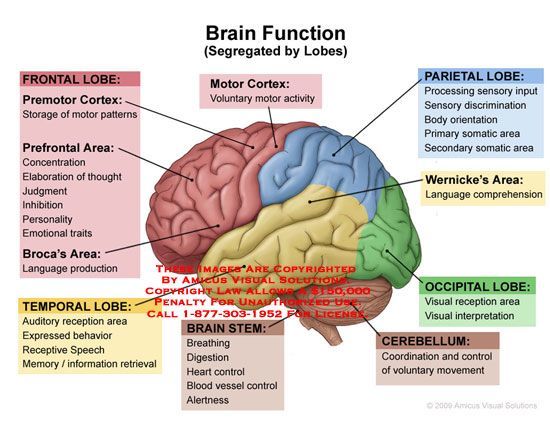
- Cerebrum
- Cerebellum: Little brain
- Brainstem
- Central structures of the brain, including the hindbrain, midbrain, thalamus, and hypothalamus, responsible for most unconscious behavior
- Involves coordination of motor & maybe other mental process
- Brainstem
- Major structure of the forebrain, consisting of two virtually identi cal left and right hemispheres
- Cerebellum: Little brain
- Cerebral circulation
- Surface boold vessels
- Anterior, Middle & Posterior arteries
- Stroke
- Result of severe interruption of blood flow
- Because the brain connections are crossed Left Hemisphere affects sensation & movement on the right side of the body
- Surface boold vessels
- Cerebrum
5. Internal features of the brain
- Macro
- Grey Matter
- Composed of cell bodies & blood vesels
- White Matter
- Areas of the nervous system rich in fat-sheathed neural axons
- Corpus Callosum
- Fiber system connecting the 2 cerebral hemispheres
- Contains @ 200 million nerves
- Fiber system connecting the 2 cerebral hemispheres
- Grey Matter
- Four ventricles
- Cavities in the brain that contain cerebrospinal fluid
- 2 Lateral ventricles (right & left) Third ventricle & Four ventricle
- CBS Fluid: cushions the brain & meningitis
- Cavities in the brain that contain cerebrospinal fluid
- Macro
Brain through life
- 6. The teenage brain
- Goes through a process of selection and reorganization of neural networks from the onset of puberty into the early 20s
- Loss of the overall number of neurons
- Faster & more efficient info
- # of myelinated fibers connecting functional neural networks
- Faster & more efficient info
- Social transitions (creation of flia & peers)
- Change in reward circuitry: risk taking decisions - poor decision making abilities
- Loss of the overall number of neurons
- Goes through a process of selection and reorganization of neural networks from the onset of puberty into the early 20s
- 7. Adult brain
- Prefrontal cortex continues to develop
- > pruning of grey matter & increase white matter connectivity
- Coupled with decreasing hormonal and emotional influences
- lateral specialization in the frontal lobe peaks- less efficient stuff gets eliminated (speed over deeper consideration of problems)
- # of neurons within the cortex continues to decrease: adaptation to new envinroments/processing capabilities
- lateral specialization in the frontal lobe peaks- less efficient stuff gets eliminated (speed over deeper consideration of problems)
- Coupled with decreasing hormonal and emotional influences
- > pruning of grey matter & increase white matter connectivity
- Prefrontal cortex continues to develop
- 8. Aging brain
- Neural networks are more vulnerable
- The dorsal and lateral areas of the prefrontal lobe show the earliest signs of aging
- Structural changes in the frontal lobe + shrinkage in lower brain nuclei (involved in attentional and memory functions)
- The orbital medial prefrontal cortex systems continue to develop – reflects the retention and improvement of social judgement and empathy
- Structural changes in the frontal lobe + shrinkage in lower brain nuclei (involved in attentional and memory functions)
- The dorsal and lateral areas of the prefrontal lobe show the earliest signs of aging
- Neural networks are more vulnerable
- 6. The teenage brain
Imagens e arquivos do mapa
Informações
- Descrição
- Biology Mapa Mental sobre (Chapter 3) The Developing Brain - Social Brain Structures & Functions, criado por keila aruni em 10-07-2017.
- Criado por
- keila aruni
- Visualizações
- 0
- Avaliação