
Mapa mental
Ethics in Psychology
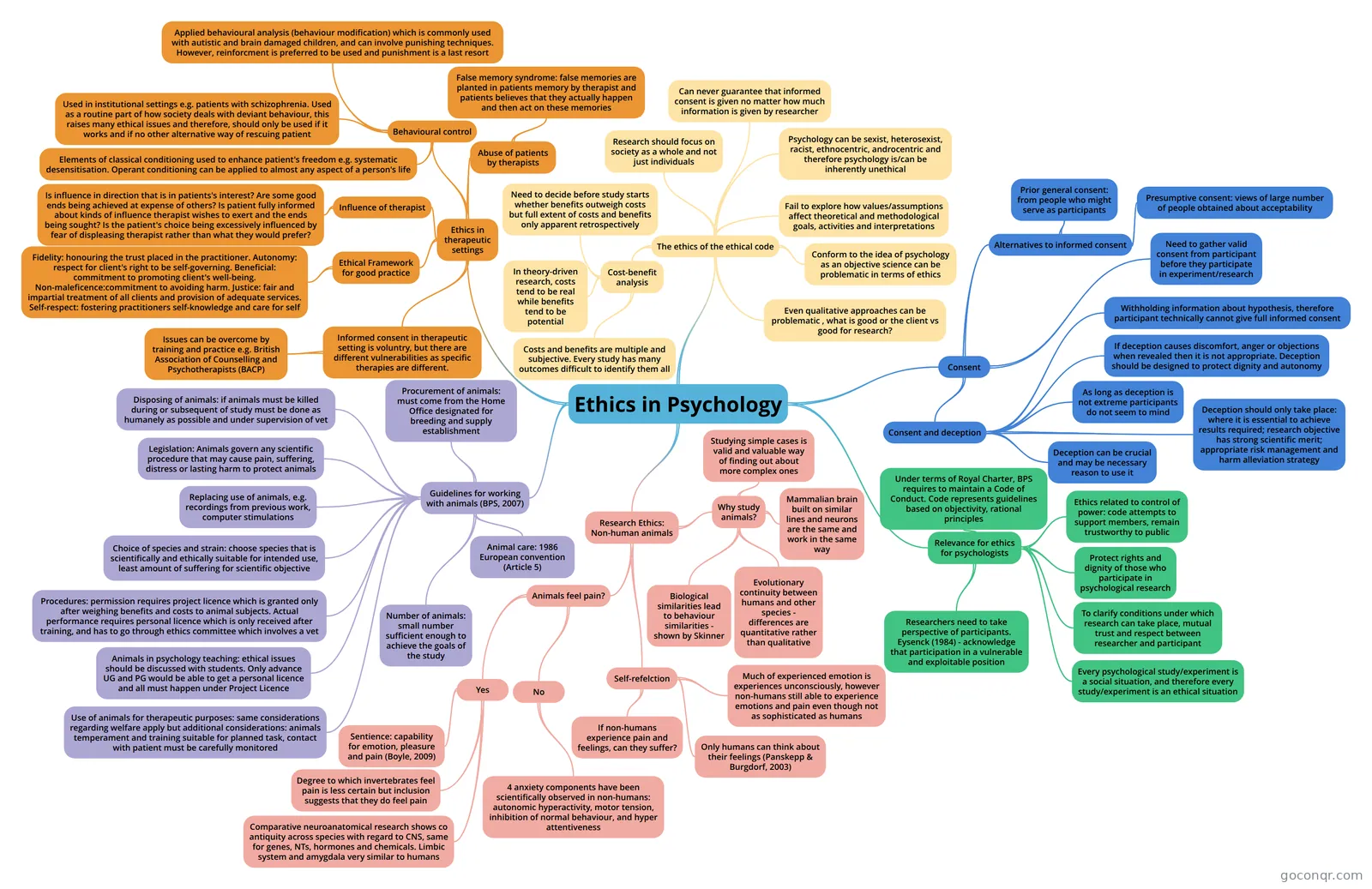
Mind map: Ethics in psychology
Conteúdo do mapa
Ethics in Psychology
Research Ethics: Non-human animals
- Why study animals?
- Evolutionary continuity between humans and other species - differences are quantitative rather than qualitative
- Mammalian brain built on similar lines and neurons are the same and work in the same way
- Biological similarities lead to behaviour similarities - shown by Skinner
- Studying simple cases is valid and valuable way of finding out about more complex ones
- Animals feel pain?
- Yes
- Sentience: capability for emotion, pleasure and pain (Boyle, 2009)
- Comparative neuroanatomical research shows co antiquity across species with regard to CNS, same for genes, NTs, hormones and chemicals. Limbic system and amygdala very similar to humans
- Degree to which invertebrates feel pain is less certain but inclusion suggests that they do feel pain
- No
- 4 anxiety components have been scientifically observed in non-humans: autonomic hyperactivity, motor tension, inhibition of normal behaviour, and hyper attentiveness
- Yes
- Self-refelction
- If non-humans experience pain and feelings, can they suffer?
- Only humans can think about their feelings (Panskepp & Burgdorf, 2003)
- Much of experienced emotion is experiences unconsciously, however non-humans still able to experience emotions and pain even though not as sophisticated as humans
- Why study animals?
Relevance for ethics for psychologists
- Every psychological study/experiment is a social situation, and therefore every study/experiment is an ethical situation
- Under terms of Royal Charter, BPS requires to maintain a Code of Conduct. Code represents guidelines based on objectivity, rational principles
- Ethics related to control of power: code attempts to support members, remain trustworthy to public
- To clarify conditions under which research can take place, mutual trust and respect between researcher and participant
- Protect rights and dignity of those who participate in psychological research
- Researchers need to take perspective of participants. Eysenck (1984) - acknowledge that participation in a vulnerable and exploitable position
The ethics of the ethical code
- Cost-benefit analysis
- Costs and benefits are multiple and subjective. Every study has many outcomes difficult to identify them all
- In theory-driven research, costs tend to be real while benefits tend to be potential
- Need to decide before study starts whether benefits outweigh costs but full extent of costs and benefits only apparent retrospectively
- Research should focus on society as a whole and not just individuals
- Can never guarantee that informed consent is given no matter how much information is given by researcher
- Psychology can be sexist, heterosexist, racist, ethnocentric, androcentric and therefore psychology is/can be inherently unethical
- Fail to explore how values/assumptions affect theoretical and methodological goals, activities and interpretations
- Conform to the idea of psychology as an objective science can be problematic in terms of ethics
- Even qualitative approaches can be problematic , what is good or the client vs good for research?
- Cost-benefit analysis
Ethics in therapeutic settings
- Informed consent in therapeutic setting is voluntry, but there are different vulnerabilities as specific therapies are different.
- Issues can be overcome by training and practice e.g. British Association of Counselling and Psychotherapists (BACP)
- Ethical Framework for good practice
- Fidelity: honouring the trust placed in the practitioner. Autonomy: respect for client's right to be self-governing. Beneficial: commitment to promoting client's well-being. Non-maleficence:commitment to avoiding harm. Justice: fair and impartial treatment of all clients and provision of adequate services. Self-respect: fostering practitioners self-knowledge and care for self
- Influence of therapist
- Is influence in direction that is in patients's interest? Are some good ends being achieved at expense of others? Is patient fully informed about kinds of influence therapist wishes to exert and the ends being sought? Is the patient's choice being excessively influenced by fear of displeasing therapist rather than what they would prefer?
- Behavioural control
- Elements of classical conditioning used to enhance patient's freedom e.g. systematic desensitisation. Operant conditioning can be applied to almost any aspect of a person's life
- Used in institutional settings e.g. patients with schizophrenia. Used as a routine part of how society deals with deviant behaviour, this raises many ethical issues and therefore, should only be used if it works and if no other alternative way of rescuing patient
- Applied behavioural analysis (behaviour modification) which is commonly used with autistic and brain damaged children, and can involve punishing techniques. However, reinforcment is preferred to be used and punishment is a last resort
- Abuse of patients by therapists
- False memory syndrome: false memories are planted in patients memory by therapist and patients believes that they actually happen and then act on these memories
- Informed consent in therapeutic setting is voluntry, but there are different vulnerabilities as specific therapies are different.
Consent
- Need to gather valid consent from participant before they participate in experiment/research
- Consent and deception
- Withholding information about hypothesis, therefore participant technically cannot give full informed consent
- If deception causes discomfort, anger or objections when revealed then it is not appropriate. Deception should be designed to protect dignity and autonomy
- Deception should only take place: where it is essential to achieve results required; research objective has strong scientific merit; appropriate risk management and harm alleviation strategy
- As long as deception is not extreme participants do not seem to mind
- Deception can be crucial and may be necessary reason to use it
- Alternatives to informed consent
- Presumptive consent: views of large number of people obtained about acceptability
- Prior general consent: from people who might serve as participants
Guidelines for working with animals (BPS, 2007)
- Legislation: Animals govern any scientific procedure that may cause pain, suffering, distress or lasting harm to protect animals
- Replacing use of animals, e.g. recordings from previous work, computer stimulations
- Choice of species and strain: choose species that is scientifically and ethically suitable for intended use, least amount of suffering for scientific objective
- Number of animals: small number sufficient enough to achieve the goals of the study
- Procedures: permission requires project licence which is granted only after weighing benefits and costs to animal subjects. Actual performance requires personal licence which is only received after training, and has to go through ethics committee which involves a vet
- Procurement of animals: must come from the Home Office designated for breeding and supply establishment
- Animal care: 1986 European convention (Article 5)
- Disposing of animals: if animals must be killed during or subsequent of study must be done as humanely as possible and under supervision of vet
- Animals in psychology teaching: ethical issues should be discussed with students. Only advance UG and PG would be able to get a personal licence and all must happen under Project Licence
- Use of animals for therapeutic purposes: same considerations regarding welfare apply but additional considerations: animals temperament and training suitable for planned task, contact with patient must be carefully monitored
Informações
- Descrição
- year 2 Mapa Mental sobre Ethics in Psychology, criado por Lacey Jones em 11-07-2017.
- Criado por
- Lacey Jones
- Visualizações
- 1
- Avaliação
Mais sobre Research Ethics and Guidelines