
Mapa mental
Neurologic System
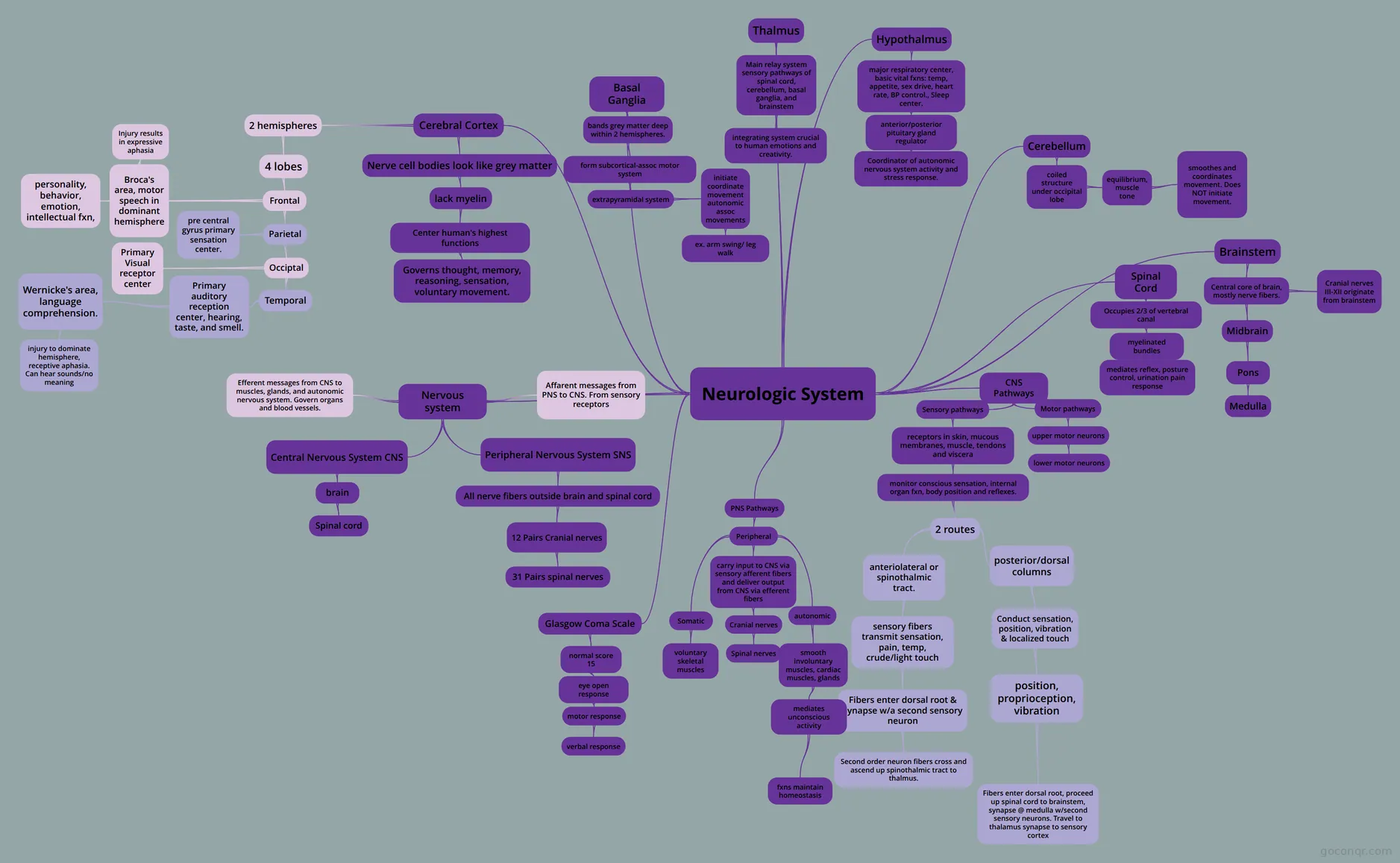
Mind map: neurologic system
Conteúdo do mapa
Neurologic System
Nervous system
- Central Nervous System CNS
- brain
- Spinal cord
- brain
- Peripheral Nervous System SNS
- All nerve fibers outside brain and spinal cord
- 12 Pairs Cranial nerves
- 31 Pairs spinal nerves
- 12 Pairs Cranial nerves
- All nerve fibers outside brain and spinal cord
- Affarent messages from PNS to CNS. From sensory receptors
- Efferent messages from CNS to muscles, glands, and autonomic nervous system. Govern organs and blood vessels.
- Central Nervous System CNS
Cerebral Cortex
- Nerve cell bodies look like grey matter
- lack myelin
- Center human's highest functions
- Governs thought, memory, reasoning, sensation, voluntary movement.
- Center human's highest functions
- lack myelin
- 2 hemispheres
- 4 lobes
- Frontal
- Parietal
- Occiptal
- Temporal
- Primary auditory reception center, hearing, taste, and smell.
- Wernicke's area, language comprehension.
- injury to dominate hemisphere, receptive aphasia. Can hear sounds/no meaning
- Wernicke's area, language comprehension.
- Primary auditory reception center, hearing, taste, and smell.
- Primary Visual receptor center
- Temporal
- pre central gyrus primary sensation center.
- Occiptal
- personality, behavior, emotion, intellectual fxn,
- Broca's area, motor speech in dominant hemisphere
- Injury results in expressive aphasia
- Parietal
- Frontal
- 4 lobes
- Nerve cell bodies look like grey matter
Basal Ganglia
- bands grey matter deep within 2 hemispheres.
- form subcortical-assoc motor system
- extrapyramidal system
- initiate coordinate movement autonomic assoc movements
- ex. arm swing/ leg walk
- initiate coordinate movement autonomic assoc movements
- extrapyramidal system
- form subcortical-assoc motor system
- bands grey matter deep within 2 hemispheres.
Thalmus
- Main relay system sensory pathways of spinal cord, cerebellum, basal ganglia, and brainstem
- integrating system crucial to human emotions and creativity.
- Main relay system sensory pathways of spinal cord, cerebellum, basal ganglia, and brainstem
Hypothalmus
- major respiratory center, basic vital fxns: temp, appetite, sex drive, heart rate, BP control., Sleep center.
- anterior/posterior pituitary gland regulator
- Coordinator of autonomic nervous system activity and stress response.
- anterior/posterior pituitary gland regulator
- major respiratory center, basic vital fxns: temp, appetite, sex drive, heart rate, BP control., Sleep center.
Cerebellum
- coiled structure under occipital lobe
- equilibrium, muscle tone
- smoothes and coordinates movement. Does NOT initiate movement.
- equilibrium, muscle tone
- coiled structure under occipital lobe
Brainstem
- Central core of brain, mostly nerve fibers.
- Cranial nerves III-XII originate from brainstem
- Midbrain
- Pons
- Medulla
- Pons
- Central core of brain, mostly nerve fibers.
Spinal Cord
- Occupies 2/3 of vertebral canal
- myelinated bundles
- mediates reflex, posture control, urination pain response
- myelinated bundles
- Occupies 2/3 of vertebral canal
CNS Pathways
- Sensory pathways
- receptors in skin, mucous membranes, muscle, tendons and viscera
- monitor conscious sensation, internal organ fxn, body position and reflexes.
- 2 routes
- anteriolateral or spinothalmic tract.
- sensory fibers transmit sensation, pain, temp, crude/light touch
- Fibers enter dorsal root & synapse w/a second sensory neuron
- Second order neuron fibers cross and ascend up spinothalmic tract to thalmus.
- Fibers enter dorsal root & synapse w/a second sensory neuron
- sensory fibers transmit sensation, pain, temp, crude/light touch
- posterior/dorsal columns
- Conduct sensation, position, vibration & localized touch
- position, proprioception, vibration
- Fibers enter dorsal root, proceed up spinal cord to brainstem, synapse @ medulla w/second sensory neurons. Travel to thalamus synapse to sensory cortex
- position, proprioception, vibration
- Conduct sensation, position, vibration & localized touch
- anteriolateral or spinothalmic tract.
- 2 routes
- monitor conscious sensation, internal organ fxn, body position and reflexes.
- receptors in skin, mucous membranes, muscle, tendons and viscera
- Motor pathways
- upper motor neurons
- lower motor neurons
- upper motor neurons
- Sensory pathways
PNS Pathways
- Peripheral
- Somatic
- voluntary skeletal muscles
- autonomic
- smooth involuntary muscles, cardiac muscles, glands
- mediates unconscious activity
- fxns maintain homeostasis
- mediates unconscious activity
- smooth involuntary muscles, cardiac muscles, glands
- carry input to CNS via sensory afferent fibers and deliver output from CNS via efferent fibers
- Cranial nerves
- Spinal nerves
- Cranial nerves
- Somatic
- Peripheral
Glasgow Coma Scale
- normal score 15
- eye open response
- motor response
- verbal response
- motor response
- eye open response
- normal score 15