
Mapa mental
Chp 25- Blood
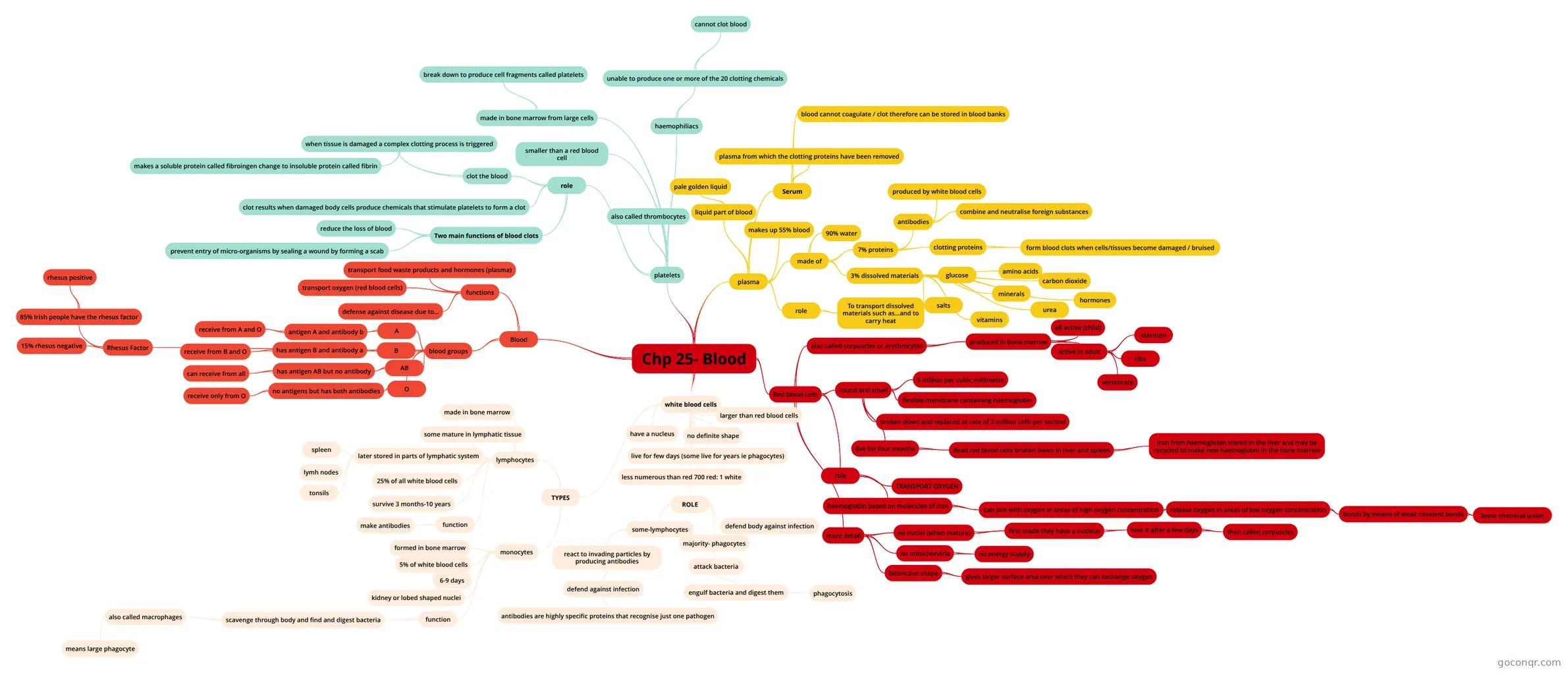
Mind map: Blood
Conteúdo do mapa
Chp 25- Blood
plasma
- liquid part of blood
- pale golden liquid
- makes up 55% blood
- made of
- 90% water
- 7% proteins
- antibodies
- produced by white blood cells
- combine and neutralise foreign substances
- clotting proteins
- form blood clots when cells/tissues become damaged / bruised
- antibodies
- 3% dissolved materials
- glucose
- salts
- minerals
- amino acids
- vitamins
- carbon dioxide
- urea
- hormones
- role
- To transport dissolved materials such as...and to carry heat
- Serum
- plasma from which the clotting proteins have been removed
- blood cannot coagulate / clot therefore can be stored in blood banks
- liquid part of blood
Red blood cells
- also called corpuscles or erythrocytes
- produced in bone marrow
- all active (child)
- active in adult
- sternum
- ribs
- vertebrate
- produced in bone marrow
- round and small
- 5 million per cubic millimetre
- flexible membrane containing haemoglobin
- broken down and replaced at rate of 3 million cells per second
- live for four months
- dead red blood cells broken down in liver and spleen
- iron from haemoglobin stored in the liver and may be recycled to make new haemoglobin in the bone marrow
- dead red blood cells broken down in liver and spleen
- role
- TRANSPORT OXYGEN
- haemoglobin based on molecules of iron
- can join with oxygen in areas of high oxygen concentration
- release oxygen in areas of low oxygen concentration
- bonds by means of weak covalent bonds
- loose chemical union
- bonds by means of weak covalent bonds
- release oxygen in areas of low oxygen concentration
- can join with oxygen in areas of high oxygen concentration
- more detail
- no nuclei (when mature)
- first made they have a nucleus
- lose it after a few days
- then called corpuscles
- lose it after a few days
- first made they have a nucleus
- no mitochondria
- no energy supply
- biconcave shape
- gives larger surface area over which they can exchange oxygen
- no nuclei (when mature)
- also called corpuscles or erythrocytes
white blood cells
- larger than red blood cells
- no definite shape
- have a nucleus
- live for few days (some live for years ie phagocytes)
- less numerous than red 700 red: 1 white
- ROLE
- defend body against infection
- majority- phagocytes
- attack bacteria
- engulf bacteria and digest them
- phagocytosis
- engulf bacteria and digest them
- attack bacteria
- some-lymphocytes
- react to invading particles by producing antibodies
- defend against infection
- antibodies are highly specific proteins that recognise just one pathogen
- defend against infection
- react to invading particles by producing antibodies
- TYPES
- lymphocytes
- made in bone marrow
- some mature in lymphatic tissue
- later stored in parts of lymphatic system
- spleen
- lymh nodes
- tonsils
- 25% of all white blood cells
- survive 3 months-10 years
- function
- make antibodies
- monocytes
- formed in bone marrow
- 5% of white blood cells
- 6-9 days
- kidney or lobed shaped nuclei
- function
- scavenge through body and find and digest bacteria
- also called macrophages
- means large phagocyte
- also called macrophages
- scavenge through body and find and digest bacteria
- lymphocytes
platelets
- also called thrombocytes
- made in bone marrow from large cells
- break down to produce cell fragments called platelets
- smaller than a red blood cell
- role
- clot the blood
- when tissue is damaged a complex clotting process is triggered
- makes a soluble protein called fibroingen change to insoluble protein called fibrin
- when tissue is damaged a complex clotting process is triggered
- clot results when damaged body cells produce chemicals that stimulate platelets to form a clot
- Two main functions of blood clots
- reduce the loss of blood
- prevent entry of micro-organisms by sealing a wound by forming a scab
- clot the blood
- haemophiliacs
- unable to produce one or more of the 20 clotting chemicals
- cannot clot blood
- unable to produce one or more of the 20 clotting chemicals
Blood
- functions
- transport food waste products and hormones (plasma)
- transport oxygen (red blood cells)
- defense against disease due to...
- blood groups
- A
- antigen A and antibody b
- receive from A and O
- antigen A and antibody b
- B
- has antigen B and antibody a
- receive from B and O
- has antigen B and antibody a
- AB
- has antigen AB but no antibody
- can receive from all
- has antigen AB but no antibody
- O
- no antigens but has both antibodies
- receive only from O
- no antigens but has both antibodies
- Rhesus Factor
- 85% Irish people have the rhesus factor
- rhesus positive
- 15% rhesus negative
- 85% Irish people have the rhesus factor
- A
- functions
Informações
- Descrição
- Fifth year Biology Mapa Mental sobre Chp 25- Blood, criado por Aoibhin Connaughton em 03-10-2017.
- Criado por
- Aoibhin Connaughton
- Visualizações
- 2
- Avaliação
Mais sobre Blood composition and functions