
Mapa mental
Biology A-Level AQA Chapter 6
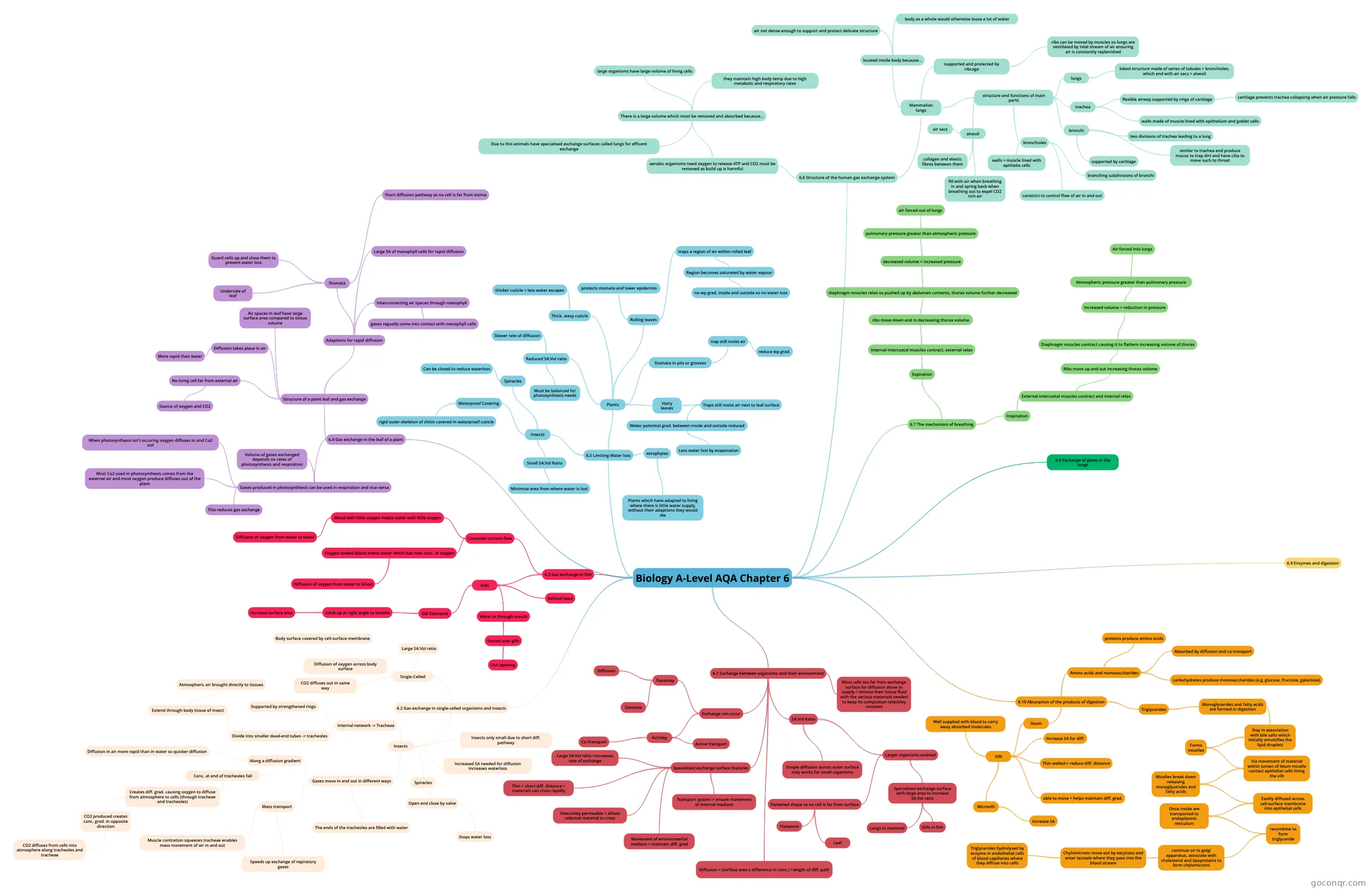
Mind map: Biology A-Level AQA Chapter 6
Conteúdo do mapa
Biology A-Level AQA Chapter 6
6.1 Exchange between organisms and their environment
- Exchange can occur
- Activley
- Active transport
- Co-Transport
- Passivley
- Osmosis
- Diffusion
- Activley
- Most cells too far from exchange surface for diffusion alone to supply / remove their tissue fluid with the various materials needed to keep its compisition relativley constant
- SA:Vol Ratio
- Simple diffusion across outer surface only works for small organisms
- Larger organisms evolved
- Flattened shape so no cell is far from surface
- Flatworm
- Leaf
- Specialised exchange surface with large area to increase SA:Vol ratio
- Lungs in mammal
- Gills in fish
- Flattened shape so no cell is far from surface
- Specialised exchange surface features
- Large SA:Vol ratio >increases rate of exchange
- Thin > short diff. distance > materials can cross rapidly
- Selectivley permeable > allows selected material to cross
- Movement of environmental medium > maintain diff. grad
- Transport system > ensure movement of internal medium
- Diffusion = (surface area x difference in conc.) / length of diff. path
- Exchange can occur
6.2 Gas exchange in single-celled organisms and insects
- Single-Celled
- Large SA:Vol ratio
- Diffusion of oxygen across body surface
- Body surface covered by cell-surface membrane
- CO2 diffuses out in same way
- Insects
- Increased SA needed for diffusion increases waterloss
- Internal network -> Tracheae
- Supported by strengthened rings
- Divide into smaller dead-end tubes -> tracheoles
- Extend through body tissue of insect
- Atmospheric air brought directly to tissues
- Extend through body tissue of insect
- Gases move in and out in different ways
- Along a diffusion gradient
- Conc. at end of tracheoles fall
- Creates diff. grad. causing oxygen to diffuse from atmosphere to cells (through tracheae and tracheoles)
- CO2 produced creates conc. grad. in opposite direction
- CO2 diffuses from cells into atmosphere along tracheoles and tracheae
- CO2 produced creates conc. grad. in opposite direction
- Creates diff. grad. causing oxygen to diffuse from atmosphere to cells (through tracheae and tracheoles)
- Diffusion in air more rapid than in water so quicker diffusion
- Conc. at end of tracheoles fall
- Mass transport
- Muscle contration squeezes tracheae enables mass movement of air in and out
- Speeds up exchange of repiratory gases
- The ends of the tracheoles are filled with water
- Along a diffusion gradient
- Spiracles
- Open and close by valve
- Stops water loss
- Open and close by valve
- Insects only small due to short diff. pathway
- Single-Celled
6.3 Gas exchange in fish
- Gills
- Behind head
- Gill Filaments
- Stack up at right angle to lamelle
- Increase surface area
- Stack up at right angle to lamelle
- Water in through mouth
- Forced over gills
- Out opening
- Forced over gills
- Coounter-current flow
- Oxygen loaded blood meets water which has max conc. of oxygen
- Diffusion of oxygen from water to blood
- Blood with little oxygen meets water with little oxygen
- Diffusion of oxygen from water to blood
- Oxygen loaded blood meets water which has max conc. of oxygen
- Gills
6.4 Gas exchange in the leaf of a plant
- Gases produced in photosynthesis can be used in respiration and vice versa
- This reduces gas exchange
- Volume of gases exchanged depends on rates of photosynthesis and respiration
- Most Co2 used in photosynthesis comes from the external air and most oxygen produce diffuses out of the plant
- When photosynthesis isn't occuring oxygen diffuses in and Co2 out
- Structure of a plant leaf and gas exchange
- No living cell far from external air
- Source of oxygen and CO2
- Diffusion takes place in air
- More rapid than water
- Air spaces in leaf have large surface area compared to tissue volume
- Adaptions for rapid diffusion
- Stomata
- Underside of leaf
- Guard cells up and close them to prevent water loss
- Short diffusion pathway as no cell is far from stoma
- Interconnecting air spaces through mesophyll
- gases regually come into contact with mesophyll cells
- Large SA of mesophyll cells for rapid diffusion
- Stomata
- No living cell far from external air
- Gases produced in photosynthesis can be used in respiration and vice versa
6.5 Limiting Water loss
- Insects
- Small SA:Vol Ratio
- Minimise area from where water is lost
- Waterproof Covering
- rigid outer-skeleton of chitin covered in waterproof cuticle
- Spiracles
- Can be closed to reduce waterloss
- Small SA:Vol Ratio
- Plants
- Thick, waxy cuticle
- thicker cuticle = less water escapes
- Rolling leaves
- protects stomata and lower epidermis
- traps a region of air within rolled leaf
- Region becomes saturated by water vapour
- no wp grad. inside and outside so no water loss
- Region becomes saturated by water vapour
- Hairy leaves
- Traps still moist air next to leaf surface
- Water potential grad. between inside and outside reduced
- Less water lost by evaporation
- Water potential grad. between inside and outside reduced
- Traps still moist air next to leaf surface
- Stomata in pits or grooves
- trap still moist air
- reduce wp grad.
- trap still moist air
- Reduced SA:Vol ratio
- Slower rate of diffusion
- Must be balanced for photosynthesis needs
- Thick, waxy cuticle
- xerophytes
- Plants which have adapted to living where there is little water supply, without their adaptions they would die
- Insects
6.6 Structure of the human gas exchange system
- aerobic organisms need oxygen to release ATP and CO2 must be removed as build up is harmful
- There is a large volume which must be removed and absorbed because...
- large organisms have large volume of living cells
- they maintain high body temp due to high metabolic and respiratory rates
- Due to this animals have specialised exchange surfaces called lungs for efficent exchange
- There is a large volume which must be removed and absorbed because...
- Mammalian lungs
- located inside body because...
- air not dense enough to support and protect delicate structure
- body as a whole would otherwise loose a lot of water
- supported and protected by ribcage
- ribs can be moved by muscles so lungs are ventilated by tidal stream of air ensuring air is constantly replenished
- structure and functions of main parts
- lungs
- lobed structure made of series of tubules > bronchioles, which end with air sacs > alveoli
- trachea
- flexible airway supported by rings of cartilage
- cartilage prevents trachea collapsing when air pressure falls
- walls made of muscle lined with epithelium and goblet cells
- flexible airway supported by rings of cartilage
- bronchi
- two divisions of trachea leading to a lung
- similar to trachea and produce mucus to trap dirt and have cilia to move such to throat
- supported by cartilage
- bronchioles
- branching subdivisions of bronchi
- walls = muscle lined with epithelia cells
- constrict to control flow of air in and out
- alveoli
- air sacs
- collagen and elastic fibres between them
- fill with air when breathing in and spring back when breathing out to expel CO2 rich air
- lungs
- located inside body because...
- aerobic organisms need oxygen to release ATP and CO2 must be removed as build up is harmful
6.7 The mechanism of breathing
- Inspiration
- External intercostal muscles contract and internal relax
- Ribs move up and out increasing thorax volume
- Diaphragm muscles contract causing it to flattern increasing volume of thorax
- Increased volume = reduction in pressure
- Atmospheric pressure greater than pulmonary pressure
- Air forced into lungs
- Atmospheric pressure greater than pulmonary pressure
- Increased volume = reduction in pressure
- Diaphragm muscles contract causing it to flattern increasing volume of thorax
- Ribs move up and out increasing thorax volume
- External intercostal muscles contract and internal relax
- Expiration
- Internal intercostal muscles contract, external relax
- ribs move down and in decreasing thorax volume
- diaphragm muscles relax so pushed up by abdomen contents, thorax volume further decreased
- decreased volume = increased pressure
- pulmonary pressure greater than atmospheric pressure
- air forced out of lungs
- pulmonary pressure greater than atmospheric pressure
- decreased volume = increased pressure
- diaphragm muscles relax so pushed up by abdomen contents, thorax volume further decreased
- ribs move down and in decreasing thorax volume
- Internal intercostal muscles contract, external relax
- Inspiration
6.8 Exchange of gases in the lungs
6.9 Enzymes and digestion
6.10 Absorption of the products of digestion
- Ileum
- Villi
- Microvilli
- Increase SA
- Thin walled-> reduce diff. distance
- Increase SA for diff.
- able to move > helps maintain diff. grad.
- Well supplied with blood to carry away absorbed molecules
- Microvilli
- Villi
- Amino acids and monosaccharides
- proteins produce amino acids
- carbohydrates produce monosaccharides (e.g. glucose, fructose, galactose)
- Absorbed by diffusion and co-transport
- Triglycerides
- Monoglycerides and fatty acids are formed in digestion
- Stay in association with bile salts which initially emulsifies the lipid droplets
- Forms micelles
- Via movement of material within lumen of ileum micelle contact epithelial cells lining the villi
- Micelles break down releasing monoglycerides and fatty acids
- Easilly diffused across cell-surface membrane into epithelial cells
- Once inside are transported to endoplasmic reticulum
- recombine to form triglyceride
- continue on to golgi apparatus, associate with cholesterol and lipoproteins to form chylomicrons
- Chylomicrons move out by excytosis and enter lacteals where they pass into the blood stream
- Triglycerides hydrolysed by enzyme in endothelial cells of blood capillaries where they diffuse into cells
- Chylomicrons move out by excytosis and enter lacteals where they pass into the blood stream
- continue on to golgi apparatus, associate with cholesterol and lipoproteins to form chylomicrons
- recombine to form triglyceride
- Once inside are transported to endoplasmic reticulum
- Easilly diffused across cell-surface membrane into epithelial cells
- Micelles break down releasing monoglycerides and fatty acids
- Via movement of material within lumen of ileum micelle contact epithelial cells lining the villi
- Forms micelles
- Stay in association with bile salts which initially emulsifies the lipid droplets
- Monoglycerides and fatty acids are formed in digestion
- Ileum
Informações
- Descrição
- A level Biology (Chapter 6) Mapa Mental sobre Biology A-Level AQA Chapter 6, criado por Amy Glue em 10-02-2018.
- Criado por
- Amy Glue
- Visualizações
- 495
- Tags
- Avaliação