
Mapa mental
Theories of Language Acquisition
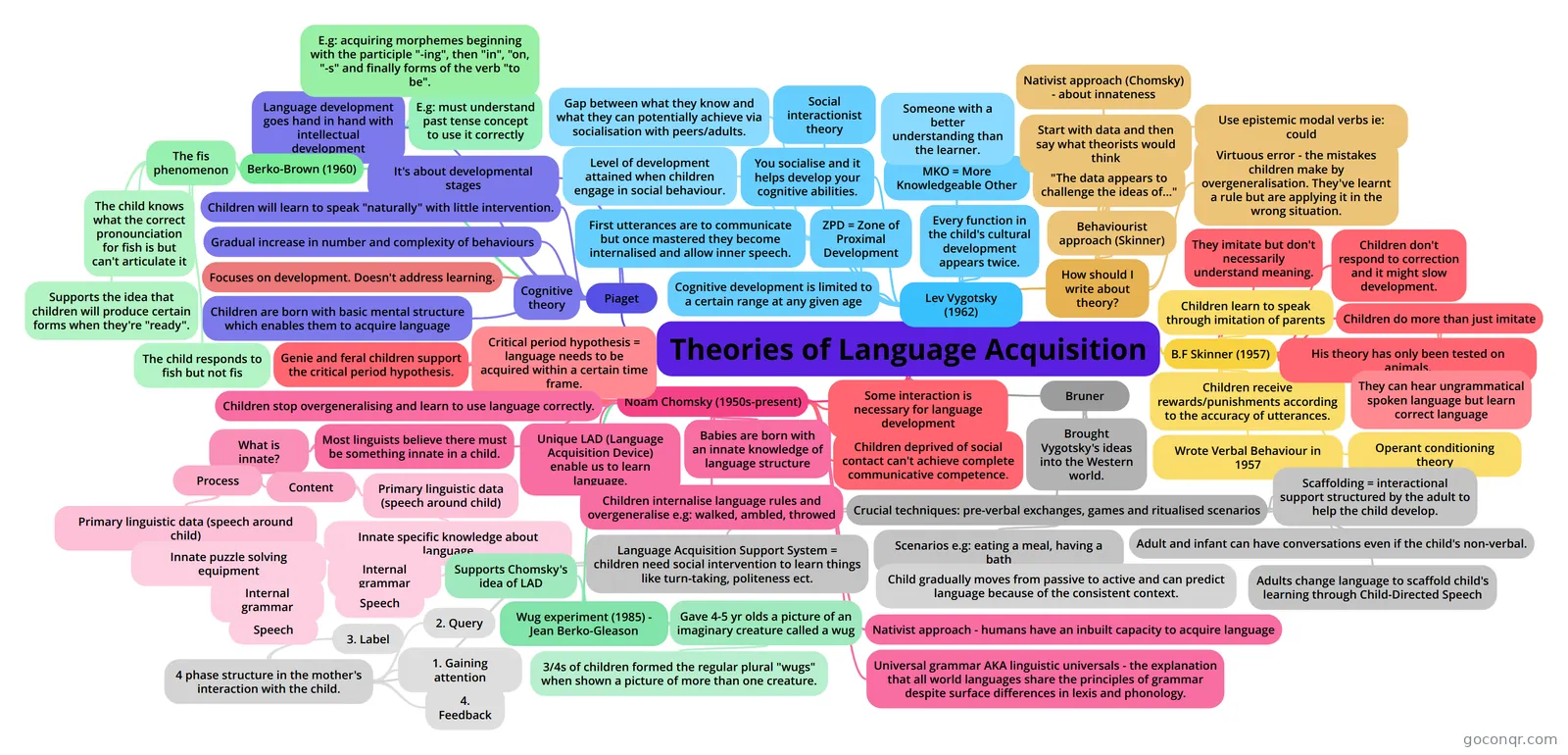
Mind map: theories of language acquisition
Conteúdo do mapa
Theories of Language Acquisition
Noam Chomsky (1950s-present)
- Babies are born with an innate knowledge of language structure
- Unique LAD (Language Acquisition Device) enable us to learn language.
- Genie and feral children support the critical period hypothesis.
- Critical period hypothesis = language needs to be acquired within a certain time frame.
- Some interaction is necessary for language development
- Children stop overgeneralising and learn to use language correctly.
- Children deprived of social contact can't achieve complete communicative competence.
- Most linguists believe there must be something innate in a child.
- What is innate?
- Content
- Primary linguistic data (speech around child)
- Innate specific knowledge about language
- Internal grammar
- Speech
- Internal grammar
- Innate specific knowledge about language
- Primary linguistic data (speech around child)
- Process
- Primary linguistic data (speech around child)
- Innate puzzle solving equipment
- Internal grammar
- Speech
- Internal grammar
- Innate puzzle solving equipment
- Primary linguistic data (speech around child)
- Content
- What is innate?
- Children internalise language rules and overgeneralise e.g: walked, ambled, throwed
- Wug experiment (1985) - Jean Berko-Gleason
- Supports Chomsky's idea of LAD
- Gave 4-5 yr olds a picture of an imaginary creature called a wug
- 3/4s of children formed the regular plural "wugs" when shown a picture of more than one creature.
- Nativist approach - humans have an inbuilt capacity to acquire language
- Universal grammar AKA linguistic universals - the explanation that all world languages share the principles of grammar despite surface differences in lexis and phonology.
B.F Skinner (1957)
- Children learn to speak through imitation of parents
- Children receive rewards/punishments according to the accuracy of utterances.
- His theory has only been tested on animals.
- Children do more than just imitate
- They can hear ungrammatical spoken language but learn correct language
- Children don't respond to correction and it might slow development.
- They imitate but don't necessarily understand meaning.
- Wrote Verbal Behaviour in 1957
- Operant conditioning theory
Lev Vygotsky (1962)
- Every function in the child's cultural development appears twice.
- ZPD = Zone of Proximal Development
- Level of development attained when children engage in social behaviour.
- Gap between what they know and what they can potentially achieve via socialisation with peers/adults.
- First utterances are to communicate but once mastered they become internalised and allow inner speech.
- Cognitive development is limited to a certain range at any given age
- Social interactionist theory
- You socialise and it helps develop your cognitive abilities.
- MKO = More Knowledgeable Other
- Someone with a better understanding than the learner.
Bruner
- Brought Vygotsky's ideas into the Western world.
- Crucial techniques: pre-verbal exchanges, games and ritualised scenarios
- Scenarios e.g: eating a meal, having a bath
- Child gradually moves from passive to active and can predict language because of the consistent context.
- Adult and infant can have conversations even if the child's non-verbal.
- Scaffolding = interactional support structured by the adult to help the child develop.
- Language Acquisition Support System = children need social intervention to learn things like turn-taking, politeness ect.
- 4 phase structure in the mother's interaction with the child.
- 1. Gaining attention
- 2. Query
- 3. Label
- 4. Feedback
- 4 phase structure in the mother's interaction with the child.
- Adults change language to scaffold child's learning through Child-Directed Speech
- Scenarios e.g: eating a meal, having a bath
Piaget
- Cognitive theory
- Children are born with basic mental structure which enables them to acquire language
- Focuses on development. Doesn't address learning.
- Gradual increase in number and complexity of behaviours
- It's about developmental stages
- Children will learn to speak "naturally" with little intervention.
- Language development goes hand in hand with intellectual development
- E.g: must understand past tense concept to use it correctly
- E.g: acquiring morphemes beginning with the participle "-ing", then "in", "on, "-s" and finally forms of the verb "to be".
- Berko-Brown (1960)
- The fis phenomenon
- The child knows what the correct pronounciation for fish is but can't articulate it
- The child responds to fish but not fis
- Supports the idea that children will produce certain forms when they're "ready".
- The fis phenomenon
How should I write about theory?
- "The data appears to challenge the ideas of..."
- Virtuous error - the mistakes children make by overgeneralisation. They've learnt a rule but are applying it in the wrong situation.
- Start with data and then say what theorists would think
- Behaviourist approach (Skinner)
- Nativist approach (Chomsky) - about innateness
- Use epistemic modal verbs ie: could
Informações
- Descrição
- A Levels English Language (Language Acquisition) Mapa Mental sobre Theories of Language Acquisition, criado por Hazel Meades em 04-09-2014.
- Criado por
- Hazel Meades
- Visualizações
- 285
- Tags
- Avaliação