
Mapa mental
Factors Affecting Eyewitness Testimony
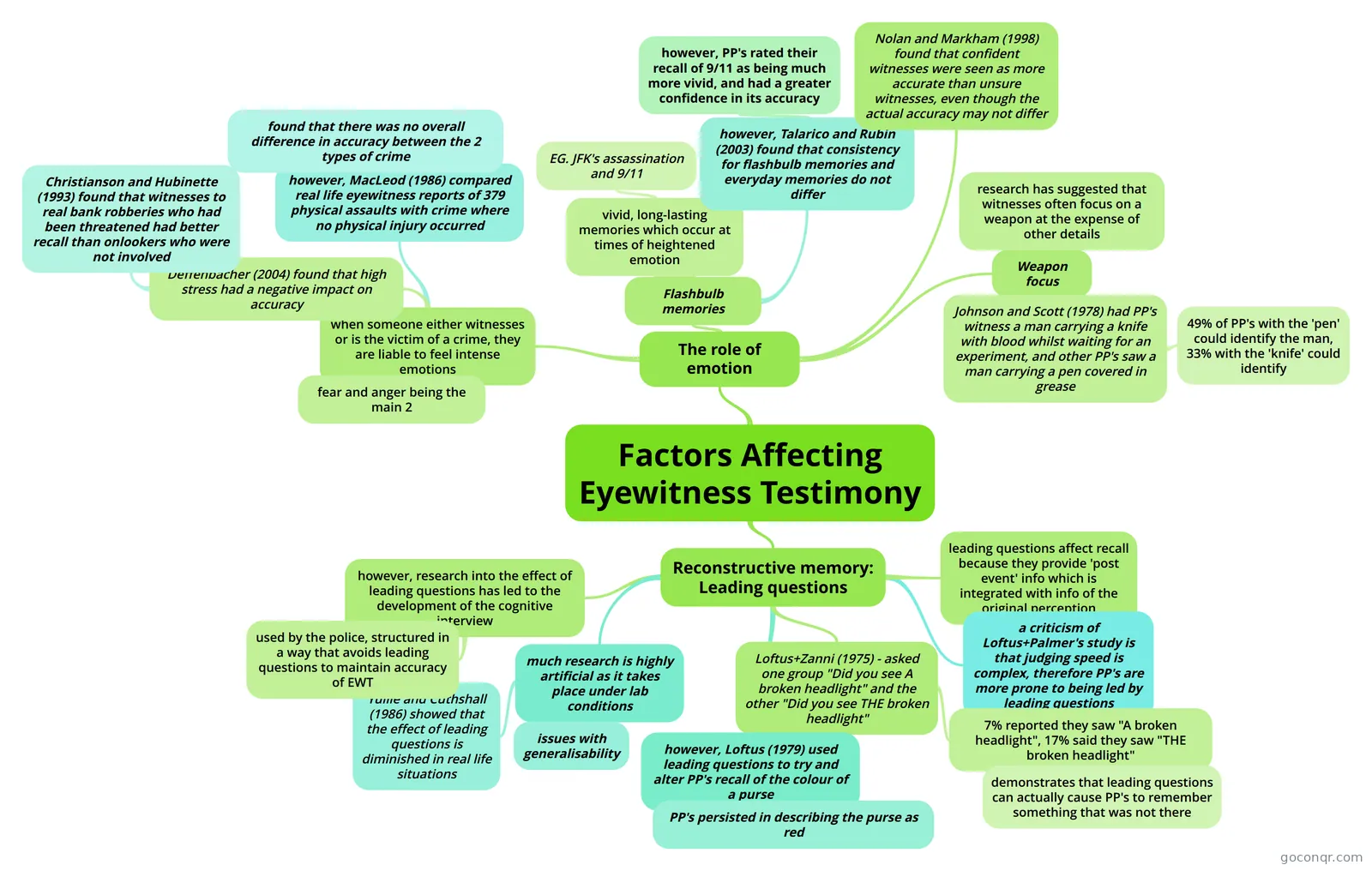
Mind map: Factors affecting eyewitness testimony
Conteúdo do mapa
Factors Affecting Eyewitness Testimony
The role of emotion
- when someone either witnesses or is the victim of a crime, they are liable to feel intense emotions
- fear and anger being the main 2
- Deffenbacher (2004) found that high stress had a negative impact on accuracy
- Christianson and Hubinette (1993) found that witnesses to real bank robberies who had been threatened had better recall than onlookers who were not involved
- however, MacLeod (1986) compared real life eyewitness reports of 379 physical assaults with crime where no physical injury occurred
- found that there was no overall difference in accuracy between the 2 types of crime
- Flashbulb memories
- vivid, long-lasting memories which occur at times of heightened emotion
- EG. JFK's assassination and 9/11
- however, Talarico and Rubin (2003) found that consistency for flashbulb memories and everyday memories do not differ
- however, PP's rated their recall of 9/11 as being much more vivid, and had a greater confidence in its accuracy
- vivid, long-lasting memories which occur at times of heightened emotion
- Nolan and Markham (1998) found that confident witnesses were seen as more accurate than unsure witnesses, even though the actual accuracy may not differ
- Weapon focus
- research has suggested that witnesses often focus on a weapon at the expense of other details
- Johnson and Scott (1978) had PP's witness a man carrying a knife with blood whilst waiting for an experiment, and other PP's saw a man carrying a pen covered in grease
- 49% of PP's with the 'pen' could identify the man, 33% with the 'knife' could identify
- when someone either witnesses or is the victim of a crime, they are liable to feel intense emotions
Reconstructive memory: Leading questions
- leading questions affect recall because they provide 'post event' info which is integrated with info of the original perception
- a criticism of Loftus+Palmer's study is that judging speed is complex, therefore PP's are more prone to being led by leading questions
- Loftus+Zanni (1975) - asked one group "Did you see A broken headlight" and the other "Did you see THE broken headlight"
- 7% reported they saw "A broken headlight", 17% said they saw "THE broken headlight"
- demonstrates that leading questions can actually cause PP's to remember something that was not there
- 7% reported they saw "A broken headlight", 17% said they saw "THE broken headlight"
- however, Loftus (1979) used leading questions to try and alter PP's recall of the colour of a purse
- PP's persisted in describing the purse as red
- much research is highly artificial as it takes place under lab conditions
- issues with generalisability
- Yullie and Cuthshall (1986) showed that the effect of leading questions is diminished in real life situations
- however, research into the effect of leading questions has led to the development of the cognitive interview
- used by the police, structured in a way that avoids leading questions to maintain accuracy of EWT
Informações
- Descrição
- A-Levels PY4 (Forensic Psychology) Mapa Mental sobre Factors Affecting Eyewitness Testimony, criado por Hayd23 em 10-06-2013.
- Criado por
- Hayd23
- Visualizações
- 282
- Tags
- Avaliação