
Mapa mental
Approaches- social learning theory
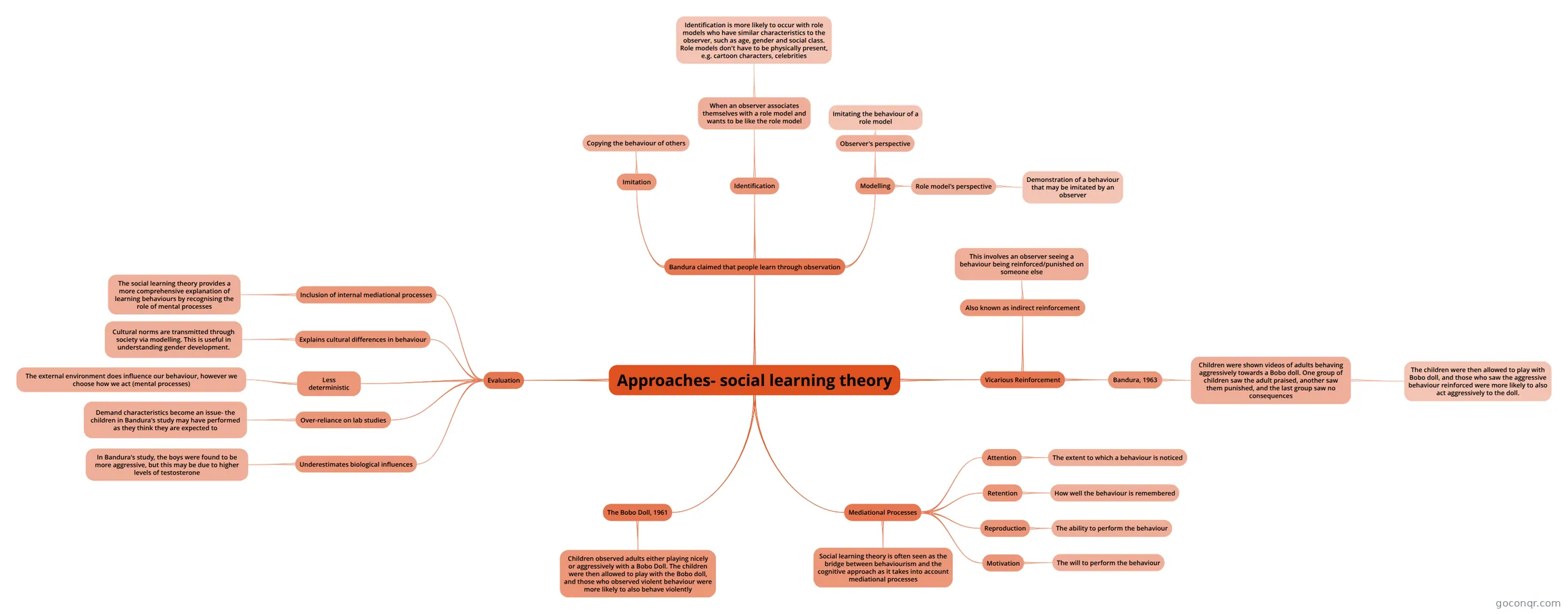
Mind map: Social learning theory approaches
Conteúdo do mapa
Approaches- social learning theory
Bandura claimed that people learn through observation
- Imitation
- Copying the behaviour of others
- Identification
- When an observer associates themselves with a role model and wants to be like the role model
- Identification is more likely to occur with role models who have similar characteristics to the observer, such as age, gender and social class. Role models don't have to be physically present, e.g. cartoon characters, celebrities
- When an observer associates themselves with a role model and wants to be like the role model
- Modelling
- Observer's perspective
- Imitating the behaviour of a role model
- Role model's perspective
- Demonstration of a behaviour that may be imitated by an observer
- Observer's perspective
- Imitation
Vicarious Reinforcement
- Also known as indirect reinforcement
- This involves an observer seeing a behaviour being reinforced/punished on someone else
- Bandura, 1963
- Children were shown videos of adults behaving aggressively towards a Bobo doll. One group of children saw the adult praised, another saw them punished, and the last group saw no consequences
- The children were then allowed to play with Bobo doll, and those who saw the aggressive behaviour reinforced were more likely to also act aggressively to the doll.
- Children were shown videos of adults behaving aggressively towards a Bobo doll. One group of children saw the adult praised, another saw them punished, and the last group saw no consequences
- Also known as indirect reinforcement
Mediational Processes
- Social learning theory is often seen as the bridge between behaviourism and the cognitive approach as it takes into account mediational processes
- Attention
- The extent to which a behaviour is noticed
- Retention
- How well the behaviour is remembered
- Reproduction
- The ability to perform the behaviour
- Motivation
- The will to perform the behaviour
The Bobo Doll, 1961
- Children observed adults either playing nicely or aggressively with a Bobo Doll. The children were then allowed to play with the Bobo doll, and those who observed violent behaviour were more likely to also behave violently
Evaluation
- Inclusion of internal mediational processes
- The social learning theory provides a more comprehensive explanation of learning behaviours by recognising the role of mental processes
- Explains cultural differences in behaviour
- Cultural norms are transmitted through society via modelling. This is useful in understanding gender development.
- Less deterministic
- The external environment does influence our behaviour, however we choose how we act (mental processes)
- Over-reliance on lab studies
- Demand characteristics become an issue- the children in Bandura's study may have performed as they think they are expected to
- Underestimates biological influences
- In Bandura's study, the boys were found to be more aggressive, but this may be due to higher levels of testosterone
- Inclusion of internal mediational processes
Informações
- Descrição
- AQA AS/A Level Psychology: Approaches. This mind map includes information on the Social Learning Theory, as well as evaluation points.
- Criado por
- Grace Fawcitt
- Visualizações
- 309
- Tags
- Avaliação