
Mapa mental
Edward VI
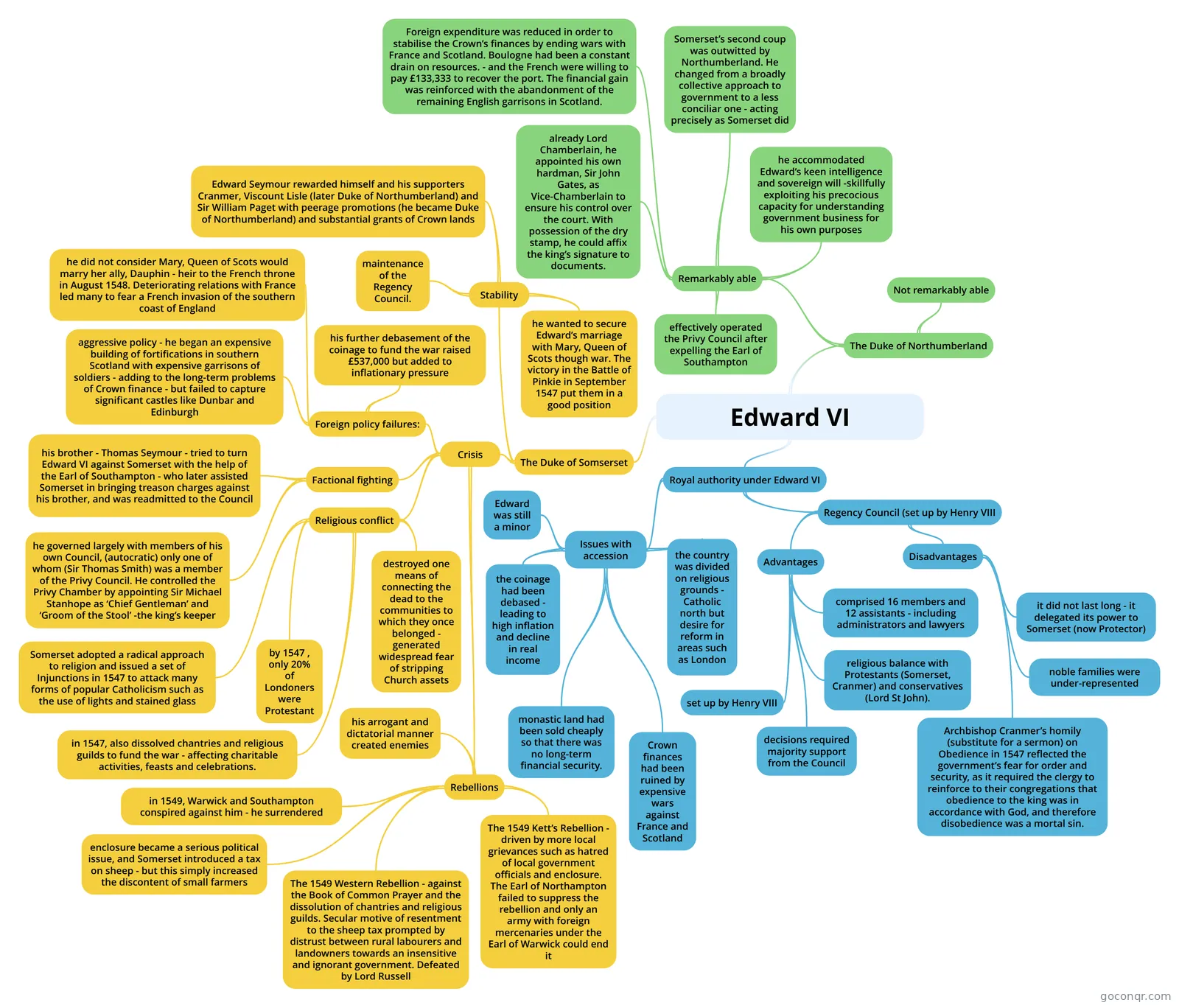
Mind map: Edward VI
Conteúdo do mapa
Edward VI
Royal authority under Edward VI
- Issues with accession
- the country was divided on religious grounds - Catholic north but desire for reform in areas such as London
- Crown finances had been ruined by expensive wars against France and Scotland
- the coinage had been debased - leading to high inflation and decline in real income
- monastic land had been sold cheaply so that there was no long-term financial security.
- Edward was still a minor
- Regency Council (set up by Henry VIII
- Advantages
- set up by Henry VIII
- comprised 16 members and 12 assistants - including administrators and lawyers
- decisions required majority support from the Council
- religious balance with Protestants (Somerset, Cranmer) and conservatives (Lord St John).
- Disadvantages
- noble families were under-represented
- it did not last long - it delegated its power to Somerset (now Protector)
- Archbishop Cranmer’s homily (substitute for a sermon) on Obedience in 1547 reflected the government’s fear for order and security, as it required the clergy to reinforce to their congregations that obedience to the king was in accordance with God, and therefore disobedience was a mortal sin.
- Advantages
- Issues with accession
The Duke of Somserset
- Stability
- Edward Seymour rewarded himself and his supporters Cranmer, Viscount Lisle (later Duke of Northumberland) and Sir William Paget with peerage promotions (he became Duke of Northumberland) and substantial grants of Crown lands
- he wanted to secure Edward’s marriage with Mary, Queen of Scots though war. The victory in the Battle of Pinkie in September 1547 put them in a good position
- maintenance of the Regency Council.
- Crisis
- Factional fighting
- he governed largely with members of his own Council, (autocratic) only one of whom (Sir Thomas Smith) was a member of the Privy Council. He controlled the Privy Chamber by appointing Sir Michael Stanhope as ‘Chief Gentleman’ and ‘Groom of the Stool’ -the king’s keeper
- his brother - Thomas Seymour - tried to turn Edward VI against Somerset with the help of the Earl of Southampton - who later assisted Somerset in bringing treason charges against his brother, and was readmitted to the Council
- Foreign policy failures:
- aggressive policy - he began an expensive building of fortifications in southern Scotland with expensive garrisons of soldiers - adding to the long-term problems of Crown finance - but failed to capture significant castles like Dunbar and Edinburgh
- his further debasement of the coinage to fund the war raised £537,000 but added to inflationary pressure
- he did not consider Mary, Queen of Scots would marry her ally, Dauphin - heir to the French throne in August 1548. Deteriorating relations with France led many to fear a French invasion of the southern coast of England
- Religious conflict
- Somerset adopted a radical approach to religion and issued a set of Injunctions in 1547 to attack many forms of popular Catholicism such as the use of lights and stained glass
- in 1547, also dissolved chantries and religious guilds to fund the war - affecting charitable activities, feasts and celebrations.
- by 1547 , only 20% of Londoners were Protestant
- destroyed one means of connecting the dead to the communities to which they once belonged - generated widespread fear of stripping Church assets
- Rebellions
- his arrogant and dictatorial manner created enemies
- enclosure became a serious political issue, and Somerset introduced a tax on sheep - but this simply increased the discontent of small farmers
- The 1549 Western Rebellion - against the Book of Common Prayer and the dissolution of chantries and religious guilds. Secular motive of resentment to the sheep tax prompted by distrust between rural labourers and landowners towards an insensitive and ignorant government. Defeated by Lord Russell
- The 1549 Kett’s Rebellion - driven by more local grievances such as hatred of local government officials and enclosure. The Earl of Northampton failed to suppress the rebellion and only an army with foreign mercenaries under the Earl of Warwick could end it
- in 1549, Warwick and Southampton conspired against him - he surrendered
- Factional fighting
- Stability
The Duke of Northumberland
- Remarkably able
- he accommodated Edward’s keen intelligence and sovereign will -skillfully exploiting his precocious capacity for understanding government business for his own purposes
- already Lord Chamberlain, he appointed his own hardman, Sir John Gates, as Vice-Chamberlain to ensure his control over the court. With possession of the dry stamp, he could affix the king’s signature to documents.
- effectively operated the Privy Council after expelling the Earl of Southampton
- Somerset’s second coup was outwitted by Northumberland. He changed from a broadly collective approach to government to a less conciliar one - acting precisely as Somerset did
- Foreign expenditure was reduced in order to stabilise the Crown’s finances by ending wars with France and Scotland. Boulogne had been a constant drain on resources. - and the French were willing to pay £133,333 to recover the port. The financial gain was reinforced with the abandonment of the remaining English garrisons in Scotland.
- Not remarkably able
- Remarkably able
Informações
- Descrição
- A level History Mapa Mental sobre Edward VI, criado por Mahek Bhatti em 17-09-2018.
- Criado por
- Mahek Bhatti
- Visualizações
- 275
- Tags
- Avaliação