
Mapa mental
SAMPLING
Conteúdo do mapa
SAMPLING
group of persons (students, teachers, or other individuals)
- Part of the population Population: all the members of a particular group
- Individual or members who will participate in the research
- Or Sample
- that is similar to the population on all characteristics. SAMPLE SIZE minimum number 100 for a descriptive study 50 for a correlational study 30 in each group for experimental and causal comparative studies.
- Or Sample
Process of selecting the individuals
DEFINING THE POPULATION
- Examples of populations: 1)All high school principals in the United States 2)All elementary school counselors in the state of California 3)All students attending Central High School in Omaha,Nebraska, during the academic year 2005–2006 4)All students in Ms. Brown’s third-grade class at Wharton Elementary School
- to generalize the results
- Target population that is the actual population to whom the researcher would like to generalize; The accessible population is the population to whom the researcher is entitled to generalize
- possess a certain characteristic
- To save on time, effort, money
Subgroups of population
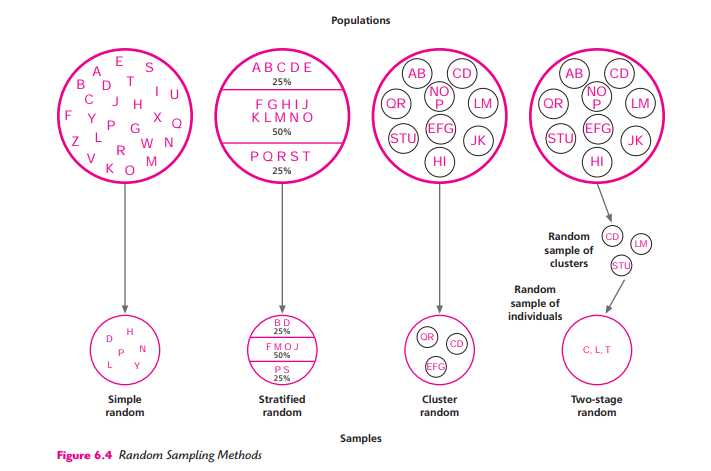
- RANDOM SAMPLING
- Every member of the population has an equal chance of being selected.
- simple random sampling
- Everyone would have the same chance of being selected. The larger a random sample is in size, the more likely it is to represent the population. table of random numbers
- stratified random sampling
- a sample selected so that certain characteristics are represented in the sample in the same proportion as they occur in the population. The advantage: increases the likelihood of representativeness It virtually ensures that key characteristics of individuals in the population are included in the same proportions in the sample. The disadvantage is that it requires more effort on the part of the researcher.
- cluster sampling
- The selection of groups, or clusters, of subjects rather than individuals. Is similar to simple random sampling except that groups rather than individuals are randomly selected The advantages of cluster random sampling are that it can be used when it is diffi- cult or impossible to select a random sample of individ- uals, it is often far easier to implement in schools, and it is frequently less time consuming. Its disadvantage is that there is a far greater chance of selecting a sample that is not representative of the population.
- two-stage random sampling
- It is often useful to combine cluster random sampling with individual random sampling. A two-stage random sample selects groups randomly and then chooses individuals randomly from these groups.
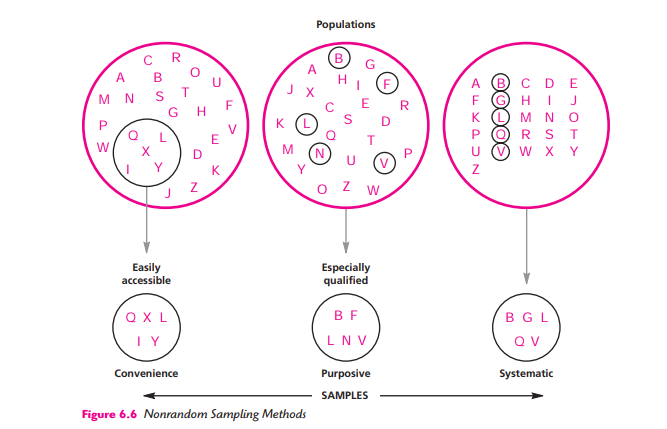
- NONRANDOM SAMPLING
- Each member of the population does not have an equal chance of being selected.
- systematic sampling
- The above method is technically known as systematic sampling with a random start. In addition, there are two terms that are frequently used when referring to systematic sampling. The sampling interval is the distance in the list between each of the individuals selected for the sample. In the example given above, it was 10. Formula: Population siza/Desire Sample size The sampling ratio is the proportion of individuals in the population that is selected for the sample. In the example above, it was .10, or 10 percent. A simple way to determine the sampling ratio is: Sample size/population size
- convenience sampling
- A convenience sample is a group of individuals who (conveniently) are available for study. In general, convenience samples cannot be considered representative of any population and should be avoided if at all possible. Unfortunately, sometimes they are the only option a researcher has. When such is the case, the researcher should be especially careful to include information on demographic and other characteristics of the sample studied. The study should also be replicated, that is,repeated, with anumber of similar samples to decrease the likelihood that the results obtained were simply a one-time occurrence.
- purposive sampling
- On occasion, based on previous knowledge of a population and the specific purpose of the research, investigators use personal judgment to select a sample. Researchers assume they can use their knowledge of the population to judge whether or not a particular sample will be representative. Purposive sampling is different from convenience sampling in that researchers do not simply study whoever is available but rather use their judgment to select a sample that they believe, based on prior information, will provide the data they need. The major disadvantage of purposive sampling is that the researcher’s judgment may be in error—he or she may not be correct in estimating the representativeness of a sample or their expertise regarding the information needed. A purposive sample consists of individuals who have special qualifications of some sort or are deemed representative on the basis of prior evidence.
- RANDOM SAMPLING
Imagens e arquivos do mapa
Informações
- Descrição
- Metodología de la Investigación Mapa Mental sobre SAMPLING, criado por Ludwig Birdy em 14-03-2019.
- Criado por
- Ludwig Birdy · mar 2019
- Atualizado
- 14 mar 2019
- Visualizações
- 1
- Avaliação