
Mapa mental
Marketing
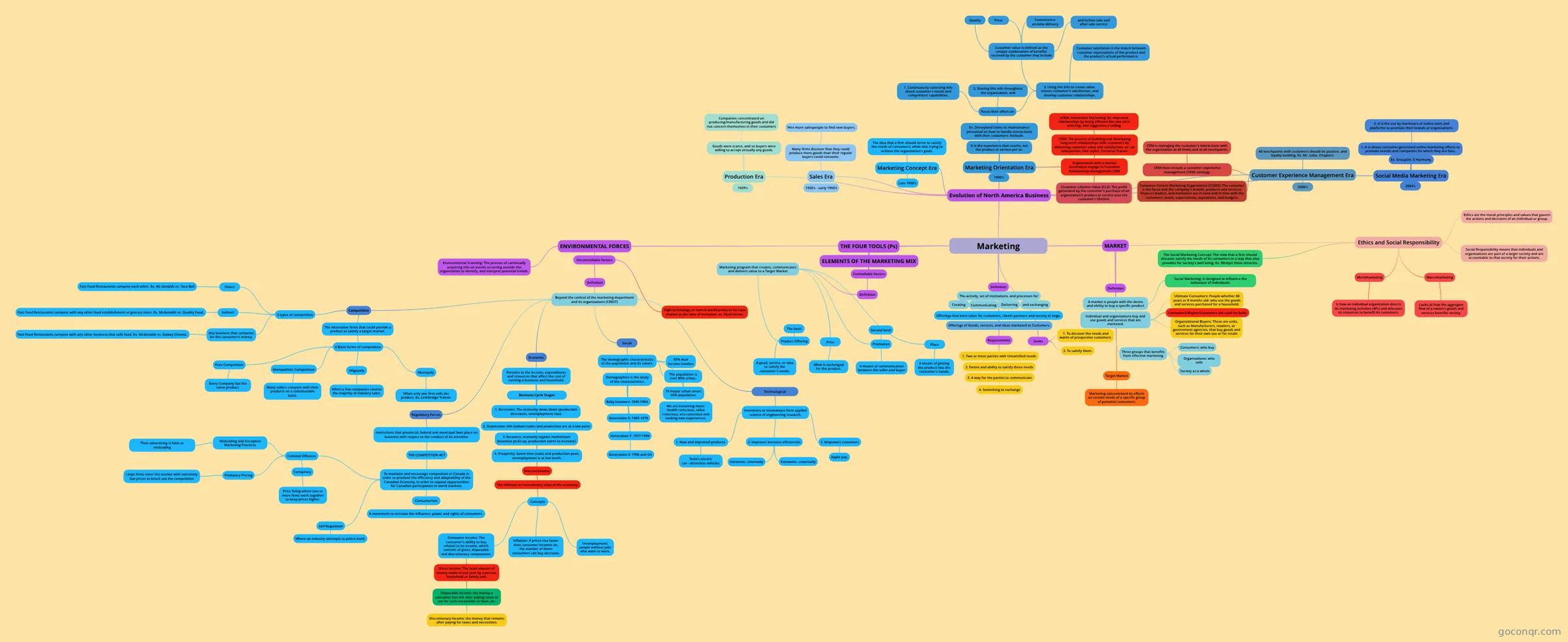
Mind map: Marketing
Conteúdo do mapa
Marketing
The activity, set of institutions, and processes for
- Creating
- Communicating
- Delivering
- and exchanging
- Offerings that have value for customers, clients partners and society at large.
- Offerings of Goods, services, and ideas marketed to Customers.
Definition
Seeks
- 1. To discover the needs and wants of prospective customers.
- 2. To satisfy them.
Requirements
- 1. Two or more parties with Unsatisfied needs
- 2. Desire and ability to satisfy these needs
- 3. A way for the parties to communicate
- 4. Something to exchange
- 3. A way for the parties to communicate
- 2. Desire and ability to satisfy these needs
- 1. Two or more parties with Unsatisfied needs
MARKET
- Definition
- A market is people with the desire and ability to buy a specific product
- Individual and organizations buy and use goods and services that are marketed.
- Ultimate Consumers: People-whether 80 years or 8 months old- who use the goods and services purchased for a household.
- Organizational Buyers: These are units, such as Manufacturers, retailers, or government agencies, that buy goods and services for their own use or for resale
- Consumers/Buyers/Customers are used for both.
- Three groups that benefits from effective marketing
- Consumers: who buy
- Organizations: who sells
- Society as a whole
- Social Marketing: is designed to influence the behaviour of individuals.
- Individual and organizations buy and use goods and services that are marketed.
- A market is people with the desire and ability to buy a specific product
- Target Market
- Marketing concentrated its efforts on certain needs of a specific group of potential consumers.
- Definition
THE FOUR TOOLS (Ps)
- Definition
- Marketing program that creates, communicates and delivers value to a Target Market
- Product Offering
- A good, service, or idea to satisfy the consumer's needs.
- The best!
- Price
- What is exchanged for the product.
- Promotion
- A means of communication between the seller and buyer
- Second best!
- Place
- A means of getting the product into the consumer's hands.
- Product Offering
- Marketing program that creates, communicates and delivers value to a Target Market
- ELEMENTS OF THE MARKETING MIX
- Controllable factors
- Definition
ENVIRONMENTAL FORCES
- Uncontrollable factors
- Definition
- Beyond the control of the marketing department and its organizations (CREST)
- Social
- The demographic characteristics of the population and its values.
- Demographics is the study of the characteristics.
- Baby boomers: 1946-1964.
- Generation X: 1965-1976
- Generation Y: 1977-1994
- Generation X: 1995 and On
- The population is over 80% urban.
- 10 mayor urban areas: 50% population.
- 65% dual income families
- We are becoming more: Health conscious, value conscious, eco-conscious and seeking new experiences.
- Demographics is the study of the characteristics.
- The demographic characteristics of the population and its values.
- Economic
- Pertains to the income, expenditures and resources that affect the cost of running a business and household.
- Business Cycle Stages
- 1. Recession: The economy slows down (production decreases, unemployment rises
- 2. Depression: hits bottom (sales and production are at a low point
- 3. Recovery: economy regains momentum (business picks up, production starts to increase)
- 4. Prosperity: boom time (sales and production peak, unemployment is at low levels.
- Macroeconomic
- The inflation or recessionary state of the economy.
- Concepts
- Inflation: if prices rise faster than consumer incomes do, the number of items consumers can buy decrease.
- Consumer Income: The consumer's ability to buy related to its income, which consists of gross, disposable and discretionary components.
- Gross Income: The total amount of money made in one year by a person, household or family unit.
- Disposable Income: the money a consumer has left after paying taxes to use for such necessities as food, etc.
- Discretionary Income: the money that remains after paying for taxes and necessities.
- Disposable Income: the money a consumer has left after paying taxes to use for such necessities as food, etc.
- Gross Income: The total amount of money made in one year by a person, household or family unit.
- Unemployment: people without jobs who want to work.
- Concepts
- The inflation or recessionary state of the economy.
- Business Cycle Stages
- Pertains to the income, expenditures and resources that affect the cost of running a business and household.
- Technological
- Inventions or innovations from applied science of engineering research.
- 1. New and improved products.
- Tesla's electric car---driverless vehicles
- 2. Improves business efficiencies
- Intranets---internally
- Extranets---externally
- 3. Empowers customers
- Apple pay.
- 1. New and improved products.
- Inventions or innovations from applied science of engineering research.
- Regulatory Forces
- restrictions that provincial, federal and municipal laws place on business with respect to the conduct of its activities.
- THE COMPETITION ACT
- To maintain and encourage competition in Canada in order to promote the efficiency and adaptability of the Canadian Economy, in order to expand opportunities for Canadian participation in world markets.
- Criminal Offences
- Conspiracy
- Price fixing where two or more firms work together to keep prices higher.
- Predatory Pricing
- Large firms enter the market with extremely low prices to knock out the competition
- Misleading and Deceptive Marketing Practices
- Their advertising is false or misleading
- Conspiracy
- Self-Regulation
- Where an industry attempts to police itself.
- Consumerism
- A movement to increase the influence, power and rights of consumers.
- Criminal Offences
- To maintain and encourage competition in Canada in order to promote the efficiency and adaptability of the Canadian Economy, in order to expand opportunities for Canadian participation in world markets.
- THE COMPETITION ACT
- restrictions that provincial, federal and municipal laws place on business with respect to the conduct of its activities.
- Competitive
- The alternative firms that could provide a product to satisfy a target market.
- 4 Basis forms of competition
- Pure Competition
- Every Company has the same product.
- Monopolistic Competition
- Many sellers compete with their products on a substitutable basis.
- Oligopoly
- When a few companies control the majority of industry sales.
- Monopoly
- When only one firm sells the product. Ex. Lethbridge Transit.
- Pure Competition
- 4 Basis forms of competition
- 3 types of competition
- Direct
- Fast Food Restaurants compete each other. Ex. Mc donalds vs. Taco Bell
- Indirect
- Fast Food Restaurants compete with any other food establishment or grocery store. Ex. Mcdonalds vs. Quality Food.
- Any business that competes for the consume'rs money.
- Fast Food Restaurants compete with any other business that sells food. Ex. Mcdonalds vs. Galaxy Cinema.
- Direct
- The alternative firms that could provide a product to satisfy a target market.
- Social
- Beyond the control of the marketing department and its organizations (CREST)
- High-technology or new-to-world products no have market at the time of invention. ex. Ford-horses.
- Definition
- Environmental Scanning: The process of continually acquiring info on events occurring outside the organization to identify, and interpret potential trends.
- Uncontrollable factors
Evolution of North America Business
- Production Era
- Goods were scarce, and so buyers were willing to accept virtually any goods.
- 1929's
- Companies concentrated on producing/manufacturing goods and did not concern themselves in their customers
- Sales Era
- Many firms discover that they could produce more goods than their regular buyers could consume.
- Hire more salespeople to find new buyers.
- 1920's - early 1950's
- Many firms discover that they could produce more goods than their regular buyers could consume.
- Marketing Concept Era
- Late 1950's
- The idea that a firm should strive to satisfy the needs of consumers, while also trying to achieve the organization's goals.
- Marketing Orientation Era
- Focus their effort on
- 1. Continuously collecting info about customer's needs and competitors' capabilities.
- 2. Sharing this info throughout the organization, and
- 3. Using the info to create value, ensure customer's satisfaction, and develop customer relationships.
- Customer value is defined as the unique combination of benefits received by the customer that include
- Quality
- Price
- Convenience on-time delivery
- and before-sale and after-sale service
- Customer satisfation is the match between customer expectations of the product and the product's actual performance.
- Customer value is defined as the unique combination of benefits received by the customer that include
- 1990's
- Organization with a market orientation engage in Customer Relationship Management CRM
- CRM: The process of building and developing long-term relationships with customers by delivering customer value and satisfaction. ex: car salesperson, Hair stylist, Personal Trainer.
- eCRM: Interactive Marketing. Ex: Improved relationships by being efficient like one-click ordering, and suggestive e-selling
- Customer Lifetime Value (CLV): The profit generated by the customer's purchase of an organization's product or service over the customer's lifetime.
- CRM: The process of building and developing long-term relationships with customers by delivering customer value and satisfaction. ex: car salesperson, Hair stylist, Personal Trainer.
- It is the experience that counts, not the product or service per se.
- Ex. Disneyland trains its maintenance personnal on how to handle interactions with their customers: Attitude.
- Focus their effort on
- Social Media Marketing Era
- 1. It is about consumer-generated online-marketing efforts to promote brands and companies for which they are fans.
- 2. It is the use by marketers of online tools and platforms to promote their brands or organizations.
- 2004's
- Ex. GroupOn. E-Harmony.
- Customer Experience Management Era
- CRM must include a customer experience management (CEM) strategy.
- CEM is managing the customer's interactions with the organization at all levels and at all touchpoints.
- Customer-Centric Marketing Organization (CCMO): The customer is the focus and the company's brands, products and services, finances leaders, and marketers are in tune and in time with the customers' needs, expectations, aspirations, and budgets.
- 2000's
- All touchpoints with customers should be positive, and loyalty building. Ex. Mr. Lube, Chapters.
- CRM must include a customer experience management (CEM) strategy.
- Production Era
Ethics and Social Responsibility
- The Social Marketing Concept: The view that a firm should discover satisfy the needs of its consumers in a way that also provides for society's well being. Ex. Westjet Xmas miracles.
- Ethics are the moral principles and values that govern the actions and decisions of an individual or group.
- Social Responsibility means that individuals and organizations are part of a larger society and are accountable to that society for their actions.
- Macromarketing
- Looks at how the aggregate flow of a nation's goods and services benefits society.
- Micromarketing
- Is how an individual organization directs its marketing activities (4Ps) and allocates its resources to benefit its customers.
Informações
- Descrição
- MARKETING Mapa Mental sobre Marketing, criado por JUAN DIEGO CASTAÑEDA RAMIREZ em 16-09-2019.
- Criado por
- JUAN DIEGO CASTAÑEDA RAMIREZ
- Visualizações
- 5
- Avaliação