
Mapa mental
Psychology A1
Conteúdo do mapa
Psychology A1
Memory
- Sensory
- Duration: fractions of a second
- Capacity: too small to quantify
- Encoding: raw form
- STM
- Duration: 20-30s
- Peterson and Peterson: Consonant Trigrams/Counting backwards.
- Factors affecting
- Maintenance rehearsal
- Deliberate intention to recall
- Amount of information to be retained
- Capacity: 7 +/- 2
- Baddeley: Word Length: remember more short than long words
- Factors affecting
- Rhythmic grouping
- Influence of LTM
- Reading aloud
- Pronunciation time
- Encoding: Acoustic/Visual
- Baddeley: acoustically and semantically similar/dissimilar words (A,S 55%, A,D 75%)
- Factors affecting
- Other ways to encode
- The sound of words
- Duration: 20-30s
- LTM
- Duration: Lifetime
- Bahrick et al: Year book; recall less accurate than matching
- Factors affecting
- How duration is measured
- Thorough learning
- Childhood amnesia
- Capacity: limitless "permastore"
- Encoding: Semantic
- Duration: Lifetime
- Eyewitness Testimony
- Cognitive Interview
- Recall every detail
- Recall events in a different order
- Different perspective
- Recreate the context
- Anxiety
- Loftus: Weapon focus phenomenom
- Age
- Elderly
- Alzheimer's
- Schemas
- Children
- Demand Characteristics "look good"
- Elderly
- Consequences
- More accurate when outcomes are severe
- How the witnesses are tested
- Forced = more inaccurate than volunteered
- Leading questions
- "a barn" / "THE barn"
- Misleading information
- Barn or no barn, group with misled 17% fell for it
- Cognitive Interview
- Improvement
- Loci
- Mneumonics
- Pay attention
- Elaborate rehearsal
- State dependent retrieval - mood and setting
- Peg words
- Models
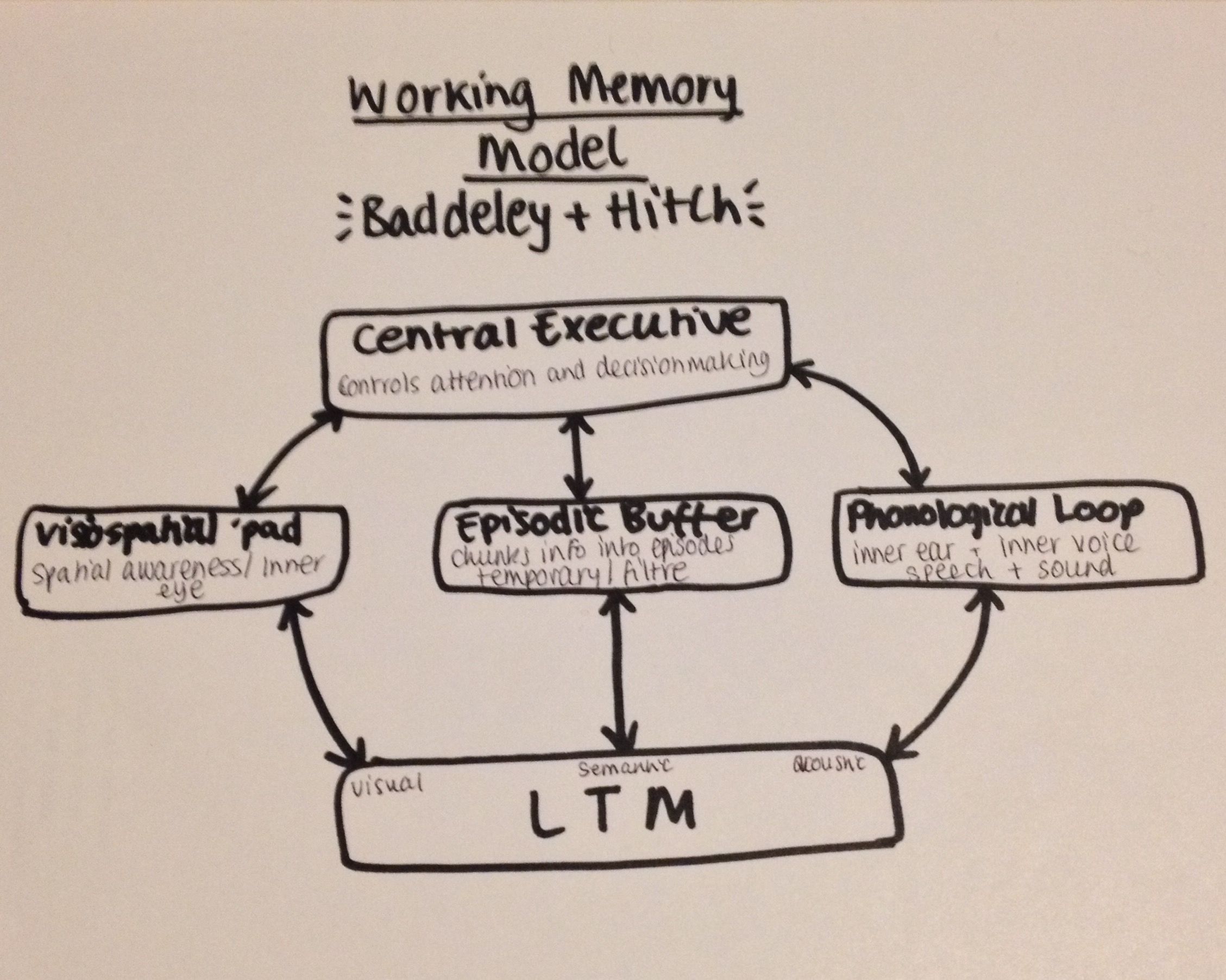
- WMM
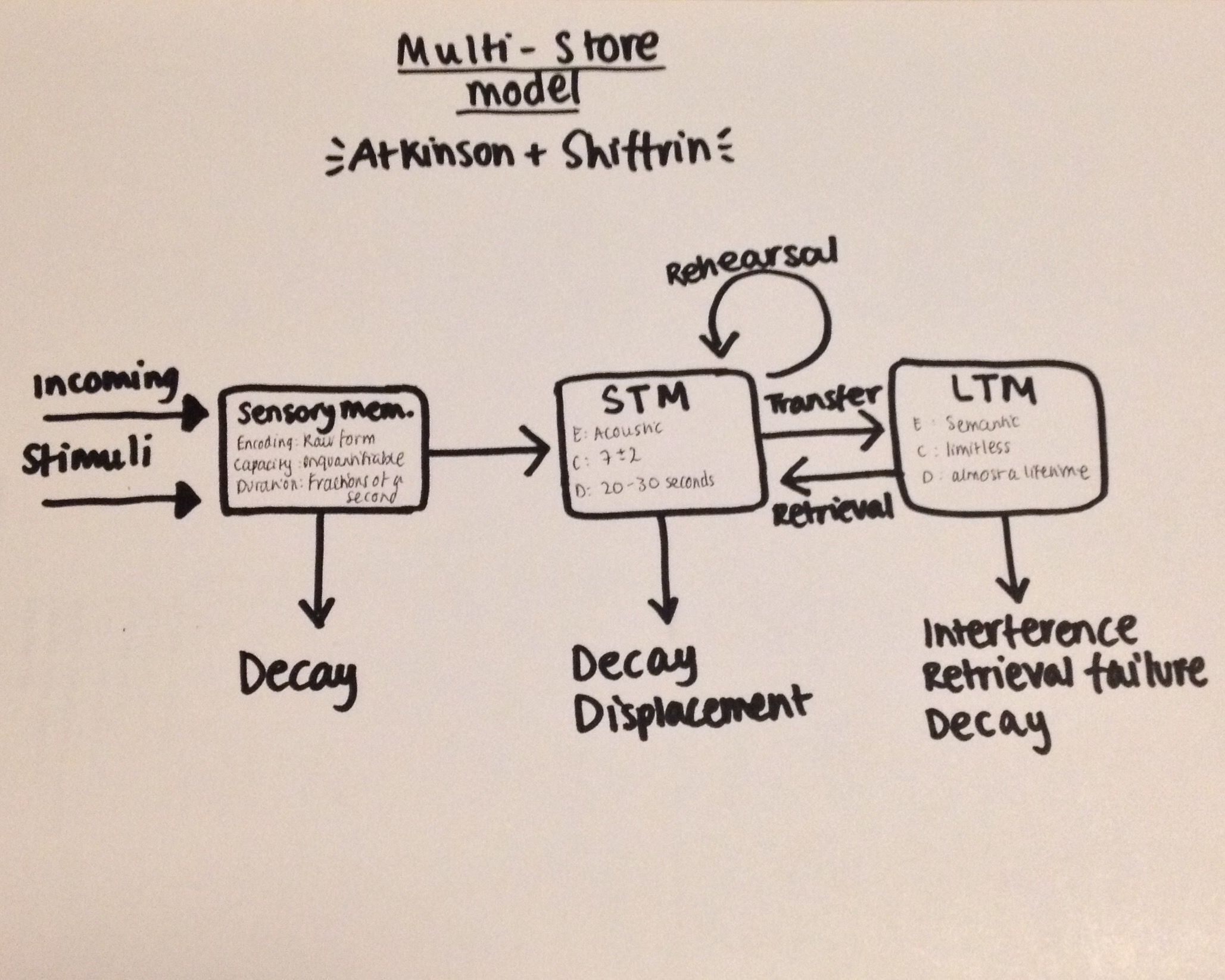
- MSM
- Interface
- Proactive - old interferes with new
- Retroactive - new interferes with old
- Sensory
Attachment
- Learning theory (Behavioural)
- Classical Conditioning
- Unconditioned reinforcer
- Conditioned response
- Association
- Pavlov's dogs
- Unconditioned reinforcer
- Operant conditioning
- Drive state
- Rewards
- Drive state
- Cupboard love
- Harlow and Harlow's monkeys
- Classical Conditioning
- A strong emotional, reciprocal bond between infant and primary caregiver
- 4 Criteria
- Orientates around primary caregiver
- Distress upon separation
- Pleasure upon reunion
- Seek proximity, particularly when stressed
- 4 Criteria
- Evolutionary (Bowlby)
- Innate programming
- Imprinting
- Lorenz' goslings
- Infants' temperament
- Caregiver Sensitivity Hypothesis
- Imprinting
- Critical period
- 2½ years
- Sensitive period, adoption
- 2½ years
- Continuity hypothesis
- Monotropy
- Internal working model
- Innate programming
- Disruptions in Attachment
- Separation: time apart from primary caregiver with the intent of reunition
- Deprivation: prolonged separation
- Privation: no attachment at all
- Reactive Attachment Disorder
- "Crazy Beth" - Child of Rage
- https://www.youtube.com/watch?v=g2-Re_Fl_L4
- "Crazy Beth" - Child of Rage
- Reactive Attachment Disorder
- Day Care
- Strange Situation
- Ainsworth and Method
- Cultural Variation
- Takahashi
- Japanese children, extremely distressed and couldn't complete
- Kroonenberg and Van Ijzendoorn
- Collectivist
- China, lowest
- Individualistic
- UK, highest secure
- 8 countries, 32 studies; meta analysis - 70% Secure, 15% IR, 15% IA
- Collectivist
- Takahashi
- Types
- Secure
- Insecure Avoidant
- Insecure Resistant
- Learning theory (Behavioural)
Research Methods
Imagens e arquivos do mapa
Informações
- Descrição
- Incomplete, but a mind map of AQA A AS Psychology (1)
- Criado por
- Ellie Hughes
- Visualizações
- 2.403
- Tags
- Avaliação