
Mapa mental
P1
Conteúdo do mapa
P1
Moving and storing heat
- When a substance is heated, its particles gain Kinetic Energy, this makes a gas or liquid move around faster.
- The hotter something is, the average Kinetic Energy of its particles.
- If there's a DIFFERENCE IN TEMPRETURE between two places, then ENERGY WILL FLOW between them
- Energy = Mass x Specific Heat Capacity x Tempreture Change
Melting and Boiling
- You need to put in energy to break Intermolecular Bonds
- When you heat a liquid, the heat energy makes the particles move faster. over time the particles will have enough energy to overcome the attraction to other particles. big bubbles of gas form in the liquid, aka boiling.
- Specific Latent Heat is the Energy Needed to Change State
- The S.L.H of melting is the amount of energy needed to melt 1kg of material without changing its tempreture
- The S.L.H of boiling is the energy needed to boil 1 kg of material without changing its tempreture
- Energy = Mass x Specific Latent Heat
- You need to put in energy to break Intermolecular Bonds
Conduction and Convection in the home
- Conduction occurs mainly in Solids
- In a solid, particles are very close to each other. When one particle is knocked, it passes on the vibrations very quickly. Particles that vibrate faster pass on extra kinetic energy to neighbouring particles. So eventually all this kinetic energy/heat will be spared across the whole solid. this causes a rise in temperature on the there side.
- CONDUCTION OF HEAT is the process where vibrating particles pass on extra kinetic energy to neighbouring particles
- Convection occurs in Liquids and Gasses
- When you heat up a liquid or gas, particles move faster and the fluid expands, therefore making it less dense. The warmer and less dense fluid rises above the coller and denser surroundings (hot air balloon). Then as the warm fluid rises, cooler fluid takes it place you eventually end up with a circulation of fluid.
- CONVECTION occurs when the more energetic particles move from the hotter region to the cooler region - and take their heat with them
- Conduction occurs mainly in Solids
Heat Radiation
- Radiation is how we get heat from the sun
- It can only occur through transparent substances such as air, glass and water
- All objects Emit ans Absorb Heat Radiation
- The hotter an object gets, the more heat radiation it emits
- Extremely useful in cooking
- Grills and toasters heat food by using infared (heat) radiation. The heat radiated by a grill is absorbed by the surface particles of the food, increasing their kinetic energy. the energy is then convected or conducted to more central parts.
- If you grill the pan with shiny foil, it will reflect the heat radiation back onto the bottom of the food so it is cooked more evenly.
- Microwave's penetrate about 1 cm into the food when they are absorbed by water or fat molecules, increasing their kinetic energy. This energy is then conducted and conceited to other parts.
- Radiation is how we get heat from the sun
Efficiency
- Machines always waste some energy
- The total energy output is exactly the same as the total energy input, but only some of the output energy is useful
- This is because some of the input energy is always lost or wasted, often as heat
- The less energy wasted, the more efficient the device is
- The total energy output is exactly the same as the total energy input, but only some of the output energy is useful
- Efficiency = Useful Energy Output ÷ Total Energy Input (x 100%)
- More efficient machines waste less energy
- Machines always waste some energy
Wave Basics
- All waves have an amplitude, wavelength and frequency
- The wavelength is the length of a full cycle of the wave, e.g. from crest to crest
- Frequency is the number of complete cycles passing a certain point per second. 1Hz is 1 wave per second
- Wave speed = Frequency x Wavelength
- velocity (v) = Frequency (f) x lambda (λ)
- 1 kHz (kilohertz) = 1000 Hz
- 1 MHz (megahertz) = 1 000 000 Hz
- All waves have an amplitude, wavelength and frequency
Wave Properties
- All waves can be reflected, refaced and diffracted
- Refraction of light lets us see things
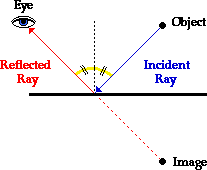
- When light reflects off an even surface (like a plane mirror), it is reflected at the same angle you see it so you get a clear reflection
- Angle of Incidence = Angle of Reflection
- Total Internal Reflection depends on the critical angle
Diffraction and Refraction
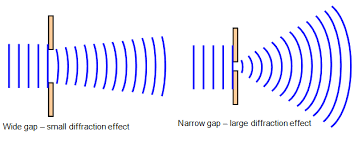
- Diffraction is where the waves spread out
- All waves diffract when they pass through a gap or pass an object
- The amount of diffraction depends on the size of the gap and the wavelength of the wave. the narrower the gap or longer the wavelength, the more the wave spreads out
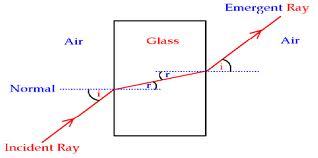
- Refraction - changing the speed of a wave can change its direction
- Waves travel at different speed in substances which have different densities
- If light hits glass 'head on' then it will slow down but carry on travelling in the same direction. It has a shorter wavelength but the same frequency
- If a wave meets a different medium (glass) at an angle, part of the wave hits the dense layer first and slows down, while another part carries on at the first and faster speed for a short while longer. this shows the wave changing direction (refraction)
- Diffraction is where the waves spread out
EM Waves and Communication
- There are 7 types of Electromagnet (EM) Waves
- All forms of EM radiation travel at the same speed through a vacuum. This means that waves with a shorter wavelength have a higher frequency.
- The properties of EM Waves depend on the frequency and wavelength
- As the frequency and wavelength of EM radiation changes, its interaction with matter change. This means that the way it is absorbed, reflect or transmitted by any given substance changes
- The EM waves at each end of the spectrum tend to be able to pass through material whilst the ones near the middle are absorbed
- The ones with a higher frequency (shorter wavelength), like x-rays, tend to be more dangerous to living cells. This is because they have more energy
- As the frequency and wavelength of EM radiation changes, its interaction with matter change. This means that the way it is absorbed, reflect or transmitted by any given substance changes
- Different sorts of signals have different advantages
- Using light, radio and electrical signals is great because the singnals travel really fast
- Electrical wires and optical fibres can carry loads of information very quickly
- Information sent through optical fibres is very secure as its in a wire, people can't tap into them as easy as radio waves which can be intercepted more easily
- However cables can be difficult to repair if broken
- Wireless communication is portable (wi-fi, mobile phones, laptops etc...) it only requires an ariel and good signal strength
- There are 7 types of Electromagnet (EM) Waves
Communicating with Light
- Communicating with light can require a code
- By §creating a doe of 'on-off' signals, a message can be relayed between stations far away by flashing light on and offing a way that it can be decoded
- Each letter of the alphabet and numbers 0 - 9 is reprsented by dots and dashes which are pulses of light or sound for a certain amount of time
- Light signals can travel through Optical Fibres
- The most modern way of using light for communication is the use of optical fibres, they can carry data over long distances as pulses of light or in fared radiation
- They work by bouncing waves off the sides of a very narrow core which is protected by outer layers
- The ray of light enters the fibre so that it hits the boundary between the core and the outer cladding at an angle greater than the critical angle for the material. this causes total internal reflection
- Using light has lots of advantages
- Light is a very quick way to communicate. in a vacuum, light travels at 300 000 000 m/s, its slowed down by 30% in an optical fbre, but thats still damn quick
- Multiplexing means that lots of different signals can be transmitted down a single optical fibre at the same time, so you only need one cable
- Digital signals means little interference
- Communicating with light can require a code
Lasers
- Lasers produce narrow, intense beams of monochromatic light
- Ordinary visible light (daylight) is a combination of waves of different frequencies and wavelengths (therefore colour) that are 'out of phase'
- A laser beam is just a special ray of visible light that has a few extra properties, all the waves in a laser beam are at the same frequency (and wavelength). This makes the light monochromatic - which is a fancy away of saying its all one pure colour
- The light waves are all in phase with each other - the troughs and crests line up, increasing the amplitude, so therefore creating an intense beam.
- Lasers ahem low divergence which means the beam is narrow, and stays narrow, even at a long distance
- CD players use Lasers to read Digital Information
- The surface of a CD has a pattern of billions of shallow pits cut into it. the area between the pits are called lands
- A laser shone onto the CD is reflected into the shiny bottom surface as it spins around in the player
- The beam is reflected from a land and a pit slightly differently - and this difference can be picked up by a light sensor. these differences in reflected signals can then be changed into an electrical signal
- An amplifier and a loudspeaker then convert the electrical signal into sound of the right pitch (frequency) and loudness
- The beam is reflected from a land and a pit slightly differently - and this difference can be picked up by a light sensor. these differences in reflected signals can then be changed into an electrical signal
- A laser shone onto the CD is reflected into the shiny bottom surface as it spins around in the player
- The surface of a CD has a pattern of billions of shallow pits cut into it. the area between the pits are called lands
- Lasers produce narrow, intense beams of monochromatic light
Infrared
- Infrared has many uses around the home
- Infrared radiation can be used in cooking (grills and toasters)
- Remote controls transfer information to TV's and DVD players using IR
- It can be used to transmit information between mobile phones or computers (but only over short distances)
- Infrared sensors are used in security systems, they detect heat from an intruders body
- Infrared can also be used instead of visible light to carry information through optical fibres
- Infrared can be used to monitor tempreture
- IR radiation is also known as heat radiation. Its given out by hot objects and the hotter the object, the more IR radiation it gives out
- This means infrared can be used to monitor temperatures. for example heat loss through a house's uninsulated roof can be detected using infrared sensors
- IR radiation is also known as heat radiation. Its given out by hot objects and the hotter the object, the more IR radiation it gives out
- Infrared signals can control electrical equipment
- Remote controls emit pulses of IR to control electrical devices such as TV's or DVD players
- The pulses act as adigital code
- the divide will detect and decode the pattern of pulses coming from the remote control and follow the coded instructions
- e.g a CD player may be programmed to know a certain sequence of pulses at a particular speed means 'play'
- the divide will detect and decode the pattern of pulses coming from the remote control and follow the coded instructions
- The pulses act as adigital code
- Remote controls emit pulses of IR to control electrical devices such as TV's or DVD players
- Infrared has many uses around the home
Wireless Communication - Radio Waves
- Long wavelengths travel well through Earth's Atmosphere
- This is because they don't get absorbed by the Earth's atmossphere as much as waves in the middle of the spectrum
- Radio waves are used mainly for communications
- Radio waves are EM radiation with wavelengths longer than about 10 cm
- Different wavelengths of radio waves refract and diffract in different ways
- Long-wave radio (wavelengths of 1 - 10 km) can be transmitted from one place and recieved halfway round the world because they diffract (bend) around the curved surface of the Earth
- Different wavelengths of radio waves refract and diffract in different ways
- Radio waves are EM radiation with wavelengths longer than about 10 cm
- Diffraction makes a difference to signal strength
- Diffraction is when waves spread out at the edges when they pass through a gap or past an object
- The amount of diffraction depends on the wavelength of the wave, relative to the size of the gap or obstacle
- Longer wavelengths can encounter a lot of diffraction because they are large compared with a gap or obstacle
- This means they are able to bend around corners and any obstacles (such as hills, tall buildings)
- Longer wavelengths can encounter a lot of diffraction because they are large compared with a gap or obstacle
- The amount of diffraction depends on the wavelength of the wave, relative to the size of the gap or obstacle
- Diffraction is when waves spread out at the edges when they pass through a gap or past an object
- Refraction can help radio waves travel further
- When a wave comes up against something that has a different density, it changes speed. if the wave hits the new substance at an angle, it changes direction. this is refraction
- Ultra Violet radiation from the sun creates layers of ionised atoms(atoms that have either lost or gained electrons) in the Earths atmosphere. These electrically charged layers are called the ionosphere
- Radio waves travel faster through ionised parts of the atmosphere than non ionised parts. this causes refraction
- The amount a wave is refracted in the ionosphere depends on its frequency and angle of elevation.
- Radio waves 'bounce' off the ionosphere in a similar way to how light waves to ally internally reflect inside optical fibres
- The amount a wave is refracted in the ionosphere depends on its frequency and angle of elevation.
- Radio waves travel faster through ionised parts of the atmosphere than non ionised parts. this causes refraction
- Digital radio helps reduce interfrence
- Theres a limited amount of radio wave frequencies that can be used to transmit a good analogue signal. radio stations often broadcast waves of similar frequencies
- When the two waves interferer, they cause noise. this is why radio stations near to each other, use different frequencies - so they don't interfere as much
- Digital Audio Broadcasting starts as digital.
- When the two waves interferer, they cause noise. this is why radio stations near to each other, use different frequencies - so they don't interfere as much
- Theres a limited amount of radio wave frequencies that can be used to transmit a good analogue signal. radio stations often broadcast waves of similar frequencies
- Long wavelengths travel well through Earth's Atmosphere
Wireless Communication - Microwaves
- Microwave's are used for satellite communication
- You need to use wavelengths which can pass easily through the Earth's watery atmosphere without too much absorption
- The signal from a transmitter is transmitted into space
- Then it is picked up by the satellites receiver dish orbiting thousands of kilometres above Earth. the satellite transmits the signal back to Earth in a different direction
- Where it is received by a satellite dish on the ground
- Then it is picked up by the satellites receiver dish orbiting thousands of kilometres above Earth. the satellite transmits the signal back to Earth in a different direction
- The signal from a transmitter is transmitted into space
- You need to use wavelengths which can pass easily through the Earth's watery atmosphere without too much absorption
- As well as mobile phones
- Calls travel as microwaves from your phone to the nearest transmitter (or mast). The transmitters pass signals between each other, then back to your phone
- Microwaves have a shorter wavelength than radiowaves, so they don't diffract as much. this means that they are affected by the curvature of the Earth because they don't bend round it like long-wave radio waves. it a;leo means they're blocked more by large obstacles (hills)
- So they are better off being place don top of hills so they can 'see each other'
- Microwaves have a shorter wavelength than radiowaves, so they don't diffract as much. this means that they are affected by the curvature of the Earth because they don't bend round it like long-wave radio waves. it a;leo means they're blocked more by large obstacles (hills)
- Calls travel as microwaves from your phone to the nearest transmitter (or mast). The transmitters pass signals between each other, then back to your phone
- Mobile Masts may be dangerous - but there's conflicting evidence
- Microwaves used for communications need to pass through the Earth's watery atmosphere, but the microwaves used in ovens have a different wavelength - they are actually absorbed by the water molecule in the food
- If microwaves are absorbed by water molecules in living tissue, cells may be burned or killed
- Some people think that the microwaves emitted into your body from using a mobile phone or living near a mast may damage your health
- If microwaves are absorbed by water molecules in living tissue, cells may be burned or killed
- Microwaves used for communications need to pass through the Earth's watery atmosphere, but the microwaves used in ovens have a different wavelength - they are actually absorbed by the water molecule in the food
- Microwave's are used for satellite communication
EM Receivers
- The size of receiver depends on the size of wave
- The minimum size of receiver needed is linked to the size of the wavelength of the wave - the longer the wavelength, the larger the receiver should be
- So radio waves need the biggest receivers, then microwaves, then infrared, then light waves
- This is because of diffraction, when a wave enters a receiver, it passes through a gap. If the wave is diffracted, it spreads out and you lose detail
- So the bigger the receiver compared with the wavelength of wave being received, the less diffraction it causes, so the clear the information
- This is because of diffraction, when a wave enters a receiver, it passes through a gap. If the wave is diffracted, it spreads out and you lose detail
- So radio waves need the biggest receivers, then microwaves, then infrared, then light waves
- The minimum size of receiver needed is linked to the size of the wavelength of the wave - the longer the wavelength, the larger the receiver should be
- The size of receiver depends on the size of wave
Imagens e arquivos do mapa

Informações
- Descrição
- Mapa Mental sobre P1, criado por will.lucas1603 em 12-02-2015.
- Criado por
- will.lucas1603
- Visualizações
- 1
- Avaliação