
Mapa mental
In trouble with the law
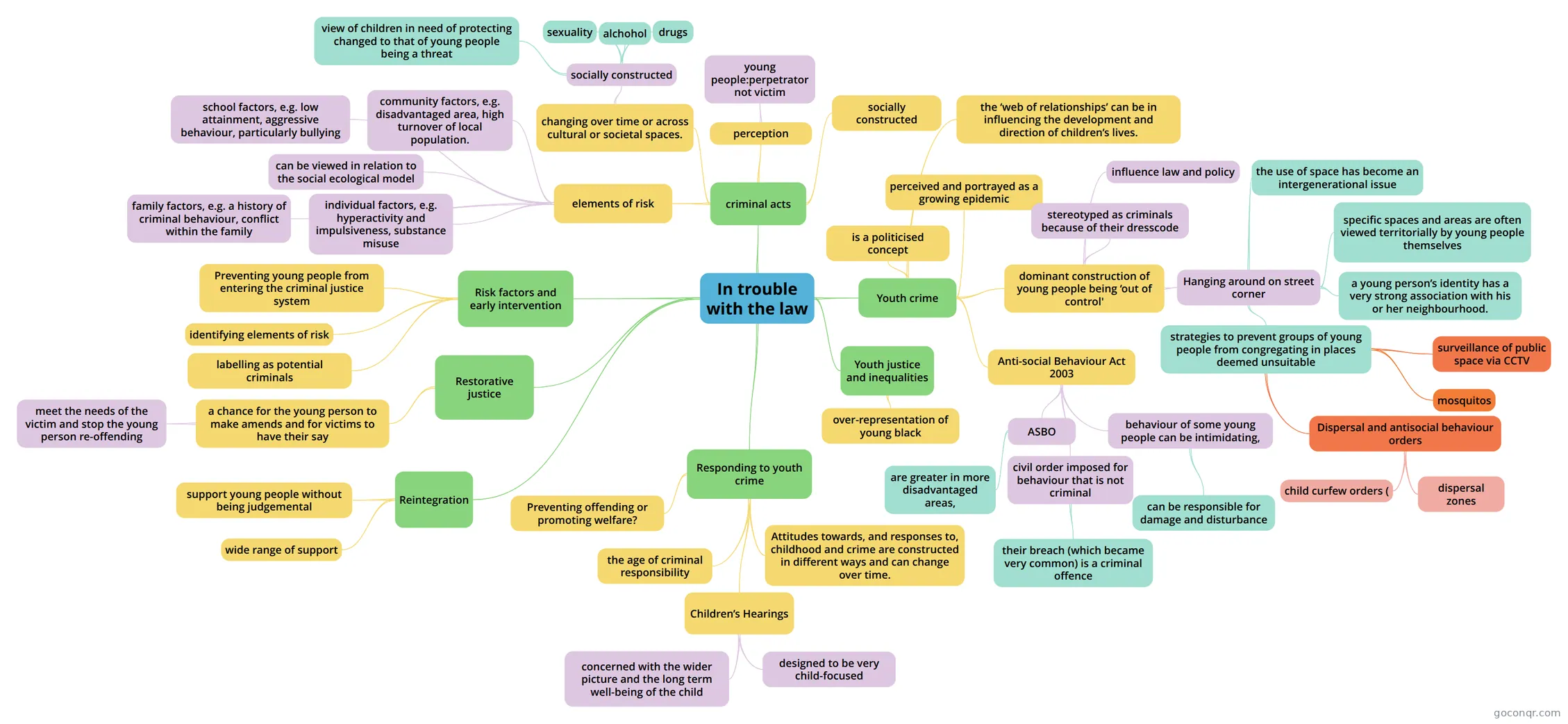
Mind map: in trouble with the law
Conteúdo do mapa
In trouble with the law
criminal acts
- changing over time or across cultural or societal spaces.
- socially constructed
- sexuality
- alchohol
- drugs
- view of children in need of protecting changed to that of young people being a threat
- socially constructed
- perception
- young people:perpetrator not victim
- elements of risk
- can be viewed in relation to the social ecological model
- individual factors, e.g. hyperactivity and impulsiveness, substance misuse
- family factors, e.g. a history of criminal behaviour, conflict within the family
- school factors, e.g. low attainment, aggressive behaviour, particularly bullying
- community factors, e.g. disadvantaged area, high turnover of local population.
- socially constructed
- changing over time or across cultural or societal spaces.
Youth crime
- perceived and portrayed as a growing epidemic
- dominant construction of young people being ‘out of control'
- influence law and policy
- stereotyped as criminals because of their dresscode
- Hanging around on street corner
- the use of space has become an intergenerational issue
- specific spaces and areas are often viewed territorially by young people themselves
- strategies to prevent groups of young people from congregating in places deemed unsuitable
- mosquitos
- surveillance of public space via CCTV
- Dispersal and antisocial behaviour orders
- child curfew orders (
- dispersal zones
- a young person’s identity has a very strong association with his or her neighbourhood.
- is a politicised concept
- Anti-social Behaviour Act 2003
- ASBO
- are greater in more disadvantaged areas,
- civil order imposed for behaviour that is not criminal
- their breach (which became very common) is a criminal offence
- behaviour of some young people can be intimidating,
- can be responsible for damage and disturbance
- ASBO
- the ‘web of relationships’ can be in influencing the development and direction of children’s lives.
Responding to youth crime
- Attitudes towards, and responses to, childhood and crime are constructed in different ways and can change over time.
- Preventing offending or promoting welfare?
- the age of criminal responsibility
- Children’s Hearings
- designed to be very child-focused
- concerned with the wider picture and the long term well-being of the child
Risk factors and early intervention
- Preventing young people from entering the criminal justice system
- identifying elements of risk
- labelling as potential criminals
Youth justice and inequalities
- over-representation of young black
Restorative justice
- a chance for the young person to make amends and for victims to have their say
- meet the needs of the victim and stop the young person re-offending
- a chance for the young person to make amends and for victims to have their say
Reintegration
- support young people without being judgemental
- wide range of support