
Mapa mental
Evolution
Conteúdo do mapa
Evolution
Darwin
- • Darwin’s theory of evolution by natural selection states that all species of living things have evolved from simple life forms that first developed more than three billion years ago.
- • These first organisms were very simple single-celled organisms, similar to bacteria.
- • The theory of evolution by natural selection was only gradually accepted because:
- the theory challenged the idea that God made all the animals and plants that live on Earth
- there was insufficient evidence at the time the theory was published to convince many scientists
- the mechanism of inheritance and variation was not known until 50 years after the theory was published.
- there was insufficient evidence at the time the theory was published to convince many scientists
- the theory challenged the idea that God made all the animals and plants that live on Earth
- Natural Selection
- • Organisms produce large numbers of offspring
- • Individual organisms within a particular species may show a wide range of variation because of differences in their genes
- • There is a struggle for all organisms to exist (eg. Predation)
- • Individuals with characteristics most suited to the environment are more likely to survive to breed successfully
- The genes which have enabled these individuals to survive are then passed on to the next generation
- • Gradually, this can result in changes in the characteristics of a species.
- The genes which have enabled these individuals to survive are then passed on to the next generation
- • Individuals with characteristics most suited to the environment are more likely to survive to breed successfully
- • There is a struggle for all organisms to exist (eg. Predation)
- • Individual organisms within a particular species may show a wide range of variation because of differences in their genes
- • Organisms produce large numbers of offspring
Lamarck
- • He proposed a theory of acquired characteristics.
- • He argued that an individual’s characteristics will change over its lifetime due to amount of use.
- • Eg. Giraffes necks get longer due to stretching for leaves.
- • Then he suggested that these characteristics could be inherited.
- We now know that in the vast majority of cases this type of reproduction cannot occur. • Changes in the body do not change the genes.
Classification
- • Studying the similarities and differences between organisms allows us to classify living organisms into animals, plants and microorganisms.
- • This helps us to understand evolutionary and ecological relationships
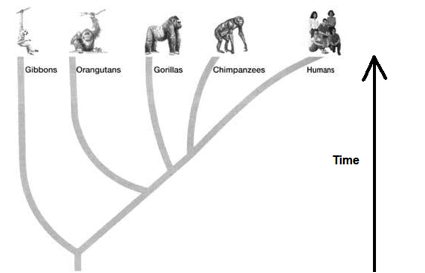
- • Evolutionary trees (models) are used to represent the relationships between organisms.
- This tree indicates how long ago the ancestors of ape species diverged from each other. It indicates that humans share a common ancestor with chimpanzees more recently than with any other ape species.
Mutations
- • How do mutations occur?
- • Errors occur when the DNA is replicated prior to cell division.
- • Errors may occur when chromosomes are separated during cell division.
- • Errors occur when the DNA is replicated prior to cell division.
- • What do mutations do?
- • Genes control the synthesis of proteins.
- • Therefore a change in a gene or a new sequence of genes can result in different proteins being synthesised.
- • This can change a characteristic.
- • Therefore a change in a gene or a new sequence of genes can result in different proteins being synthesised.
- • Genes control the synthesis of proteins.
- • Most mutations are harmful or fatal.
- • How do mutations occur?
Imagens e arquivos do mapa



Informações
- Descrição
- Mapa Mental sobre Evolution, criado por stella watkins em 26-05-2015.
- Criado por
- stella watkins
- Visualizações
- 519
- Tags
- Avaliação